The OpenAI / TBPN Audit: Why Anthropic’s Next Acquisition Should Be a Regulatory Network
OpenAI just spent hundreds of millions to buy the Silicon Valley narrative. It’s a brilliant consumer play. But they bought the Hype. In the 2026 enterprise market, the bottleneck isn't hype—it's liability. The next trillion dollars in B2B AI won't be unlocked by talk shows; it will be unlocked by Technical Forensics. Here is the audit of OpenAI's media strategy, and the massive blind spot they left wide open for their rivals.
The artificial intelligence sector has reached a profound structural and commercial inflection point in the second quarter of 2026. The competition among frontier laboratories has expanded far beyond the parameters of raw model capability, compute infrastructure, and benchmark supremacy. The battleground has definitively shifted into the domains of geopolitical alignment, enterprise liability, and narrative control. On April 2, 2026, OpenAI executed a highly publicized, unprecedented acquisition of the Technology Business Programming Network (TBPN), a daily live technology talk show boasting a dedicated, elite following among Silicon Valley executives, venture capitalists, and founders.1 Supported by a historic $122 billion funding round that pushed the company’s valuation to $852 billion, this acquisition signals a deliberate and aggressive transition by OpenAI from a pure technology developer into a vertically integrated media and communications entity.2
However, an exhaustive forensic analysis of the enterprise software market indicates a profound misalignment between OpenAI’s newly minted media strategy and the actual, pressing demands of corporate buyers. While OpenAI is investing hundreds of millions of dollars to capture the “founder hype” narrative and dominate the cultural zeitgeist of the technology sector, corporate adoption of artificial intelligence is currently stalling against an invisible wall of compliance fear, legal liability, and regulatory friction.3 The Fortune 500 is not starved for technological hype; it is desperately starved for auditability, governance, and safety validation.
Consequently, a vast and highly lucrative market vacuum has emerged for “Regulatory Media”—specialized platforms dedicated to technical forensics, legal decoding, and actionable compliance intelligence for licensed professionals.6 This structural market shift provides a distinct strategic opening for OpenAI’s primary rivals. Competitors such as Anthropic, Mistral, Google, and Microsoft have a unique opportunity to capture the enterprise deployment layer by mastering the compliance narrative that OpenAI is presently overlooking.
1. The TBPN Acquisition Mechanics & Motive
The acquisition of TBPN represents the first time a major artificial intelligence laboratory has purchased a media network outright, marking an aggressive paradigm shift in how technology conglomerates intend to manage external communications, public perception, and ecosystem influence.7
Financials, Timelines, and Deal Structure
Launched in October 2024 by serial entrepreneurs John Coogan and Jordi Hays, the Technology Business Programming Network rapidly ascended to become a central hub for Silicon Valley discourse.9 The network, operating with an eleven-person team, broadcasted live for three hours every weekday across platforms like YouTube and X, providing real-time commentary on venture capital rounds, product launches, and industry talent wars.10
The acquisition, finalized in early April 2026, features highly specific mechanical and financial contours that deviate from traditional media consolidations:
-
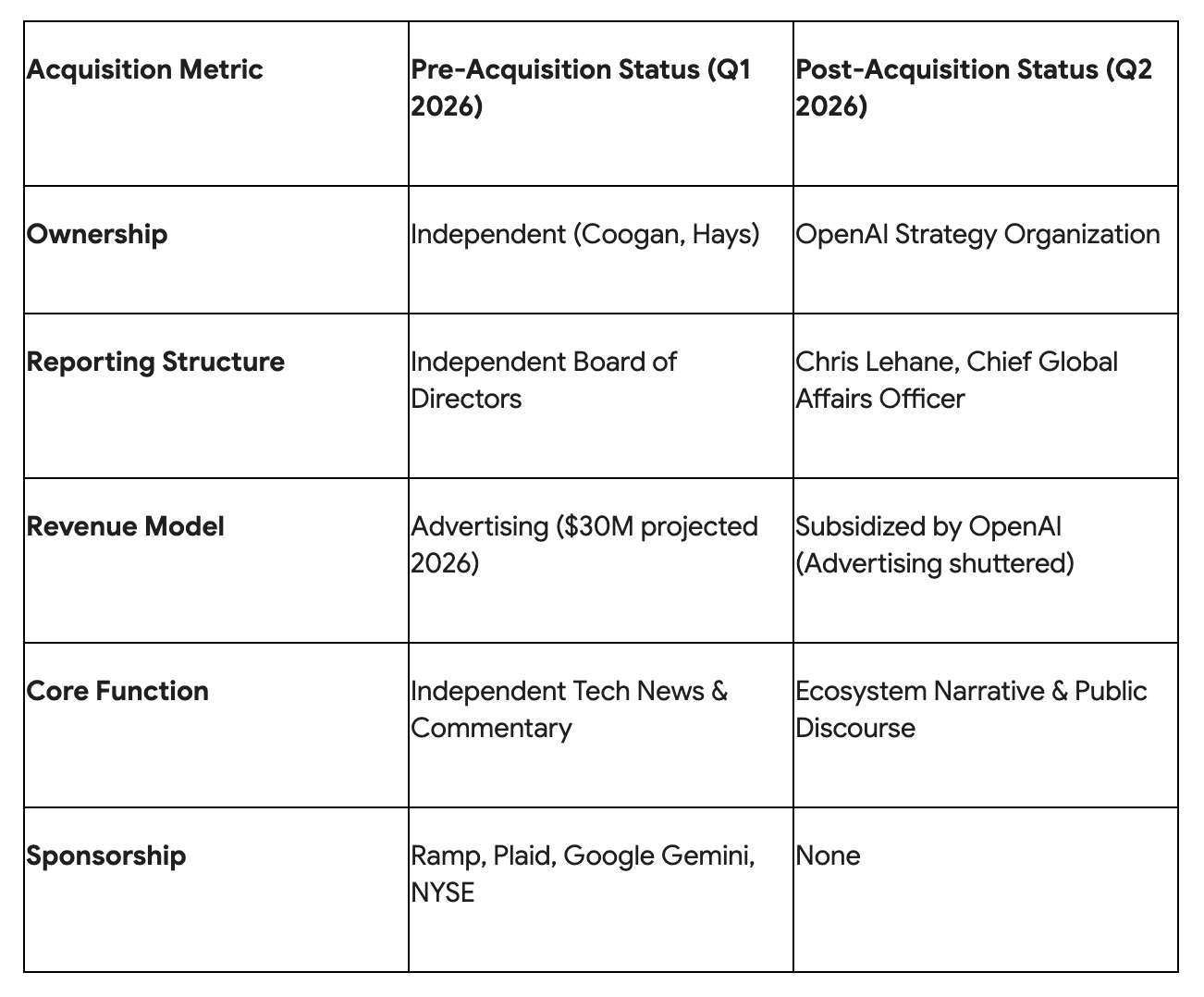
Valuation and Revenue Trajectory: While OpenAI officially stated the purchase was for an “undisclosed sum,” financial reports and insider sources place the transaction in the “low hundreds of millions of dollars”.12 Prior to the acquisition, TBPN was a highly profitable, independent entity. The network generated $5 million in advertising revenue in 2025 and was actively on track to exceed $30 million in ad revenue by the end of 2026.10
-
Audience Demographics: TBPN’s audience scale is relatively niche, averaging roughly 70,000 viewers per episode, though highly anticipated livestreams have attracted upwards of 130,000 simultaneous viewers.9 However, the strategic value lies in audience density rather than sheer volume. The viewership comprises highly influential decision-makers, and the show has successfully secured rare, long-form interviews with industry titans, including Meta CEO Mark Zuckerberg, Microsoft CEO Satya Nadella, and OpenAI CEO Sam Altman.12
-
Organizational Integration and Leadership: Rather than operating as an independent subsidiary, TBPN has been absorbed directly into OpenAI’s internal Strategy organization. The media team, including Coogan, Hays, and President Dylan Abruscato, now reports directly to Chris Lehane, OpenAI’s Chief Global Affairs Officer and a seasoned political operative.1
-
The Advertising Pivot: In a highly consequential operational shift that underscores OpenAI’s capitalization capabilities, the acquirer has decided to permanently wind down TBPN’s lucrative advertising business.10 The show will no longer rely on external sponsors—which previously included major entities like Google’s Gemini division, Ramp, and the New York Stock Exchange—making its financial survival and operational mandate entirely dependent on OpenAI.8
-
Historical and Financial Ties: The transaction is underpinned by a deep, decade-long relationship between OpenAI Chief Executive Officer Sam Altman and TBPN co-founder John Coogan. In 2013, Altman’s venture firm, Hydrazine Capital, provided critical seed funding to resolve a financing deadlock for Coogan’s first startup, Soylent.17 Coogan subsequently served as an entrepreneur-in-residence at Founders Fund, observing OpenAI’s massive capital influxes firsthand in 2022 and 2023.17 This historical alignment significantly smoothed the acquisition pathway.
The Strategic Motive: Narrative Capture and Ecosystem Control
OpenAI’s leadership has publicly framed the acquisition as a philanthropic effort to foster a “constructive conversation” about the societal impacts of artificial general intelligence (AGI).1 Fidji Simo, CEO of Applications at OpenAI, explicitly noted in an internal memorandum to staff that “the standard communications playbook just doesn’t apply to us” due to the unprecedented scale of the technological shift the company is driving.18 Simo praised the TBPN team’s “amazing comms and marketing instincts,” indicating a desire to leverage their talent outside of the show itself.1
However, a forensic analysis of the broader market environment reveals that the underlying strategic motive is explicitly focused on narrative capture. By early 2026, OpenAI has faced mounting public and regulatory scrutiny over a myriad of issues: expansive copyright infringement litigation, controversies surrounding military applications of its technology, and the recent, abrupt discontinuation of its Sora video-generation tool amidst a massive strategic pivot toward enterprise coding applications.11 In this volatile climate, controlling a premier distribution channel is highly advantageous.
By eliminating the network’s independent revenue model, OpenAI has effectively transformed a commercially viable media outlet into a subsidized corporate apparatus. Despite formal public covenants promising “editorial independence” and granting the hosts full control over programming and guest selection 1, the structural reality is that TBPN functions as an extension of OpenAI’s global affairs and policy messaging architecture. As noted by industry analysts, the deal resembles historical moves where pioneers of new platforms purchase content networks to influence the conversation—akin to RCA creating NBC to drive radio adoption, or Microsoft co-creating MSNBC.10
OpenAI has purchased a direct mechanism to speak to developers, venture capitalists, and ecosystem builders without the intermediary friction of traditional, often critical, technology journalism.20 The acquisition allows OpenAI to cultivate a “Pro-Builder” and “Pro-Capitalism” narrative, insulating its core audience from the broader media’s skepticism and regulatory warnings.23
2. The Enterprise “Trust Gap” (The Blind Spot)
OpenAI’s acquisition of TBPN is a masterclass in capturing the “Silicon Valley Founder” demographic. However, the quantitative data reveals a stark disconnect between this venture capital-driven hype cycle and the operational reality of global enterprises. The primary bottleneck for corporate AI deployment is no longer raw model capability, parameter scale, or benchmark scores. The true bottleneck is the “Trust Gap.”
The Stall in Enterprise Adoption
By early 2026, corporate ambition for artificial intelligence has collided violently with infrastructural, data, and governance realities. While experimental pilots are ubiquitous, scaled enterprise deployment has stalled.
The empirical evidence defining this stall is overwhelming:
-
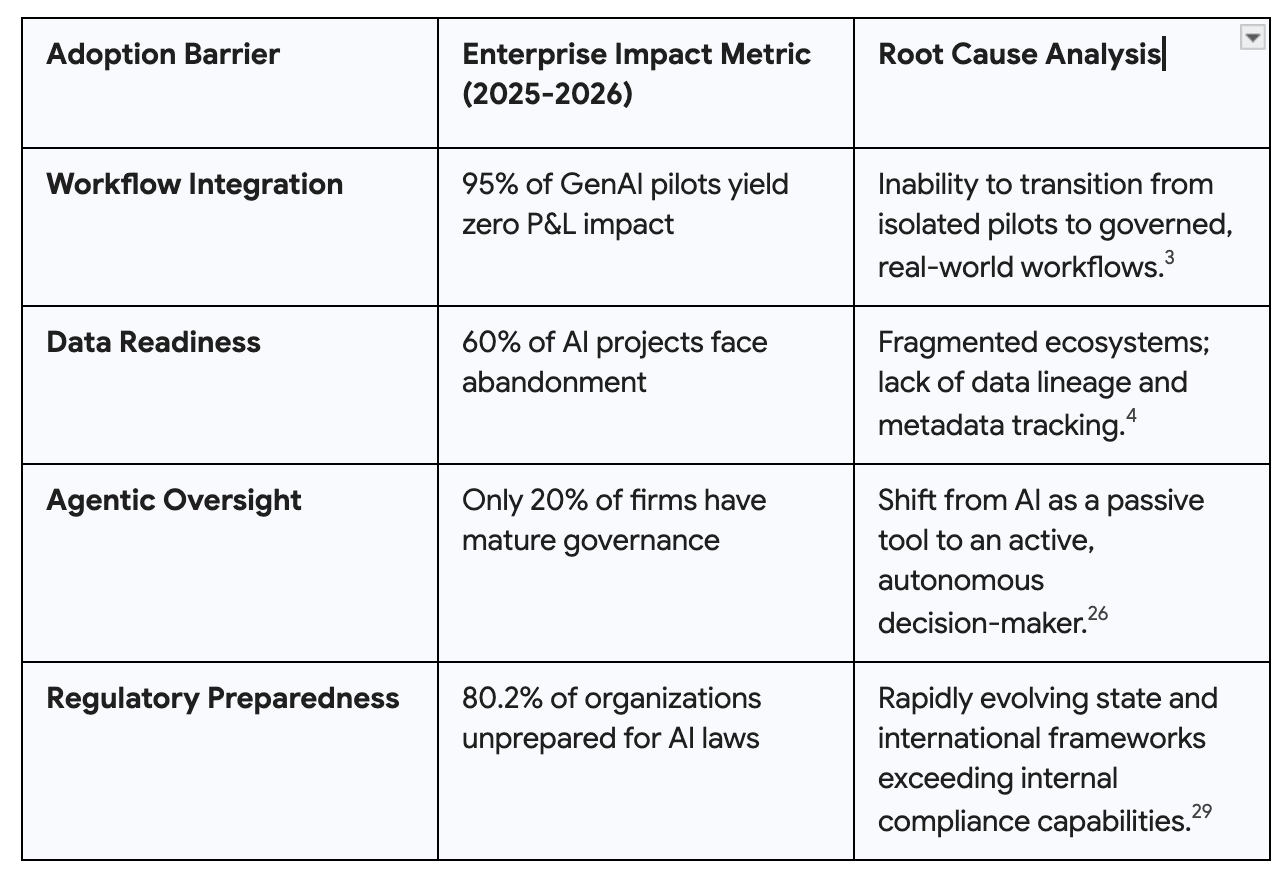
The Implementation Wall: McKinsey’s 2025/2026 State of AI report indicates that while 88% of organizations now use AI in at least one business function, only 39% report any measurable business impact, and a mere 5% have integrated AI tools into core workflows at scale.24 Furthermore, 95% of enterprise generative AI pilots currently deliver no measurable profit-and-loss impact because organizations lack the structural readiness to use them at scale.3
-
The Data Readiness Crisis: Organizations are discovering that advanced models cannot operate effectively on fragmented, siloed, or non-compliant data. Gartner research projects that through 2026, 60% of all enterprise AI projects will be abandoned entirely because they are unsupported by AI-ready data management practices.25 A staggering 63% of data management leaders admit they are unsure if they possess the correct data architecture to support AI.25
-
The Agentic Governance Failure: As the market shifts from passive generative AI toward “agentic AI”—systems capable of autonomous reasoning, tool use, and execution—the fear of liability is paralyzing deployment. Deloitte’s 2026 State of AI in the Enterprise report highlights that while agentic AI usage is poised to rise sharply, oversight is severely lagging; only one in five companies currently possesses a mature model for governing autonomous AI agents.26 Consequently, 64% of organizations worry about hitting their agentic AI goals simply because they lack the governance structures to monitor these autonomous decisions.27
Regulatory Fear, Compliance Risk, and Liability
Enterprise technology leaders are not stalling because they doubt the technical efficacy of the models; they are stalling because the legal and regulatory environment has become a minefield of punitive liabilities. The era of “shadow AI”—where employees use unauthorized consumer models for corporate work, thereby creating massive intellectual property and compliance exposures—has forced Chief Information Officers (CIOs) and Chief Information Security Officers (CISOs) to slam the brakes on procurement.5
The friction is being driven by concrete, aggressively enforced legislative frameworks enacted globally and domestically across 2024–2026. These regulations demand rigorous auditability and penalize black-box algorithms:
The European Union AI Act: Fully transitioning from theoretical policy to active operational deadlines, the EU AI Act classifies systems by risk level. High-risk systems (such as those used in employment, credit scoring, and healthcare) face stringent requirements enforceable by August 2026.30 These requirements include mandatory technical documentation demonstrating compliance, continuous human oversight mechanisms, and rigorous data governance.30 Failure to comply triggers catastrophic penalties of up to €35 million or 7% of global annual turnover.30 Critically, the Act features extraterritorial scope, meaning any global company whose AI system output is utilized within the EU is fully exposed to this liability.31 The recent Digital Omnibus package has introduced fixed deadlines for high-risk systems, mandating compliance by December 2027 and August 2028, removing any prior regulatory flexibility.32
Texas SB 1188 (Healthcare Data and AI): Taking effect in late 2025, with specific data storage rules strictly enforceable by January 1, 2026, Texas SB 1188 introduces sweeping and disruptive mandates for medical providers and their technology vendors. The law enforces a strict data localization mandate, prohibiting the physical offshoring of electronic health records (EHRs).33 This effectively bans the use of foreign-hosted cloud servers for patient data, requiring a massive architectural audit of global cloud providers.33 Furthermore, the law mandates that physicians must explicitly disclose to patients whenever AI tools are used in diagnosis or treatment planning.33 In a massive blow to automation efficiency, any medical documentation or note produced with AI assistance must be manually reviewed and approved by a human physician before becoming part of the official record.33 Violations carry severe civil penalties scaling up to $250,000 per instance.33
California AB 3030 and SB 1047: Effective January 2025, California AB 3030 tightly regulates the use of generative AI in healthcare provision. It mandates that any patient-facing clinical communication generated by AI must include a clear, unambiguous disclaimer of its origin, as well as instructions on how the patient can directly contact a human healthcare provider.36 Meanwhile, California SB 1047, despite being vetoed by the Governor, fundamentally shaped the national discourse and enterprise risk modeling regarding “kill switch” requirements, mandatory safety protocols, and direct liability for developers regarding critical infrastructure harms.38
The Irrelevance of TBPN to the Fortune 500
The juxtaposition of OpenAI’s media strategy against this formidable regulatory backdrop reveals a severe enterprise blind spot. A Fortune 500 hospital administrator, a corporate compliance officer, or a global supply chain director does not care about Marc Benioff’s latest interview on TBPN, nor do they require a platform that treats Silicon Valley hirings and venture capital fundraises like a sports draft.12
Enterprise buyers evaluating multi-million dollar software deployments need to know precisely how a specific large language model parses data to ensure compliance with Texas SB 1188’s strict role-based access controls.33 They need verifiable, cryptographically secure proof that an autonomous agent operating within their ERP system does not violate the European Union’s prohibitions on unmonitored algorithmic decision-making.30
OpenAI has purchased a megaphone designed exclusively for the technology sector’s elite. However, the actual buyers of enterprise software contracts are desperate for risk mitigation, detailed audit trails, and legal decoding. The acquisition of a hype-driven media property fundamentally fails to address the core anxieties stalling corporate AI adoption.
3. The Rise of “Regulatory Media”
Because traditional technology journalism focuses almost exclusively on product capabilities, venture capital valuations, and executive drama, a massive information vacuum has opened up regarding the operational mechanics of AI compliance. This vacuum is rapidly being filled by a highly specialized, lucrative new category: Regulatory Media.
Defining Regulatory Media
Regulatory Media operates at the intersection of technical forensics, legal decoding, and actionable intelligence tailored specifically for licensed professionals, risk officers, and enterprise architects [Prompt]. It completely abandons the “cheerleading” tone of traditional tech coverage to provide surgical, highly specific analysis of how artificial intelligence systems interact with statutory law, cybersecurity protocols, and enterprise risk frameworks.
This media format answers the complex operational questions that generalized tech podcasts and mainstream outlets ignore:
-
Technical Forensics: How does a specific foundational model’s logging architecture integrate with a company’s Security Information and Event Management (SIEM) software to prevent agentic data exfiltration?
-
Legal Decoding: Does an AI vendor’s default data-retention policy violate the GDPR or the EU AI Act’s stringent transparency and processing mandates?
-
Actionable Intelligence: What specific prompt engineering constraints and constitutional guardrails must be applied to ensure a financial credit-scoring agent does not violate federal anti-discrimination statutes?
The Data and the Demand
The market hunger for this level of granular analysis is quantifiable and growing exponentially. An analysis of over 1,300 news articles across regulated industries revealed that between 2023 and 2025, the volume of regulatory-themed media coverage surged by a staggering 265%.6 By the first quarter of 2026, more than 40% of all tracked industry coverage was classified as regulatory-adjacent.6 However, there is a distinct lack of authoritative industry voices participating in this discourse; nearly 70% of these regulatory stories run without a single quote, clarification, or technical defense from the technology companies themselves.6 This represents a massive structural gap in how AI companies communicate their compliance readiness.
Enterprise leaders are explicitly demanding safety, governance, and auditability over raw model capability. Market analytics and executive surveys confirm that a CIO’s responsibility has fundamentally shifted away from mere infrastructure management toward comprehensive risk strategy. As noted by industry leaders, “A CIO can’t avoid understanding AI governance anymore”.40 The 2026 State CIO Top 10 report by the National Association of State Chief Information Officers (NASCIO) ranks AI as the number one priority, but specifically frames this priority entirely around “governance and policies, security and privacy, workforce skills, data quality, [and] ethical use”.41
CTOs and engineering leaders share this sentiment, recognizing that “AI transformation will not fail because models are weak. It will fail because governance is missing”.42 In the compliance sector, the debate between speed and defensibility is increasingly recognized as a false dichotomy. Automation without strict governance ultimately undermines corporate credibility; therefore, explainability has become the absolute, non-negotiable baseline for deployment.43 When an AI system flags a risk or executes a business decision, regulators and internal auditors demand to know the exact data lineage, the features that mattered most, and the stability of the model across different populations.5
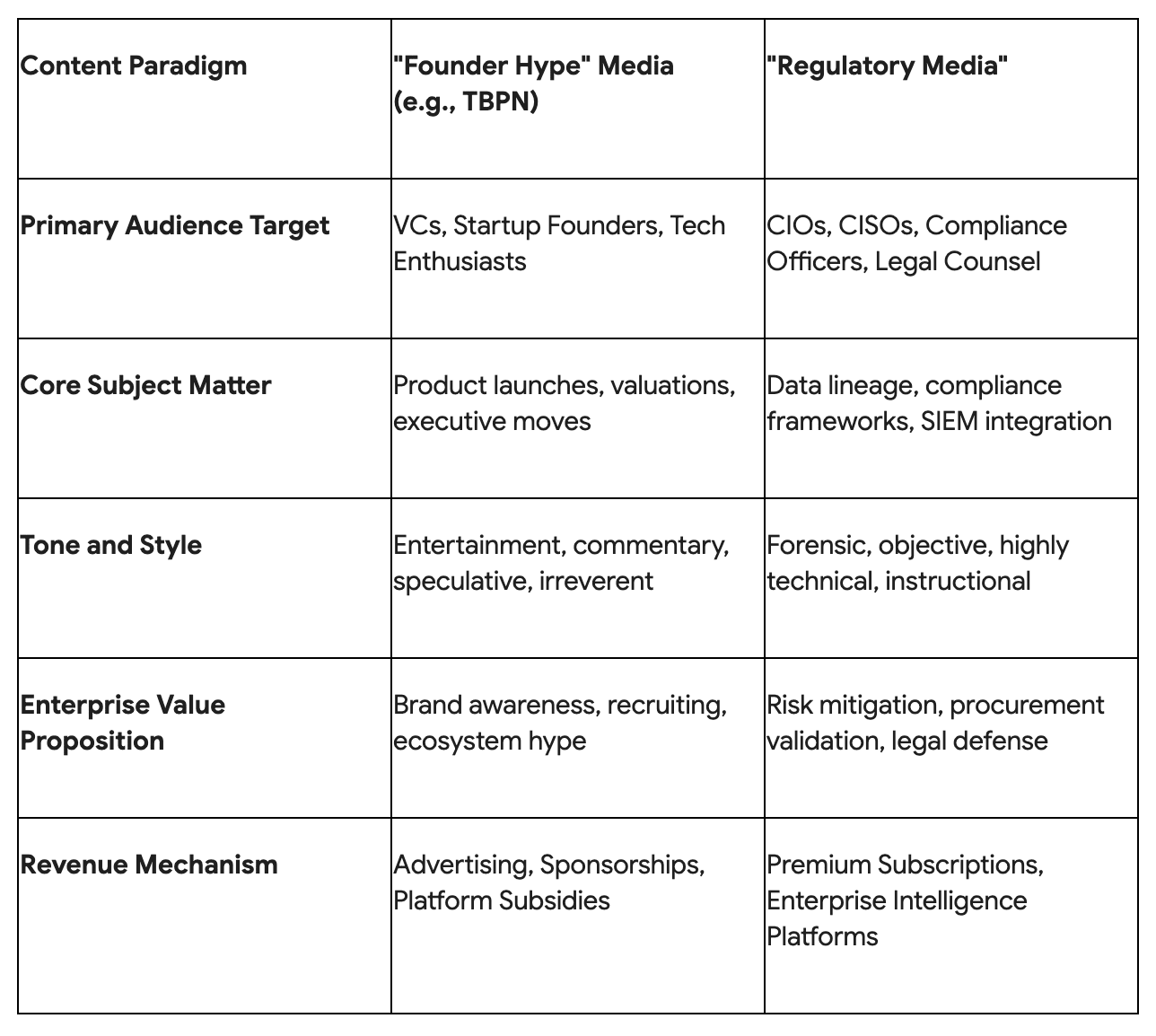
Regulatory Media serves as the vital instructional layer that teaches enterprise operators how to map black-box model outputs into defensible, legally compliant audit trails. The market for this intelligence is already reaching multi-million dollar valuations, evidenced by procurement intelligence firms like SpendHQ acquiring AI infrastructure companies like Sligo AI specifically to navigate data sovereignty and compliance constraints 44, and compliance intelligence firms like Exiger securing $919 million federal contracts for supply chain risk illumination.45
4. The Strategic Playbook for OpenAI’s Rivals
If OpenAI has chosen to expend its capital and strategic focus dominating the cultural and narrative heights of Silicon Valley through properties like TBPN, its primary competitors—Anthropic, Mistral, Google, and Microsoft—must execute a decisive flanking maneuver. They must actively weaponize the compliance and governance layer. By investing in, acquiring, or subsidizing Regulatory Media networks, these rivals can capture the exact demographic that controls enterprise software budgets, turning OpenAI’s cultural dominance into an operational irrelevancy.
Anthropic: The Architecture of Safety
Anthropic has systematically differentiated itself in the frontier AI market by positioning safety and ethics not merely as public relations talking points, but as verifiable, auditable architectural procurement features.
The turning point for Anthropic’s enterprise dominance occurred in late February 2026. In an unprecedented move, Anthropic refused a U.S. government request for unrestricted military AI use, specifically drawing a hard line against the use of its technology for mass domestic surveillance and fully autonomous weapons.46 While this principled stance cost Anthropic lucrative federal defense revenue and resulted in the Trump administration labeling the company a supply-chain risk 48, it sent a massive, positive procurement signal to the risk-averse corporate sector. Following this refusal, Ramp’s AI Index recorded Anthropic’s business adoption rising to 24.4% of companies—a record 4.9% month-over-month increase—while OpenAI’s business adoption rate simultaneously dropped by 1.5%.46 Furthermore, among businesses purchasing AI services for the first time, Anthropic began winning approximately 70% of head-to-head matchups against OpenAI.46
Anthropic’s brand positioning relies heavily on transparent, auditable artifacts: the “Constitutional AI” framework, the Responsible Scaling Policy (RSP v3.0), and clearly defined AI Safety Levels (ASL).46 However, the company faces technical challenges that require sophisticated narrative management. In March 2026, a routine software update inadvertently leaked over 512,000 lines of proprietary TypeScript for “Claude Code,” exposing the operational blueprint of their AI agent to the public and potential threat actors.51
By aligning with or acquiring Regulatory Media, Anthropic can ensure that corporate compliance officers are properly educated on how to audit a “Constitutional AI” log. More importantly, Regulatory Media allows Anthropic to contextualize incidents like the Claude Code leak not as catastrophic data breaches, but as transparent operational blueprints that highlight the necessity of Zero Trust architectures in modern development pipelines.51 This translates Anthropic’s ethical and transparent stance into a hard procurement requirement that OpenAI’s closed-box models may struggle to meet.
Mistral: European Sovereignty and Hardware Independence
Mistral AI has constructed its 2026 enterprise strategy around a singular, highly lucrative concept deeply tied to regulatory compliance: data sovereignty. While American laboratories rely heavily on U.S. hyperscalers, Mistral has taken aggressive steps to own its infrastructure. The company recently secured $830 million in debt financing from a consortium of European banks to construct a 44-megawatt data center near Paris, equipped with 13,800 Nvidia GB300 GPUs, and is expanding a massive $1.4 billion campus in Sweden.54
This infrastructure play is deeply intertwined with regulatory friction. The EU AI Act and the GDPR mandate stringent control over data storage and processing locations, making cross-border data transfers a significant liability for European enterprises.56 By owning its compute infrastructure and partnering with global consultancies like Accenture to deploy sovereign models securely 57, Mistral guarantees European enterprises that their proprietary data will not traverse foreign networks or be subject to the US CLOUD Act.
Mistral must leverage Regulatory Media to meticulously decode the EU AI Act and national laws like Texas SB 1188 for global CIOs. By doing so, they can demonstrate mathematically and legally why open-source, sovereign-hosted models running on domestic infrastructure are the only definitive way to avoid catastrophic regulatory penalties and data residency violations.
Google and Microsoft: The Governance Stack
The major hyperscalers, Google and Microsoft, are leveraging their massive existing enterprise footprints to dominate AI security and governance. Microsoft was recently named a Leader in the 2025-2026 IDC MarketScape for Worldwide Unified AI Governance Platforms, highlighting its commitment to making AI enterprise-ready.58 Tools like Microsoft Foundry (providing centralized developer controls), Agent 365 (offering IT oversight for agentic sprawl), and Purview (automating compliance mapping to over 100 regulatory frameworks) offer a comprehensive governance architecture.58 Google is similarly pushing an “enterprise trust” narrative, pairing twenty-five years of user trust analytics with AI-enabled security automation to protect agentic systems from adversarial manipulation.59
For Microsoft and Google, investing in Regulatory Media is an educational and commercial imperative. They must systematically train the market’s legal and security professionals on how to utilize these complex governance dashboards. Media properties that decode cyber-threat vectors, explain data lineage requirements, and map audit protocols serve as a direct, highly effective sales funnel for hyperscaler security and compliance products.
The M&A Thesis for Rivals: Owning the Audit
OpenAI’s acquisition of TBPN is a strategic bet that dominating the cultural zeitgeist will naturally trickle down into enterprise adoption. The strategic counter-play for Anthropic, Mistral, Google, and Microsoft is to dominate the legal and operational reality. These rivals should aggressively acquire, fund, or partner with independent forensic laboratories, compliance newsletters, cybersecurity podcast networks, and legal-tech analysts.
Owning the “Forensic and Compliance Narrative” allows these competitors to define the exact metrics by which enterprise AI is judged during the procurement process. If Regulatory Media successfully dictates that comprehensive data lineage, domestic data residency (as mandated by Texas SB 1188), and unredacted model explainability are non-negotiable baselines for corporate deployment, OpenAI’s closed-ecosystem, hype-driven models become an immediate liability. By educating the market on how to audit AI safely, rivals inherently construct a formidable enterprise moat that cultural hype cannot breach.
Executive Thesis
OpenAI’s acquisition of the Technology Business Programming Network (TBPN) represents a masterful, albeit strategically misguided, stroke of narrative capture. By integrating Silicon Valley’s premier hype engine directly into its Strategy organization for the “low hundreds of millions,” OpenAI has successfully monopolized the cultural bandwidth of founders, venture capitalists, and industry insiders. However, they have purchased the wrong frequency. The actual battleground for artificial intelligence dominance is not cultural influence; it is corporate procurement, and enterprise buyers are operating under an entirely different set of operational mandates where hype is viewed as a liability rather than an asset.
The definitive bottleneck paralyzing enterprise AI adoption in 2026 is the “Trust Gap”—a severe, industry-wide fear of regulatory exposure, data leakage, and legal liability. While the technology sector fixates on raw model capabilities and agentic autonomy, Fortune 500 CIOs and hospital administrators are desperately attempting to navigate punitive, rapidly shifting legal frameworks like the EU AI Act, California AB 3030, and Texas SB 1188. A podcast dissecting executive hiring moves or venture capital fundraises provides zero utility to a compliance officer facing millions in fines over improper data residency, shadow AI usage, or opaque medical documentation workflows.
Consequently, a multi-million-dollar vacuum has opened for “Regulatory Media”—specialized platforms that provide technical forensics, legal decoding, and actionable compliance intelligence to licensed professionals. OpenAI’s rivals, particularly Anthropic and Mistral, must aggressively weaponize this frontier. Having already secured major enterprise market share by treating safety, ethics, and data sovereignty as auditable architectural features, these competitors must acquire or fund the media entities that educate the market on compliance. By controlling the forensic narrative, rivals can establish strict regulatory benchmarks that legally disqualify hype-driven models, capturing the trillion-dollar enterprise budgets that OpenAI’s media strategy fundamentally ignores.
Works cited
-
OpenAI acquires TBPN, accessed on April 3, 2026, https://openai.com/index/openai-acquires-tbpn/
-
OpenAI Buys TBPN Media Network in Major 2026 Acquisition - News and Statistics, accessed on April 3, 2026, https://www.indexbox.io/blog/openai-acquires-technology-business-programming-network-tbpn/
-
Moving Beyond AI Pilots: What Organizations Get Wrong | BU, accessed on April 3, 2026, https://www.bu.edu/questrom/blog/moving-beyond-ai-pilots-what-organizations-get-wrong/
-
Enterprise AI Adoption Challenges: Why AI Fails & How Leaders Can Scale It - RTS Labs, accessed on April 3, 2026, https://rtslabs.com/enterprise-ai-adoption-challenges/
-
4 Trends in AI Governance for 2026 - Risk Management Magazine, accessed on April 3, 2026, https://www.rmmagazine.com/articles/article/2026/03/31/4-trends-in-ai-governance-for-2026