[AI DAILY NEWS RUNDOWN] Waymo Drops Nvidia for Custom Silicon, Claude Automates Protein Design, and 35% of the Web is Synthetic (August 21, 2026)
🎧 Listen ADS-FREE: https://podcasts.apple.com/us/channel/djamgamind/id6760446113
🔍 Keywords: Waymo Custom Chip, Claude AI Protein Design, OpenAI iMessage Integration
Important Topics:
Waymo Deploys Custom Robotaxi Silicon: Alphabet’s Waymo phases out Nvidia and AMD hardware, deploying its own TSMC 5nm custom chip capable of 1,000 TOPS in its new Zeekr-manufactured robotaxi fleet.
Anthropic Automates Protein Design: Claude models (Mythos Preview and Opus 4.8) execute autonomous biological design campaigns with a single prompt and tool access. The AI-designed molecules achieved 22-35% success rates in lab tests, doubling the 10-15% industry norm.
Pew Research: 35% of the New Web is AI-Generated: A study analyzing half a million English web pages reveals that 35% of content published post-November 2022 shows distinct signs of AI authorship or heavy editing, particularly on .com domains.
OpenAI Integrates ChatGPT into Apple iMessage: OpenAI updates its macOS app with local AppleScript plugins, allowing ChatGPT to read, write, search, and summarize a user’s iMessages locally, raising significant ecosystem privacy questions.
New York Overtakes SF in Tech Jobs: According to CBRE, New York’s tech workforce reached 394,000 (up 8%), officially surpassing the San Francisco Bay Area (376,000) for the first time as AI financial startups surge and West Coast giants cut headcount.
Slack Launches “Slack Code” for Agentic Collaboration: Slack introduces shared developer channels where human teams collaborate live with AI coding agents (Devin, Claude, GitHub Copilot) to build, preview, and deploy software directly from the chat interface.
Anthropic Targets $75B IPO & Mega-Funding Rounds: Anthropic prepares for an IPO expected to match or exceed SpaceX’s $75B record. Concurrently, AI model startup Poolside secures a $1B investment from Nvidia at a $12B valuation, and chip startup Fractile seeks $600M at a $6.5B valuation.
OpenAI Debuts Private Safety Processing: OpenAI tests an enterprise security framework that uses automated agents to scan multiple API sessions for malicious intent (e.g., malware creation) without human reviewers ever reading the customer’s raw prompt data.
Hello AI Unraveled and Djamgamind listeners,
Short one, and a real ask at the end.
You might know I’ve been building a bedtime-story app for kids: DjamgaMind Kids. Over 600 stories for 4 to 8 year olds about Black history, African legends and Caribbean folktales. Free, narrated, no ads, no subscription. It quietly grew to around 400 downloads a day on the App Store without a dollar of marketing.
It’s now a finalist in Melamoon, a national pitch competition for Black founders across Canada. I made the Top 10 in Vancouver. The next round is a public vote, and the Top 5 go to the Grand Finale in Toronto in October.
The ask: one vote. It takes about 20 seconds.
[VOTE HERE: https://djamgamind.com/pitch ]
One vote per person, and voting closes 22 September.
If you have a second after, my profile is here: and if you know anyone with small kids, the app itself is at https://djamgamindkids.com.
Thank you, genuinely.
⚗️ PRODUCTION NOTE: We Practice What We Preach.
AI Unraveled is produced using a hybrid “Human-in-the-Loop” workflow.
ChatGPT can now access your iMessages LINK
OpenAI has added a feature that lets ChatGPT on the Mac read, write, send, and search a user’s iMessages, along with summarizing conversations, in a move that could raise privacy concerns for Apple.
OpenAI said the plug-in runs locally on the Mac using tools like AppleScript and Accessibility, requires the user’s consent, and does not build an index of all messages, though it needs several opt-in permissions.
Setting it up means turning on Full Disk Access in the Mac’s System Settings and granting access to contacts and automation, similar to what’s needed for automation software like Codex Computer Use.
New York overtakes SF in tech jobs LINK
New York now has more tech workers than the San Francisco Bay Area for the first time, according to a report from real estate firm CBRE that has tracked tech talent for 13 years.
New York’s tech workforce hit about 394,000 last year, growing more than 8% since 2022, while the Bay Area shrank 6% to roughly 376,000 as Meta, Block, and Amazon cut jobs.
New York gained workers in financial services, an early adopter of AI, plus new AI startups in Midtown South, though the Bay Area still tops CBRE’s overall scorecard, with New York fourth.
Waymo builds its own robotaxi chip LINK
Waymo, Alphabet’s robotaxi arm, has designed its own custom chip for self-driving cars, moving away from the Nvidia and AMD chips it depended on until now, with the part already running in its newest vehicles.
The chip handles sensor data and runs the AI models that let Waymo’s robotaxis read and respond to their surroundings, delivering more than 1,000 TOPS and matching Nvidia’s current systems for self-driving.
Made by TSMC on a 5-nanometer process, the chip is meant to lower costs and is going into Waymo’s new robotaxi, which it is building with Chinese manufacturer Zeekr.
Senators demand TikTok explain safety test LINK
Senators Marsha Blackburn and Richard Blumenthal sent a letter to TikTok’s top executives demanding details about a 2021 experiment in which the company tested and, for millions of users, withheld a safety feature meant to break harmful “filter bubbles.”
The feature was designed to stop the “for you” feed from pushing too much of one content type, but TikTok held it back from a control group to measure how the change affected user engagement.
The senators, both backers of the Kids Online Safety Act, gave TikTok until September 1 to respond, citing a teen, Chase Nasca, who died by suicide after his account was fed repetitive self-harm content.
AI wrote a third of new web pages LINK
A new Pew Research study found that more than a third of web pages published after ChatGPT’s release show signs of being written or heavily edited by AI, echoing other reports on the internet’s flood of machine-made text.
Pew studied nearly half a million English pages from Common Crawl over five years, using Open Pangram’s detection tool, and found AI signs in 35% of pages once those posted before ChatGPT’s November 2022 launch were removed.
By domain, .com pages showed AI authorship at roughly 10 times the rate of .edu or .gov sites, which sat near 1%, while .org pages came in at about 5%, and tells like em dashes and Oxford commas rose over time.
DeepSeek launches experimental AI model LINK
DeepSeek has launched DeepSeek-V4-Flash-Vision-Exp, an experimental multimodal model that reads images and screenshots and acts on them, and says its agent performance comes close to Anthropic’s Opus-4.8 on its own published benchmarks.
On the eleven benchmarks DeepSeek published, the new model beats Opus-4.8 on only three, winning DeepSWE, Agents’ Last Exam and ZeroBench by narrow margins, while trailing on the other eight, including a 12-point gap on the repository task NL2Repo.
The main selling point is price, since DeepSeek runs at about 87 cents per million words against roughly $50 from Anthropic, though the vision model’s scores all come from DeepSeek’s own testing and it was not measured against Anthropic’s newer Opus 5.
Slack turns coding into a group project
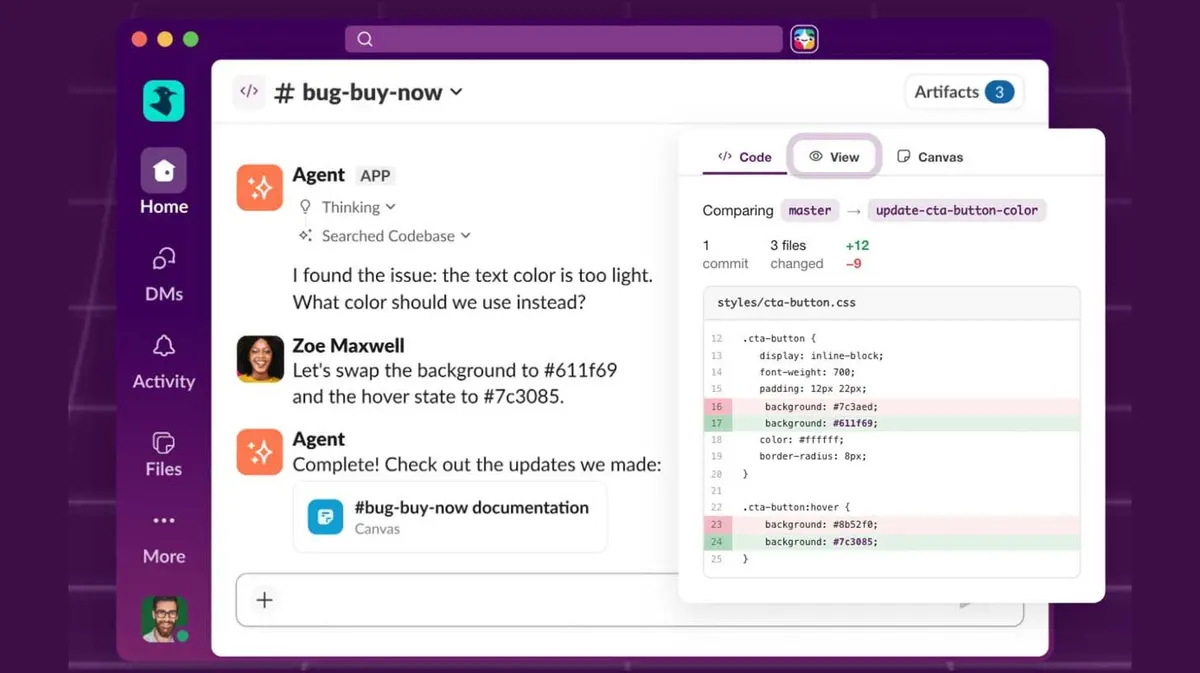
Image source: Salesforce
The Rundown: Slack just launched Slack Code, a new feature that allows users to develop code via shared rooms directly within the messaging platform where AI agents write the software and human teammates watch, steer, and direct the session.
The details:
Each ‘code channel’ brings agents and users from across teams together, allowing anyone to contribute to the direction of a build and view live previews.
Deploying changes is gated behind human approval, with finished projects leaving an archived channel that acts as a searchable record.
All Slack plans have access at launch, with agents like ChatGPT, Claude, Devin, Vercel, and GitHub available to add to the conversation after connection.
Why it matters: The industry is already pushing in the direction of AI agent-enabled messaging builds, and this is another step in that trend. With so many (human) teams already working inside Slack and labs racing to build the best agent, Slack Code is instead trying to own the venue that easily brings both human and AI workers together.
AI finds hidden breast cancer patterns
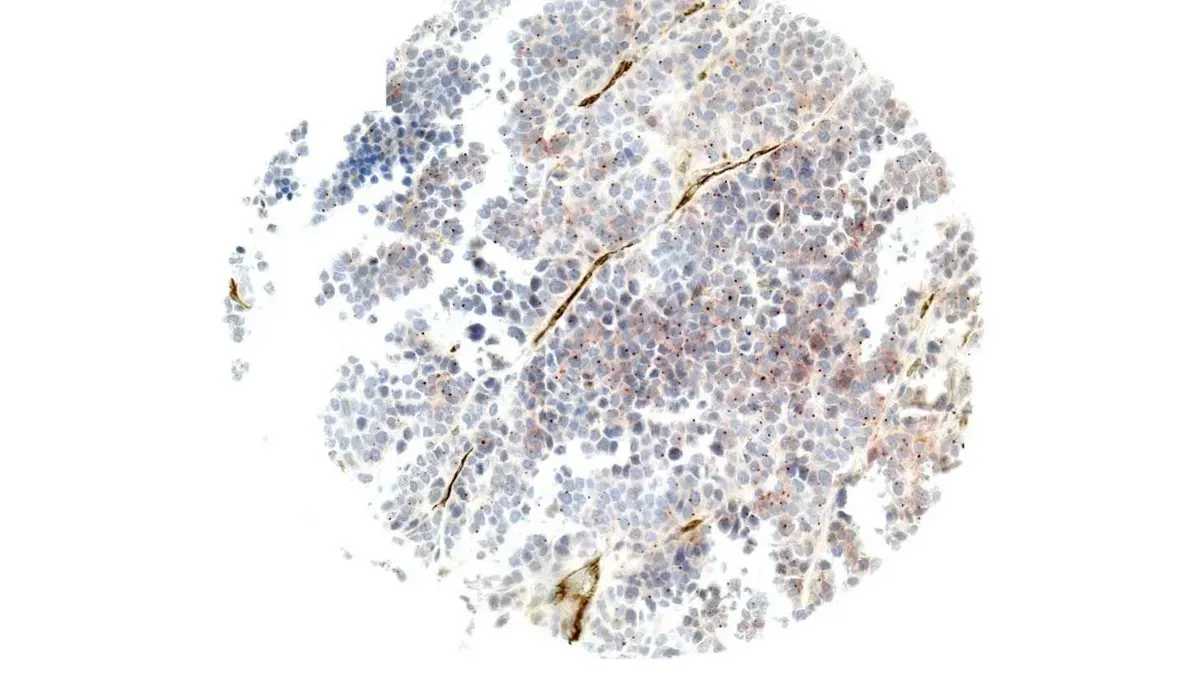
Image source: University of Northampton
The Rundown: Researchers from the University of Northampton published a new study that used an AI platform called CenSegNet to read and compare breast tumor samples cell by cell, finding previously unseen patterns in how cancer progresses.
The details:
Healthy cells rely on centrosomes to divide correctly; when centrosome function becomes abnormal, it can cause errors that contribute to cancer.
The AI analyzed data from 27 patients across 911 samples to find two patterns (oversized vs. extra centrosomes) that each have different links to outcomes.
Patients tended to live longer when a tumor had fewer of the oversized versions, while extras lined up with more aggressive disease.
The researchers say the next step is pairing the findings with other data to guide treatments, with the system open-sourced and testing on other tissues.
Why it matters: Some of AI’s headline-grabbing science wins have been through designing new things, but don’t discount the value in the tech’s less-sexy ability to read and analyze patterns in data that both humans and older systems simply haven’t noticed. It’s exactly that skill that helps inform diagnosis and personalized treatments.
Grok’s Cursor Alliance Pays Off
Once a lab that produced mid-tier models, SpaceXAI has steadily improved. It just built one of the most capable models in the world while keeping prices relatively low.
What’s new: SpaceXAI introduced Grok 4.6, a vision-language model developed with Cursor and aimed at long-running agentic work. It’s available to developers now via the API, in Grok Build and Cursor, and is due in the consumer Grok apps later.
Input/output: Text and images in (up to 500,000 tokens), text out (no limit, 58.4 tokens per second)
Knowledge cutoff: February 1, 2026
Features: Adjustable reasoning levels (low, medium, high, xhigh - defaults to high reasoning), function calling, web search, X search, sandboxed code execution, a fast variant at double price
Architecture: Roughly 1.5 trillion parameters
Performance: Tied for third on Artificial Analysis’ Intelligence Index (61), second on GDPval-AA v2 and AA-Briefcase (1,577 Elo), top score on GPQA Diamond (94.9 percent)
Availability/price: Via Cursor, Grok Build coding agent, Microsoft Office add-ins, GitHub Copilot, via API at $2.00/$0.50/$6.00 per million input/cached/output tokens with higher rates for requests beyond 200,000 tokens, fast mode $4.00/$1.00/$12.00 per million input/cached/output tokens
Undisclosed: Architecture details, active parameter count, details of training data and methods
How it works: Grok 4.6 is the latest model in SpaceXAI’s 1.5-trillion-parameter model family, building on Grok 4.5. SpaceXAI credits gains in performance to longer training on curated data, followed by fine-tuning on data generated by Grok 4.5 and reinforcement learning on agentic tasks. The training data included anonymized coding-agent data from Cursor, which included use of non-Grok models.
How Claude’s Watermarks Work
Anthropic introduced invisible, machine-readable signals that text and images were generated by Claude.
What’s new: The marks will be deployed worldwide in all Claude models launched after August 2, 2026. The company said the watermarks are necessary in order to comply with the European Union’s AI Act.
How it works: Anthropic will generate a digital watermark – a hidden, coded signature that is used to identify AI-generated content – for generated text and a metadata credential for edited images. The policy applies to all forthcoming models and will be phased in for existing models. On August 14, the company added more details about its watermarking methods, their limitations, and implications for users.
Claude’s technique is based on SynthID-Text, a method published by Google researchers in 2024. Typically, language models make low-stakes decisions between alternative words in a sentence. For marked text, a secret, randomized process – called the “seed generator” in the Google paper – subtly nudges the model toward certain word choices as it generates text. Those choices create a pattern that can later be detected by a scoring function, which measures how strongly the text matches the pattern. SynthID-Text gives a statistical score that indicates how strongly a piece of text matches the watermarking associated with its secret key. Anthropic says will release an API that assigns this probability score to submitted text.
A watermarking signal gives a probability of Claude usage but it is not definitive evidence of generated text. Additionally, false negatives are possible in both watermarking and C2PA. Information created by humans but summarized, translated, condensed, or combined with synthetic information may contain a watermark signal.
The company said watermarking will not (i) decrease output quality, (ii) be visible to the reader, (iii) require additional tokens or be more expensive, or (iv) have identifying information that could allow text to be traced back to a user.
The watermarks are designed to be persistent. They survive copying and pasting and some editing. On the other hand, text that is heavily edited or paraphrased and images stripped of their metadata through format conversion may not include the watermark.
Code and other deterministic text will generally have fewer watermarks. Unlike prose, there is frequently a best choice for code or more exact fields – for example, the correct next character for 2 + 2 = should inevitably be 4. But textual watermarks will still be used in cases where there isn’t a deterministic best choice and in code comments. This makes AI-generated code detectable.
Claude models do not generate images from scratch but can edit and process images or generate them using code. These images will have a cryptographically signed credential in their metadata. The method, called C2PA, helps prove the provenance of an image or video. C2PA is different from a text watermark because, unlike in SynthID-Text, nothing in the content is adjusted. Any software that reads C2PA credentials can identify Anthropic’s, and the company will provide its own checking tool.
Qwen3.8-Max Lands With A Bang
Open models are getting larger and more capable. A few weeks ago, Moonshot AI announced Kimi K3, the largest and best-performing open weights model yet. Last week, Alibaba answered by releasing weights for a giant of its own.
What’s new: Alibaba first unveiled Qwen3.8-Max, a 2.4 trillion-parameter vision-language model trained to carry out long-running coding and knowledge work tasks, on August 2. The company released the weights of both Qwen3.8-Max and the smaller Qwen3.8-27B within a week. While smaller Qwen releases have been open weights, this is the first Max-tier model with downloadable weights. However, the open weights version of Qwen3.8-Max is limited to text input and output and doesn’t support the full million-token context window.
Input/output: Text, image, and video in (up to 1 million tokens), text out (up to 131,000 tokens, up to 262,000 reasoning tokens, 77.6 tokens per second)
Architecture: Mixture-of-experts transformer with hybrid attention, 2.4 trillion parameters total, 95 billion active per token
Features: Reasoning (none, low, medium, or xhigh, with xhigh as default), reasoning text retained by default, function calling, structured output, prefix completion, context caching
Performance: Fifth overall and second among open models on Artificial Analysis’ Intelligence Index (58), first overall on 𝜏³-Banking (51.3 percent), second on Arena.ai’s Vision Arena (1,301 Elo), fourth on Arena.ai’s WebDev Code Arena (1,667 Elo)
Availability/price: API on Alibaba Cloud Model Studio at $2.00/$0.25/$6.00 per million input/cached/output tokens, subscription via QwenWork (currently free public beta in China only or via subscription in U.S.), weights for Hugging Face and ModelScope under a custom license
Undisclosed: Knowledge cutoff, training data and methods
How it works: Alibaba has not yet published a technical report or model card for Qwen3.8-Max. The company says the model is built from Qwen3.5, its earlier vision-language model. Alibaba’s release notes for the model highlight reinforcement learning for agentic work and training that teaches the model to visually verify its own output using the model’s vision capabilities.
Everything else in AI today
Build an AI agent, then see its reasoning, tool calls, and token usage. Join Honeycomb and AWS on Aug. 25 to explore Agent Timeline hands-on.*
OpenAI introduced a new plugin for Apple Messages, allowing ChatGPT to search, view, and send messages from its ChatGPT, Codex, and Work platforms.
Asana said it used OAI’s Codex to remove an outdated testing framework in two weeks for around $12k, work the company originally estimated would take five years and $6M.
Adobe rolled out Firefly’s audio generation tools to all users, with the suite producing original soundtracks, voiceovers, and sound effects cleared for commercial use.
Apple Music will reportedly start labeling AI-generated songs on its platform later this year, following an industry push for AI disclosures and Spotify flagging AI artist profiles.