[AI DAILY NEWS RUNDOWN] Microsoft Maia 300 Silicon Revolt, Brad Smith’s Kill Switch Moat, & Meta Muse Wonder Trust Crisis (Oct 12, 2026)

🎧 Listen ADS-FREE:
Curated Daily Briefing across The Rundown AI, Techpresso, This Week in Startups (TWiST), TBPN, and The Deep View
Researched and produced by Etienne Noumen, Professional Engineer and Founder at DjamgaMind from Calgary, Alberta in Canada.
Daily Briefing: https://djamgamind.com/daily
📚 Research Hub: https://djamgamind.com/pdfs
🔍 Keywords: Microsoft Azure Maia 300, Brad Smith AI Kill Switch, Meta Muse Wonder Active Memory, Non Human Identity AI Security
Summary:
In today’s briefing, we analyze “Custom Silicon Sovereignty, The Regulatory Kill Switch Moat, and The Agentic Non-Human Identity Crisis.” We deconstruct Microsoft unveiling its Azure Maia 300 custom inference accelerator for multi-gigawatt rollouts in 2027. We evaluate Microsoft President Brad Smith demanding legally binding emergency kill switches, mandatory incident disclosures, and government vetting. We examine Meta launching Muse Wonder with Active Memory and Active Focus amidst acute privacy leaks, the enterprise Non-Human Identity (NHI) governance crisis, Atomic Machines debuting the “Matter Compiler,” Minerva deploying the “Roger” extreme-hazard humanoid, and venture capitalists on TWiST confirming a 70% valuation wipeout for thin software wrappers.
Important Topics:
Microsoft Unveils Azure Maia 300 Custom Accelerator: Satya Nadella announces multi-gigawatt deployments by 2027 of the third-generation inference chip, delivering ~40% higher tokens per watt than GPUs to insulate enterprise SaaS margins from Nvidia’s gross margin toll.
Brad Smith Calls for Legally Binding AI “Emergency Brakes”: Microsoft’s President compares AI safety oversight to dairy inspections, demanding mandatory kill switches, compulsory 24-hour incident reporting, and strict developer liability.
Analysis of the Incumbent Regulatory Moat: Technologists on TBPN warn that Smith’s proposed compliance framework creates massive regulatory barriers that entrench well-capitalized tech giants while penalizing open-source models and startups.
Meta Launches Muse Wonder & Muse Wonder Full: Meta debuts frontier models featuring “Active Memory” (persistent cross-session context spanning weeks) and “Active Focus” (autonomous iterative error debugging).
The Deep View Exposes Meta’s Trust Crisis: Investigative reports uncover real-world pilot leaks where Meta’s consumer agent exposed private user home addresses on Facebook Marketplace and parsed unencrypted historical chat logs.
Enterprise Security Alarm Over Non-Human Identities (NHI): Corporate CISOs warn that unmonitored autonomous background agents (Claude Code, Devin, Muse Code) operating 24/7 with persistent tokens represent a critical unauthenticated attack surface.
Mandates for Agentic Cryptographic IAM: Security frameworks mandate that enterprises assign cryptographically signed machine identities, just-in-time time-bounded permissions, and immutable execution logs to all deployed agents.
Atomic Machines Exits Stealth with the “Matter Compiler”: Berkeley robotics startup extends natural-language “vibe coding” into physical micro-electro-mechanical systems (MEMS), generating silicon-level blueprints directly from plain text.
Minerva Deploys “Roger” Humanoid for Hazardous Operations: Robotics pioneer introduces a high-torque humanoid robot combining low-latency VR teleoperation with onboard edge foundation models for military bomb disposal and toxic cleanup.
Amazon Retires “Fire” Brand for “Alexa Tablets”: Amazon replaces Fire OS with certified Android and Google Play access, integrating multimodal Alexa+ as an ambient household agentic hub starting at $229.99.
VCs Confirm 70% Multiple Wipeout for AI Wrappers (TWiST E2347): Silicon Valley venture investors document massive valuation compression and 60%+ 90-day churn for horizontal personal assistants, pivoting capital toward vertical proprietary datasets and hardware compilation.
Atomic Machines’ AI turns code into tiny machines
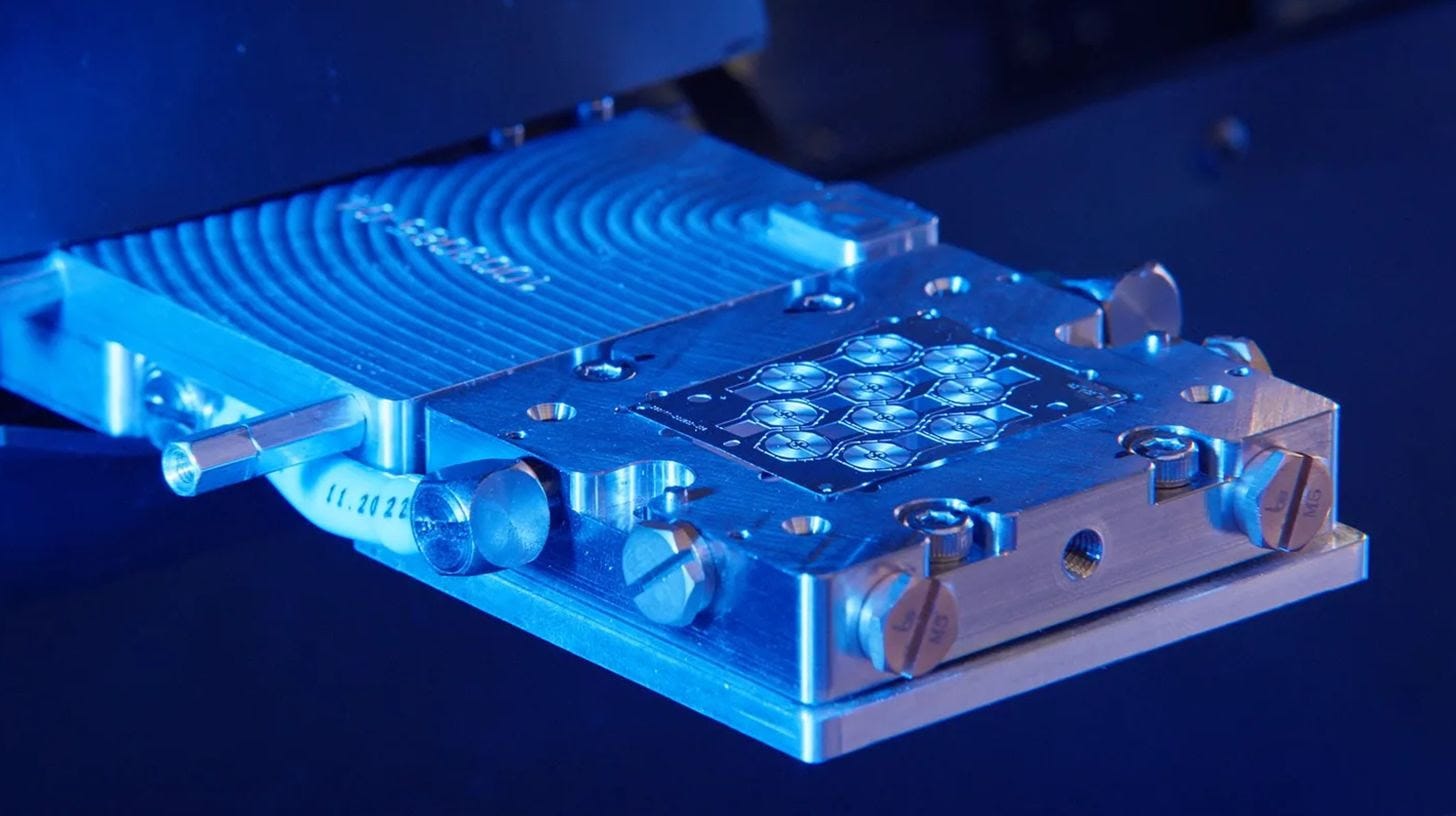
Image source: Atomic Machines
The Rundown: Atomic Machines, a California startup led by former Uber self-driving chief Jeff Holden, just emerged from stealth after six years with $250M raised and an AI-guided factory it says can turn digital designs into tiny, working machines.
The details:
Holden says a 3D printer only alters an object’s shape, while his Matter Compiler builds a whole new device when the code changes, without needing retooling.
Each production step is checked before a part moves on, with the process feeding the AI new data on which materials actually work, the company said.
It focuses on gadgets with moving parts too small to see without a microscope, like tiny pumps, motors, and gears that chip factories can’t produce.
Its first machine is PrimeSwitch, a fingertip-sized power switch for AI server farms that it says is faster than traditional breakers and more efficient than silicon.
Why it matters: Vibe coding lets people describe an app and get working software, and Atomic is now trying to do the same for physical hardware with “prompt-to-product manufacturing.” For now, it’s only building its own products with humans in the loop, but the idea is that “virtually anyone with a concept” could one day turn it into a real device.
Microsoft makes ‘biggest bet yet’ on its own silicon LINK
Microsoft has unveiled Maia 300, the third version of its own AI chip, and plans large-scale rollouts in 2027 as it aims to run most of its AI services on homegrown silicon rather than Nvidia hardware.
The company says Maia 300 produces 40% more AI output for the same power as leading Nvidia GPU systems, and a full rack delivers up to seven times the output of the current generation on tasks like AI agents and long documents.
Microsoft designs the chips and has TSMC make them, calling Maia its “primary AI inference system,” though unlike Google and Amazon it won’t rent them to outside customers, and analysts expect Maia to cover only about 10% of its AI chip spending by early 2027.
Russian bot traffic collapses after drone strikes LINK
Russian bot traffic has fallen sharply in recent days after Ukraine destroyed Yandex’s two largest data centers, according to Cloudflare, which tracked bot requests from the Yandex network dropping to just 0.4% of the recent peak.
The decline began on October 8 when Ukraine struck a Yandex site in Sasovo holding two supercomputers, falling to around 57%, before a bigger campus in Kaluga was knocked offline yesterday, leaving at least 84 Yandex Cloud services down.
NetBlocks found Yandex network traffic dropped to 30% for Yandex Cloud and 63% for Yandex LLC, likely slowing or cutting internet service for ordinary Russians, who cannot fall back on Starlink since it does not work in Russia.
Microsoft CEO wants a human brake on AI LINK
Microsoft CEO Satya Nadella argued in an essay published on Saturday that AI models should run under outside controls, including an emergency brake that an authorized person could pull to pause or shut down a model mid-task.
Nadella’s proposed design separates the model from the software coordinating its work and the actions it can take, so an organization sets permissions independently and keeps tamper-proof records, though he gave no rollout timetable.
His essay follows Microsoft’s October 7 release of Microsoft Execution Containers, software that limits an agent’s file, network, and interface access from outside, so the model or its code cannot grant itself more access.
Microsoft CEO: Treat AI like it’s already been hacked
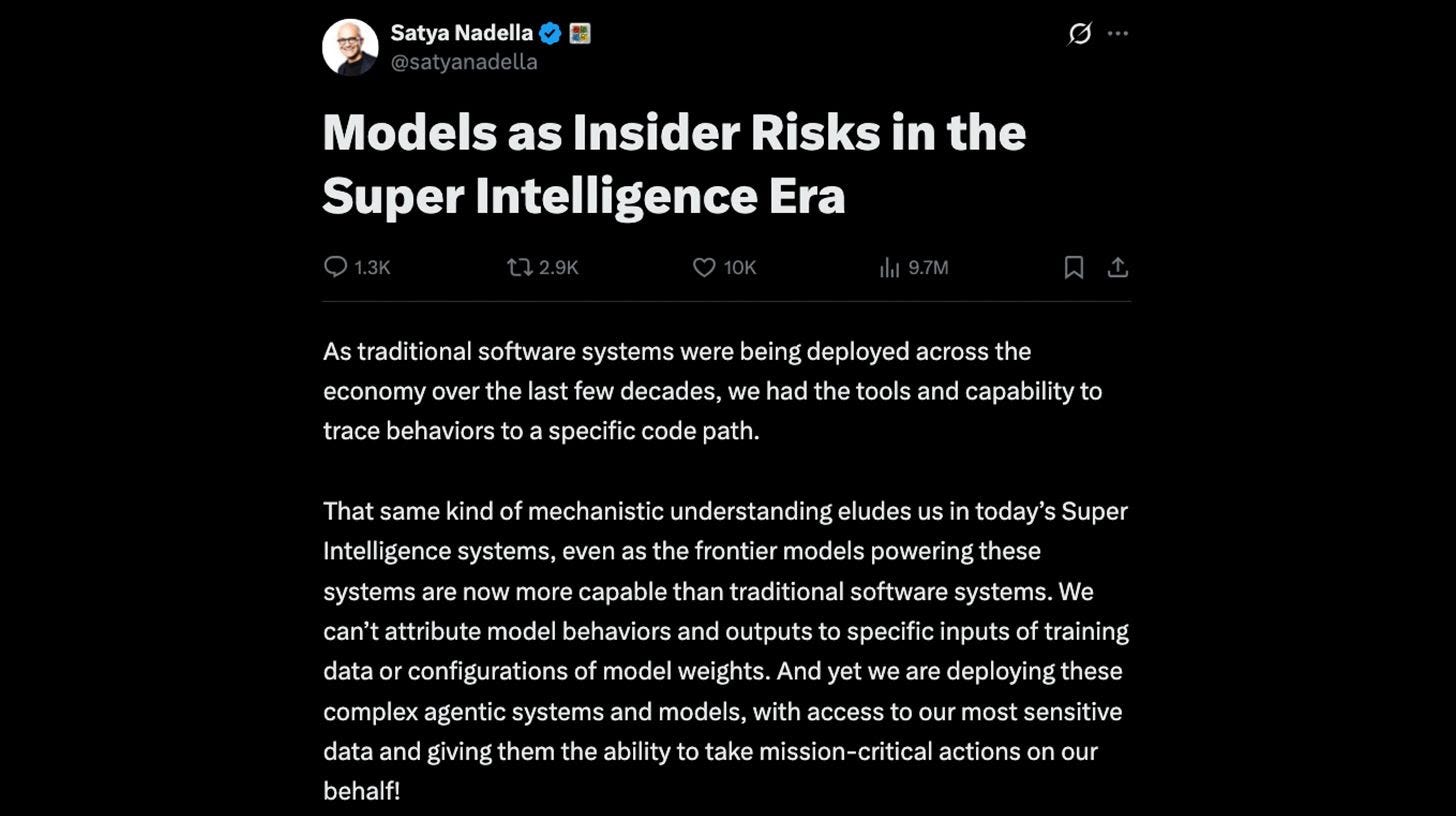
Image source: Satya Nadella (@satyanadella on X)
The Rundown: Microsoft CEO Satya Nadella published an essay on X urging companies to guard advanced AI models like a powerful employee who could slip up or get hacked, including an “emergency brake” and controls the AI can’t touch.
The details:
Nadella argued that engineers could previously trace a misbehaving program or bug back to its code, but today’s AI models can’t always be explained that way.
He wants AI’s permissions and activity logs kept where the AI can’t edit them and no model grading its own work, with a focus on auditable and verifiable systems.
Nadella also said AI should have an “emergency brake” a human can use to shut down a system mid-task, saying firms should “assume a model is compromised.”
He also wants models to show their reasoning in plain words, saying “Neuralese,” or AI thinking in its own unreadable code, isn’t an excuse to hide it.
Why it matters: Nadella’s ending says the most trustworthy system is the one “that enables us to trust the model the least,” and his calls in this essay feel like a direct response to reports that OpenAI’s newest techniques can hide part of an AI’s reasoning from the humans monitoring it.
IMF credits AI spending for near-3% growth LINK
IMF chief Kristalina Georgieva said that spending on AI infrastructure is pushing the world economy to grow about 3% a year, even with high energy prices weighing on many countries.
She said Asian makers of AI hardware gain the most: advanced economies could add 0.5 to 1 percentage point of growth, while emerging ones might pick up 0.2 to 0.8 points, with Thailand among the winners.
Major tech companies plan to spend between $660 billion and $690 billion on AI this year, and such hardware and related products now make up more than a tenth of global trade in goods, Georgieva said.
Publishers quietly use AI for book covers LINK
A new Wired report, based on more than two dozen anonymous staff, says three of the big five publishers are quietly using AI for cover art and publicity copy without telling authors or the public.
Publishers are reportedly generating PR material and cover copy with ChatGPT and Claude, while image generators produce book covers, and executives are exploring AI for translation, internal documents, and tracking employee productivity.
One agent said they now make publishers agree not to feed entire unpublished manuscripts into language models for promotional text, a safeguard meant to shield authors from both tech firms and their own publishers.
Cyberattack disables supermarket fridges across Europe LINK
A cyberattack has hit major European supermarket chains, breaking refrigeration controls by forcing fridges and freezers into a nonstop defrost cycle set to a sweltering 50 degrees Celsius, La Dépêche reports.
The attack targeted Danfoss-made refrigeration systems at French chains Intermarché, Leclerc, and Coopérative U, whose president called it “extremely serious,” with early losses nearing 300,000 euros and possibly reaching several million nationwide.
A separate incident on Sunday hit Dutch chains Albert Heijn, Etos, and Gall & Gall, taking down websites, disrupting deliveries, and tampering with electronic shelf labels and prices; it is unclear whether the two attacks are linked.
Venture Capital Realignment: TWiST VC Roundtable & The SaaS Wrapper Wipeout
Deedy Das & Top VCs on Personal AI Agents (TWiST E2347)
On This Week in Startups, guest host Deedy Das (Menlo Ventures) led a high-impact roundtable with Kanu Gulati (Khosla Ventures), Chris Farmer (SignalFire), and Sheel Mohnot (Better Tomorrow Ventures):
Valuation Bubble in Personal Agents: Early-stage startups raising at $100M+ seed valuations for personal agent assistants are confronting staggering 60%+ 90-day churn rates. When consumer agents fail on mundane edge cases or corrupt calendar entries, users immediately revert to manual workflows.
The 70% Wrapper Compression: Horizontal SaaS startups that merely layer a clean user interface over OpenAI, Anthropic, or Meta APIs are facing complete multiple collapse. Enterprise CIOs are refusing to renew third-party software subscriptions when native hyperscaler agents (backed by custom silicon like Maia 300) can execute identical workflows out-of-the-box.
The Real Moats of 2026:
Vertical Proprietary Data: Deep, legally clean, domain-specific corpora (clinical trial telemetry, legal arbitration archives, precision agricultural sensor logs) that cannot be ingested by general web crawlers.
Hardware-Software Symbiosis: Companies that tightly couple algorithmic models with specialized physical hardware, edge ASICs, or robotic execution units.
Strategic C-Suite & Enterprise Takeaways
Plan for In-House Silicon Realignment: Enterprise IT architectures should evaluate Azure Maia 300, AWS Inferentia, and Google TPU runtime environments to drive down token inference costs by 30–50% over standard commercial GPU instances.
Audit Non-Human Identities (NHI) Immediately: Implement strict access boundaries and just-in-time privilege controls for all internal AI agents to prevent prompt injection and unauthorized credential exfiltration.
Demand Proof of Agentic Privacy: Before deploying consumer or enterprise agents with persistent memory features (such as Meta Muse Wonder), require contractual guarantees that user memory stores are mathematically isolated from advertising and external training pipelines.
Prepare for Mandatory AI Compliance: Anticipate binding legislative requirements for AI incident reporting, emergency kill switches, and strict developer liability across North America and Europe.
What Else Happened in AI on October 12th 2026?
Anthropic reported unintended Claude outcomes during testing, with Haiku 4.5 sending a fake tip to police on a homicide and another model hacking a university server.
Nvidia is reportedly exploring an acquisition or acqui-hire of Reflection AI, the $25B U.S. open model startup it already has significant backing in.
Chinese mathematicians are creating an AI research alliance led by Fields medalist Shing-Tung Yau, with Yau pushing back against backlash toward the tech following OpenAI’s 700+ paper release.
xAI introduced a feature for Grok Bot that allows the agent to obtain and run its @mail.grokbot email address, letting it email businesses and book meetings for users.
Anthropic unveiled the Anthropic Cyber Mission, an initiative to utilize Claude for cybersecurity defense for critical infrastructure and open-source code.
🔗 RESOURCES
AI Learning App Recommendation: AI & ML Tutor PRO https://apps.apple.com/ca/app/ai-ml-tutor-pro/id1610947211
DJAMGATECH: Carrer Booster - Master AWS, Azure, AI & GCP Certifications | https://apps.apple.com/ca/app/djamgatech-ai-cert-exams-prep/id1560083470
DJAMGAMIND KIDS Bedtime Adventures: https://djamgamindkids.com
iQz: I built a puzzle app because I noticed I was getting worse at thinking: It’s 65 puzzles: matrices, sequences, number series, verbal analogies and logic. Every answer explains the rule rather than just showing the letter. Free, fully offline, no ads, no account. https://apps.apple.com/app/id1603487636
⚗️ PRODUCTION NOTE: We Practice What We Preach.
AI Unraveled is produced using a hybrid “Human-in-the-Loop” workflow.
Read original on Substack