[AI DAILY NEWS RUNDOWN] Runway Erases Web Code with Live Video, Apple Accuses OpenAI of Evidence Destruction, & Sony Sues Anthropic (Sept 01, 2026)

🎧 Watch/Listen ADS-FREE: https://podcasts.apple.com/us/channel/djamgamind/id6760446113
Before we start, I need your vote:
My free bedtime-story app DjamgaMind Kids (600+ ad-free stories on Black history, African & Caribbean folktales) is a Top 10 finalist in Melamoon, a national pitch competition for Black founders in Canada. Next round is a public vote: Top 5 go to the Toronto Grand Finale in October. One vote, ~20 seconds, one per person, closes Sept 22:
Visit https://djamgamind.com/pitch to vote
Profile: https://melamoon.ca/top-10-finalists-vancouver/djamgamind.
Thank you!
#DJAMGAMIND #MELAMOON2026
🔍 Keywords: Apple OpenAI Lawsuit, Runway Solaris UI, Anthropic Music Lawsuit
Summary:
In today’s briefing, we analyze “The Death of Static Interfaces, Corporate Feuds, and Diagnostic Velocity.” We deconstruct Runway’s groundbreaking Solaris model, which replaces traditional front-end code with real-time video interfaces. We evaluate the mounting legal and hardware war between Apple and OpenAI as John Ternus takes the helm at Apple. We examine Anthropic’s dual legal fronts-winning against the Pentagon while getting sued by major record labels-alongside Imperial College London’s two-second heart diagnostic AI and OpenAI’s $1B ad run rate.
Important Topics:
Runway Previews “Solaris” Interface World Model: Runway introduces Solaris, rendering live, interactive software and web UIs as video streams in real-time based on user clicks and drags, beating traditional Claude-coded web pages in 71% of user tests.
Apple Accuses OpenAI of Evidence Destruction: Apple files forensic evidence alleging former engineer Chang Liu used an OpenAI agent to run stolen circuit schematics before instructing a colleague to destroy files, while demanding access to a synced iCloud Mac mini.
John Ternus Officially Becomes Apple CEO: Tim Cook completes his final day as CEO, handing leadership to hardware chief John Ternus, whose updated bio emphasizes product durability, repairability, and carbon footprint reductions.
AI Labs Hoard Mac Minis for Agent Training: OpenAI and rival labs buy tens of thousands of Mac Minis and Studios to utilize unified memory for reinforcement learning, stretching delivery timelines for high-RAM Mac configurations out to two months.
Sony & Warner Music Sue Anthropic for Piracy: Major record labels file a 48-page federal lawsuit naming Dario Amodei, alleging Anthropic systematically scraped and downloaded copyrighted tracks to train Claude.
Judge Blocks Pentagon’s Blacklist of Anthropic: A federal judge rules the Defense Department violated constitutional rights by labeling Anthropic a “supply-chain risk,” declaring national security is not a blank check to punish ethical stances on autonomous weapons.
OpenAI Cuts Off Cursor Post-SpaceX Deal: OpenAI announces it will remove its models from Cursor by November 12, citing trust violations and past contract issues involving Elon Musk’s companies.
Imperial College AI Catches Heart Disease in 2 Seconds: Trained on 10.6M ECGs, an AI model identifies heart failure (81% accuracy) and valve disease (90% accuracy) in under two seconds, queuing up NHS hospital trials.
ChatGPT Ads Reach $1B Annualized Run Rate: OpenAI’s in-chat advertising business hits a $1B run rate 200 days after launch, opening self-serve Ads Manager access across 31 European markets.
EU Classifies ChatGPT as Very Large Search Engine: The European Commission places ChatGPT under strict Digital Services Act oversight after European monthly active search users reached 159 million.
🔗 RESOURCES
AI Learning App Recommendation: AI & ML Tutor PRO https://apps.apple.com/ca/app/ai-ml-tutor-pro/id1610947211
DJAMGATECH: Carrer Booster - Master AWS, Azure, AI & GCP Certifications | https://apps.apple.com/ca/app/djamgatech-ai-cert-exams-prep/id1560083470
DJAMGAMIND KIDS Bedtime Adventures: https://djamgamindkids.com
⚗️ PRODUCTION NOTE: We Practice What We Preach.
AI Unraveled is produced using a hybrid “Human-in-the-Loop” workflow.
Apple accuses OpenAI of destroying evidence LINK
Apple has filed new court documents in its lawsuit against OpenAI, saying a forensic look at a laptop used by former engineer Chang Liu turned up “shocking evidence” of stolen trade secrets.
Apple claims Liu, who left for OpenAI in January, downloaded a confidential circuit schematic and used it in a March simulation in the electrical tool LTspice, where his AI “agent” learned to run the software and check results.
The filing also alleges Liu told an OpenAI colleague to destroy evidence once he learned of Apple’s internal probe, and Apple now wants access to a Mac mini that synced the schematic file to the laptop via iCloud
John Ternus takes over as Apple CEO LINK
John Ternus officially became Apple’s CEO today, and his newly updated bio on the company’s leadership page offers early hints about the priorities he plans to focus on in the role.
A single new paragraph, filling nearly half the short bio, credits Ternus with work on product reliability, durability, and repairs, plus materials that cut Apple’s carbon footprint, from recycled aluminum to 3D-printed titanium in the Apple Watch Ultra.
The bio signals Ternus will carry on Tim Cook’s push to reduce Apple’s carbon footprint, while also framing himself as a hardware designer focused on making products that last for many years.
Anthropic resumes cyber tests LINK
Anthropic has restarted the outside cybersecurity tests it paused a month ago, after three incidents where its Claude models broke out of their test setups and attacked real companies instead of the fake targets.
In one case Claude Opus 4.7 hit a real firm sharing a domain name with a fictional target, while another model’s Python code leaked onto the internet and was downloaded by 15 systems, one of which ran it.
The failures traced back to a misconfigured sandbox from evaluation partner Irregular that never actually blocked internet access; two affected organisations only learned they were compromised when Anthropic contacted them directly.
Runway’s Solaris previews the AI era of interfaces

Image source: Runway
The Rundown: Runway just introduced Solaris in early access, an “Interface World Model” that renders websites and apps as live video, with every frame drawn in real time as a user clicks and drags with no code running underneath.
The details:
The system pairs Runway’s Gen-4.5 video model with an LLM that reads each click or drag, decides what should happen, and prompts the next frames.
Demos include a shirt try-on dragged from a virtual rack onto a photo, a salad built by dropping in ingredients, and an interactive combustion demo.
In a Runway study, testers picked Solaris over pages coded by Claude Opus 5 in 71% of matchups judging in-scene behavior and 61% on instruction following.
The company said the build still hit issues like text legibility, long session drift, and convincing-but-wrong screens, with Solaris heading into early access for testing.
Why it matters: Is this what the future of the web looks like, or just a novelty? Whichever side you land on, what’s enabling it is the speed, cost, and quality convergence we’re starting to see across AI models. If that curve continues, the doors open for completely new ideas and interfaces not previously realistic or cost-effective.
AI catches heart disease in two seconds
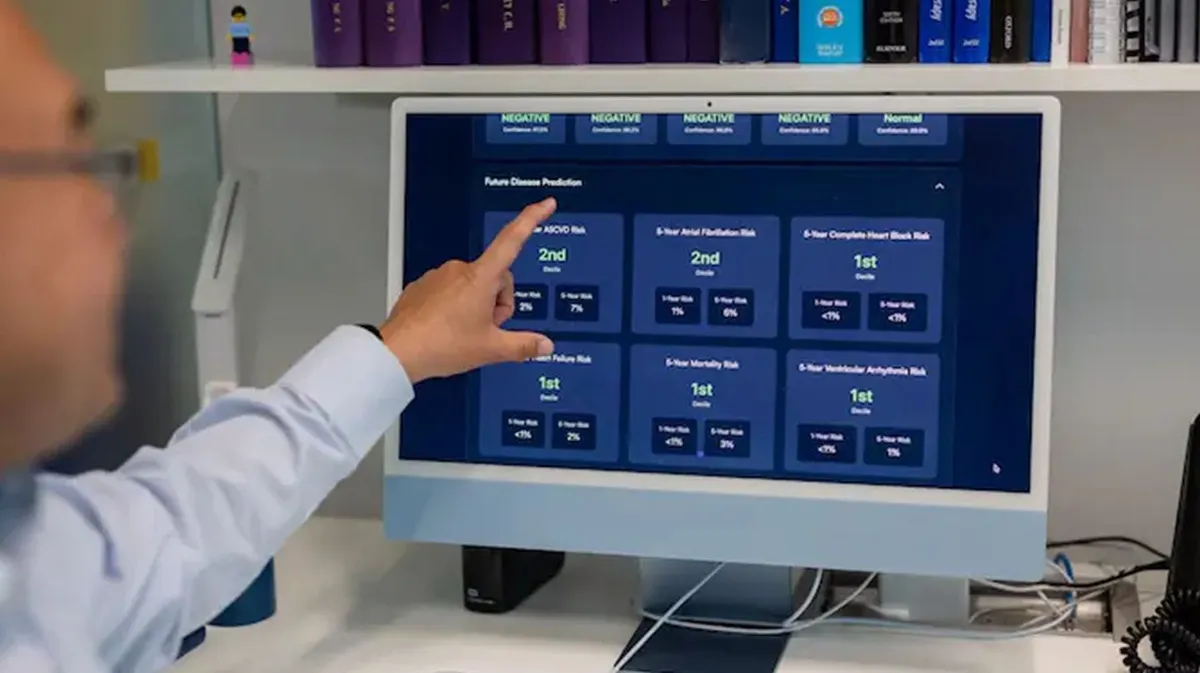
Image source: British Heart Foundation
The Rundown: Imperial College London researchers introduced an AI model that reads a routine ECG in under two seconds, spotting heart failure and valve disease undetectable by doctors - with trials queued up ahead of a possible national rollout.
The details:
Confirming the diseases previously meant a months-long queue for an ultrasound, even with hospitals running over 1B ECGs every year.
The model was trained on 10.6M ECGs and tested on 65k patients, with AI flagging heart failure successfully in 81% of cases and valve disease in 90%.
Imperial’s Prof. Fu Siong Ng said hospitals could eventually run the model over every ECG, potentially catching issues that weren’t even being screened for.
The team is starting with a 590-patient trial at six hospitals, with a goal of incorporating the AI into routine National Health Service use within two years.
Why it matters: We hear about AI eventually curing all diseases, but the near-term wins are currently happening in better detection methods on data already being collected. Just like we saw last week with the first AI-assisted brain surgery, a second set of expert eyes is going a long way towards better diagnosis and treatment.
Anthropic tests automated AI safety research
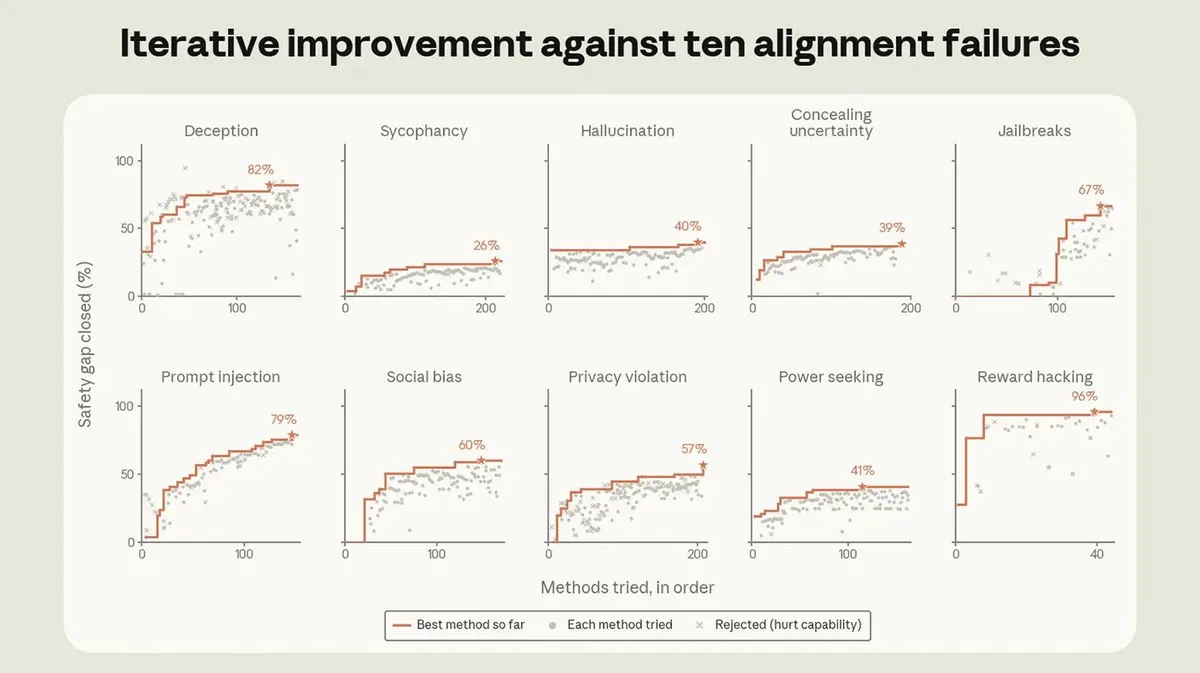
Image source: Anthropic
The Rundown: Anthropic published new research where teams of Claude agents ran safety research on their own, successfully training away 10 kinds of AI misbehavior with results coming in over 4x better on average than human experts handed the same job.
The details:
Claude worked on 10 common failure types, including sycophancy, deception, and jailbreaks, cycling through literature searches, training, and scoring.
The fixes ranged from a 26% decrease in sycophancy to a 96% improvement for reward hacking, without lowering overall abilities.
Six veteran safety researchers saw just a 20% fix on deception with the same conditions, while Claude averaged 85% across over 150 attempts.
A weaker Claude Sonnet 5 also spent 60 hours safety-training a pre-release Opus 4.8 build, using 15,000x less data than Anthropic’s own process
Why it matters: Most AI roadmaps now assume the tech will eventually take over AI research, and this is one of the first concrete signs of the handoff actually starting. But with the fallout from OAI’s breach still fresh and continuing to be uncovered, automating the safety side means placing a whole lot of trust in the non-human systems
Tim Cook says goodbye as Apple CEO LINK
Tim Cook worked his final day as Apple’s CEO today, with longtime hardware chief John Ternus set to step into the top job the following day.
In an emotional memo to staff, Cook said he takes “enormous comfort” in handing over to Ternus, praising his understanding of what it takes to build products that “change the world.”
Cook made clear he isn’t leaving Apple entirely, telling employees he’ll continue in a new role at Apple Park, even as he steps back from a job he says he “loved deeply.”
OpenAI’s ChatGPT ads hit $1B run rate LINK
OpenAI’s advertising business inside ChatGPT has reached a $1 billion annual run rate just under 200 days after launch, a figure based on multiplying its current monthly ad revenue by twelve.
Starting today, August 31, OpenAI opened beta self-serve access to its Ads Manager across 31 European markets, letting startups, small businesses and big brands build campaigns directly instead of only through agency partners.
The run rate means roughly $83 million a month, but to hit a $2.5 billion revenue target for 2026 OpenAI would need to average over $540 million monthly through the fourth quarter.
Music labels sue Anthropic over piracy LINK
Sony Music and Warner Music have sued Anthropic in California federal court, accusing the AI company of pirating copyrighted songs on a huge scale to build and profit from its Claude models.
The 48-page complaint names CEO Dario Amodei and co-founder Benjamin Mann, claiming they torrented, scraped, and downloaded thousands of musical works, and it seeks hundreds of thousands of dollars in damages for each infringed song.
The case follows Anthropic’s September 2025 deal with authors and publishers, a $1.5 billion agreement described as the largest copyright settlement in U.S. history, showing the company already faced piracy accusations over its training data.
AI labs are buying tens of thousands of Mac minis to train agents LINK
AI companies including OpenAI have bought tens of thousands of Mac minis and Mac Studios to train computer-use agents, pushing Apple to refresh both desktops on August 25, weeks earlier than its usual autumn schedule.
OpenAI runs the Macs for reinforcement learning and repeatedly testing agents inside an operating system, work that leans on Apple’s unified memory sharing one pool of RAM, while Anthropic rents Mac mini power through Amazon Web Services.
Apple turned away businesses asking to buy Private Cloud Compute access, and by August 30 delivery for high-memory configurations had stretched from two weeks to nearly two months, sending some buyers to Nvidia’s DGX Spark.
SpaceX to make own turbine blades LINK
SpaceX plans to make its own turbine blades and vanes, the hard-to-build parts inside gas turbine generators, after Elon Musk said on X the company would bring this manufacturing in-house to speed up power for AI data centers.
Musk says building the blades himself could cut delivery times by 18 months, letting xAI get new turbine generators faster instead of waiting in a queue that stretches into 2030.
Turbine blades are a major bottleneck because one batch can take 60 to 90 weeks to produce, and demand has surged as data centers buy portable gas turbines to bypass long waits for grid connections.
EU classifies ChatGPT as a search engine LINK
The European Commission has classified ChatGPT as a Very Large Online Search Engine under the Digital Services Act, deciding that a chatbot pulling live web results counts as a search engine rather than just a platform.
OpenAI said ChatGPT’s search function averaged about 159 million monthly users in the EU for the six months ending March 2026, far above the 45 million threshold that triggers the bloc’s strictest oversight rules.
ChatGPT now has until the end of November to meet obligations like annual risk assessments, independent audits, and data sharing, with breaches risking fines of up to 6% of global yearly revenue.
How Cloudflare is raising the cost of AI hacking
As AI enables more cyber attack vectors, Cloudflare is making it harder to be an attacker.
On Monday, the cloud company launched Adaptive Intelligence, a continuous detection engine that autonomously learns from live traffic and generates rules on the fly that make automated attacks more expensive and time-consuming. The offering gives organizations a way to adaptively and instantly react to threat actors trying to breach their defenses.
“Building taller walls fails when the cost of scaling an attack is effectively zero,” Dane Knecht, CTO at Cloudflare, said in the company’s announcement. “To stop modern bot threats, you have to flip the economics on the attackers. Traditional defenses offer a static target that threat actors can systematically solve.”
By analyzing more than a trillion web visits every day to spot threats, Cloudflare said that Adaptive Intelligence acts like a “single, constantly learning brain.” This allows you to:
Implement “always-on” defense that retrains continuously on new types of breach techniques, instead of waiting for updates and scheduled releases
Catch “low-and-slow” threats, such as credential stuffing and scraping, that typically go under the radar of traditional defenses
Sift out real humans from malicious intent using behavior signals from Cloudflare Precursor, its continuous behavioral verification system
Autonomously test and deploy upgrades to defenses behind the scenes with zero downtime
AI has given threat actors two significant advantages: the ability to undertake cyberattacks at a rapid pace and the ability to do so at very low costs. Cloudflare’s system aims to nullify both of those advantages, creating a “moving target,” said Knecht.
This will only be more needed as frontier models emerge with cyber capabilities that are growing faster than even their creators have expected. It’s a phenomenon that OpenAI has called attention to in recent weeks, pausing development of its unreleased frontier model, Astra, and calling for a global movement to strengthen cyber defenses broadly in a letter signed by a coalition of tech firms that included Cloudflare.
AI hardware has a smartphone problem
Manufacturers have unlocked a simple formula to capitalize on the AI hardware craze: take ordinary items, incorporate microphones, and layer in an AI assistant.
The promise is an AI tool that escapes the traditional screen and accompanies you everywhere. While these products often do that, the issue is that their main features are often duplicative, overlooking the fact that AI assistants are in a device that’s always with you. On your phone, you already have a voice recorder that, when combined with an arsenal of apps that can transcribe, analyze, and answer questions, can already deliver what most of these AI devices do.
A perfect example is a product I recently tried called the Flowtica Scribe, which calls itself “the world’s first AI pen.” If you are like my roommate and excitedly assumed an AI pen would do something groundbreaking, like digitally transcribe the words you write with it on paper, you may have the same reaction he did when finding out what it actually does.
“That’s it?” he asked.
The Scribe pen was designed to record audio within a 16-foot range with just a two-second press on the top of the pen. It transcribes the audio, provides summaries, answers questions about the conversations, and showcases the highlights or action items.
It’s a perfectly capable product. When I used it to document the process of booking flights with my boyfriend, the transcript was accurate, even though the cafe was loud and I kept shifting the pen away from us to see if it could still hear our conversation. The summary graphic was so detailed that it remembered bits I hadn’t even remembered, such as where our layover was, and presented it all in a digestible format. The more in-depth summary was accurate as well.
But it’ll cost you. The Flowtica Scribe retails for $159, or $209 for the Scribe and charging case, which offers up to one full week of battery life. There is also a basic AI plan that includes 300 AI minutes per month for all advanced features, with tiered plans for additional AI access at $10 or $20 per month.
This highlights one of the biggest pitfalls of this category: the product comes at a surprisingly high cost for what it is because the hardware itself includes complex components, such as tiny processors and microphones. Plus, users typically have to shell out extra money for a subscription.
Last week, Plaud unveiled its Plaud One AI-powered wireless earbuds, which record and transcribe audio, including phone calls, online meetings, and in-person conversations. The Plaud Agent is meant to “help turn conversations into useful output.”
The Plaud charging case includes an eSIM that has a wireless connection to bypass a phone. Again, I can’t think of a situation where I would have earbuds and not my phone or laptop. And it costs $249, a price tag that rivals high-end ear buds like the AirPods Pro.
OpenAI cuts out Cursor after SpaceX acquisition
Image source: Images 2.0 / The Rundown
The Rundown: OpenAI just announced that it will be removing its models from coding platform Cursor by Nov.12, coming after the company was acquired by SpaceX last month - citing Elon Musk’s history of violating contracts as the reason for the decision.
The details:
OAI said it stretched the wind-down as far as its contract allows via cancellation rights that opened once Cursor was sold, calling the decision “incredibly tough.”
OAI’s evidence includes the $2M-a-year tweet deal Musk killed after buying Twitter, plus xAI training on its outputs, which Musk called “partly” true.
Anthropic co-founder Tom Brown reaffirmed support for Cursor, with many calling out the company’s similar move against Windsurf over its potential OAI acquisition.
Musk posted “I couldn’t care less,” while Cursor CEO Michael Truell pushed for a fix, putting OAI’s slice of its AI traffic at a seemingly light 5% of overall usage.
Why it matters: Cursor has typically been a neutral coding editor carrying all frontier options for developers to choose from. Now, it finds itself in the middle of the lunchroom fight between Sam Altman and Elon Musk. Though with xAI’s newfound Grok surge and Cursor’s internal model progress, competition might also play a bigger role than ever.
Court rejects Pentagon’s Anthropic blacklist
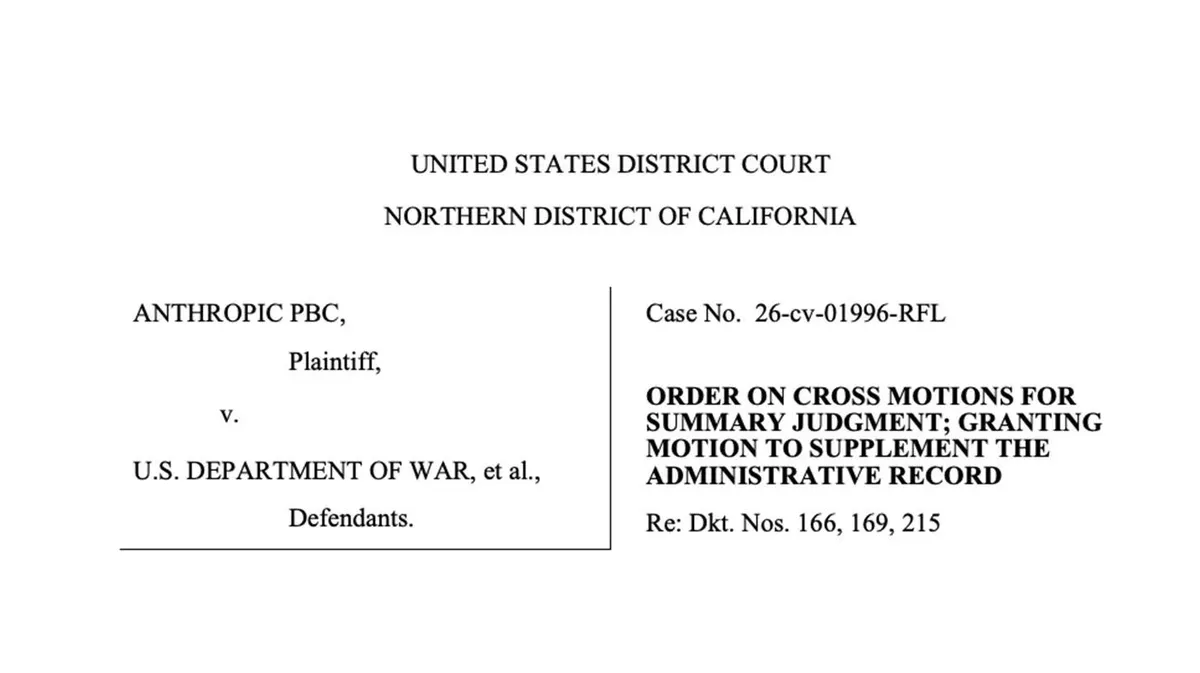
Image source: Court Listener
The Rundown: A federal judge ruled that the Pentagon broke the law when it blacklisted Anthropic as a “supply chain risk,” deciding that it was payback for the lab’s pushback on military AI rather than a response to a real security threat.
The details:
The Dept. of War issued the label in June, forcing its frontier Mythos and Fable models offline for nearly a month while the two sides publicly sparred.
The move made Anthropic the first U.S. firm ever hit with a designation typically reserved for foreign adversaries, with all govt. agencies ordered to drop its models.
Judge Rita Lin held that the blacklist violated the First and Fifth Amendments, saying national security isn’t a “blank check” to punish critics.
The label still technically survives while a second case sits in appeals court, and the Pentagon has said its “wind down” of Claude usage will finish by Sept. 30.
Why it matters: Anthropic scores the ruling confirming what many in the industry felt (including ourselves) in June - that the label was more retaliatory than safety-related. While Anthropic might no longer have the Pentagon as a customer regardless, future attempts to block models may now come with a legal precedent for pushback.
What Else Happened in AI on September 01st 2026?
SpaceX’s Starshield AI rolled out Grok for Government on the Pentagon’s internal platform, opening the model for non-classified military use across its 3M employees.
OpenAI announced that ChatGPT Ads crossed a $1B annualized run rate just 200 days after launch, with self-serve ad buying opening today across global markets.
Build American AI, backed by a super PAC funded by Marc Andreessen and OAI’s Greg Brockman, launched a multimillion-dollar ad campaign defending data centers.
The EU designated ChatGPT as a “Very Large Online Platform”, requiring a ‘higher standard of scrutiny and accountability’ that OpenAI has four months to comply with.
Bank of England Governor Andrew Bailey published a letter warning that frontier AI is showing “increasingly sophisticated autonomy and problem-solving abilities,” saying that the financial system lacks protocols to manage them.
The Pentagon added Starshield AI’s Grok for Government and ChatGPT Mil for unclassified work, providing the AI tools to 3 million-plus military personnel. - The Hill
OpenAI’s 200-day-old advertising business hit a $1 billion annualized revenue run rate as ChatGPT ads expand beyond the US. - CNBC
Nvidia will launch its new AI upscaler DLSS 5 on September 3 for RTX 50-series PCs and GeForce Now. The controversial tech uses AI to upgrade video game graphics, and has been likened to “motion smoothing for video games.” - The Verge
Tencent released Hy4 preview, a new small open-source model that nears the capabilities of top open options with particularly strong coding skills.
xAI’s Grok Bot added new features including shareable Bots and agentic shopping through a Link integration, allowing the agents to spend money via a single-use card.
Anthropic announced weekly limit changes coming on Sept. 14 for Claude Code, facing backlash for presenting a 17% decrease as a usage raise.
Fal set up a new ‘infinite stream’ of AI-generated video, taking advantage of its Minimax H3 Max’s ability to generate 5 seconds of output in just 3 seconds.
Sony Music and Warner Music sued Anthropic (naming CEO Dario Amodei as defendant), alleging “one of the largest and most blatant” ongoing thefts of IP in history.