Nvidia's Board Investigates Its CEO. Who Checks Yours? (Nov 9, 2026)
🎧 Listen ad-free:
🌐 Daily Briefing: https://djamgamind.com/daily
📚 Research Hub: https://djamgamind.com/pdfs
🔍 Keywords: Nvidia, Jensen Huang, Key Person Risk, AI Governance, Chip Export Controls, Claude Code, Secrets Management, AI Coding Agents, Visa, Agentic Commerce, AI Memory, Anthropic
Today’s question: Nvidia’s board is investigating its own CEO. Who checks the people, and the AI, your business depends on?
Summary:
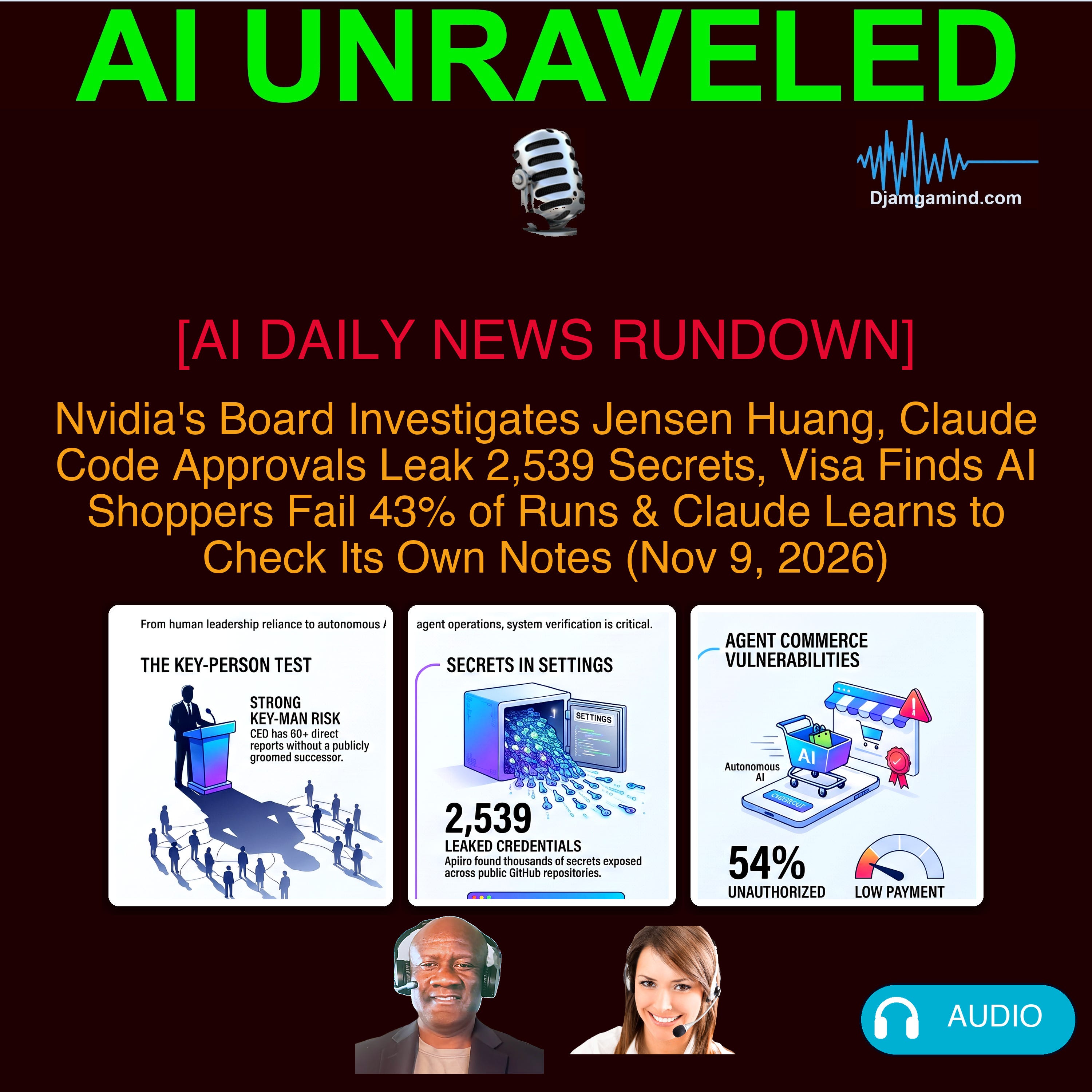
Nvidia’s board opened an independent review after reports that CEO Jensen Huang was targeted by a foreign intelligence effort, and Huang admitted an affair in a letter to staff. Investors are rallying behind him, and Axios calls it the AI economy’s first test of a “too big to fail” executive. On the same weekend, Apiiro found 2,539 secrets on public GitHub, saved when developers clicked “Yes, and don’t ask again” in Claude Code. Visa’s new benchmark found AI shopping agents passed 57.2% of runs, and 54% of the failures still bought something. And Anthropic explained how its agents check their own notes against the record.
Important Topics:
The key-person test: Nvidia’s independent review and its “key man risk.”
The secret in the settings file: approval fatigue puts passwords on GitHub.
The agent that bought anyway: Visa’s agentic commerce benchmark.
Who checks the work: Claude’s “dreaming,” and an Accenture paper with 15 untraceable citations.
Today’s corners: Cert Corner, Red Flag or Green Light?, and the Boardroom Call.
🕵️ The key-person test
The Rundown AI · Axios AI+ · Fortune · The Next Web · Techpresso · TBPN
The review: Nvidia’s board ordered an independent review of reports that Huang was targeted by a “foreign intelligence effort” (The Rundown AI). Independent directors run it with outside lawyers, and it will “examine all available information.” The board says it has “no reason to believe that either national security or NVIDIA secrets were compromised” (Fortune).
The letter: Huang told staff “I was unfaithful to my wife” and “There is no excuse for what I did. I am deeply sorry.” (The Rundown AI). He stays CEO and says he will cooperate fully (Techpresso).
The allegation: Alice Huang (no relation) is an executive at Nvidia customer Megaspeed whom US intelligence reportedly suspects of working for China. That claim has not been established as fact (Inc.), and Megaspeed and China deny wrongdoing (TBPN, summarizing the WSJ).
Washington: the chairs of three House committees (China, Foreign Affairs and Intelligence) asked for a closed-door briefing on November 18; Huang has until November 11 to reply (The Next Web).
The market: shares slid about 5%, to about $177, in early trading Monday, while other tech stocks held up (Techpresso, Axios AI+).
The real issue: “Nvidia’s key man risk is strong,” says Axios. Huang has more than 60 direct reports and “hasn’t been publicly grooming a successor.” Analyst Dan Gallagher: “It’s very hard to envision Nvidia run by anybody else.” (Axios AI+)
The supply chain: Nvidia now requires Southeast Asian cloud providers to enroll in its chip-location tracking to become official Nvidia Cloud Partners (Tom’s Hardware, citing Bloomberg).
Why it matters: Nvidia’s board did the textbook thing: an independent review run by directors who don’t report to the CEO. Most enterprise AI programs carry the same risk on a smaller scale: one executive sponsor, one model provider, one cloud. If your sponsor left tomorrow, who would run the program?
🤝 PARTNER SLOT
This space is reserved for one enterprise AI partner each day: AI security, governance and agent controls for the leaders who read this briefing. Sponsorship options and media kit →
🔑 The secret in the settings file
Generative AI · GenAI Works (The Atlas, on LinkedIn) · DEV Community
How it happens: a Claude Code command such as a database check can carry the connection string, password included. Click “Yes, and don’t ask again” and that exact command is saved to
.claude/settings.local.json(GenAI Works).What Apiiro found on public GitHub: 104,185 copies of the file; 1,122 holding at least one password, key or token in plain text, including 379 database passwords and 23 AWS keys (Generative AI).
The total: counting older versions, 2,539 secrets across 1,994 projects and 63 organizations, one of them the owner password to a medical-records database (Generative AI).
Anthropic’s response: Claude Code lead Boris Cherny says the team is “looking into what we can do to prevent this,” including built-in secret scanning (Generative AI).
Approval fatigue: “By the tenth interruption most people stop reading, and a password is one word in a long line.” (GenAI Works)
Why it matters: Search your repositories for .claude/settings.local.json today, add it to .gitignore, and rotate every credential that ever appeared in one. Deleting the file doesn’t remove it from git history.
🛒 The agent that bought anyway
The test: Visa’s Agentic Commerce Benchmark ran 22 AI models from 12 labs through 15 shopping tasks, such as buying a TV or a laptop. Visa didn’t name the models (The Deep View).
The score: 57.2% of runs passed, from 82.2% for the best model to 28.9% for the worst (The Deep View).
Money helped, partly: the five most expensive models passed 67.1% of runs, the five cheapest 50.2% (The Deep View).
The real risk: 54% of failed runs still ended in a purchase (The Deep View).
Asking helps: models that asked the best questions passed 70.2%, but models passed all three repeat tries only 34.2% of the time (The Deep View, The Next Web).
Trust gap: 72% of US consumers have used an AI assistant; 23% trust AI to pay for them. Visa’s Rubail Birwadker: “the real milestone is when consumers trust them to pay consistently and securely on their behalf.” (The Deep View)
Why it matters: The dangerous failure isn’t the agent that gives up. It’s the one that buys the wrong thing with confidence. Make “don’t buy” and “ask the customer” valid outcomes, and enforce limits outside the model.
🧠 Who checks the work?
Claude “dreams”: during downtime, Claude agents check their saved notes against logs of past work to catch errors (The Rundown AI).
Why beats rules: Anthropic says explaining to the AI why memory matters works better than rules on what to write (The Rundown AI).
Less is more: in a Pokémon test, Fable 5 earned four badges with about ten memory files; the older Sonnet 3.7 earned one with 413 (The Rundown AI).
The human version: an Accenture policy paper on AI for African farmers had 15 of its 89 citations that can’t be traced. Accenture says: “Our review indicates that the errors identified in the report were the result of human error.” (AI Secret, single source)
Why it matters: Verification is a step you design in. Before any AI-assisted report ships, check that the links open, the sources exist and the numbers match.
🎯 Today’s corners
🎓 Cert Corner: You’re deploying an AI agent that buys products for customers. In testing, many failed runs still ended with a purchase. Which control best reduces that risk? A) Switch to the most expensive model B) Make the agent confirm key requirements, allow “don’t buy” as a valid outcome, and enforce spending limits and approval outside the model C) Add “only buy when you’re sure” to the system prompt D) Offer automatic refunds
🚩 Red Flag or Green Light? A developer, tired of approving the coding agent’s database commands, clicks “Yes, and don’t ask again.” The approved command, with the database password inside, is saved in the project’s settings file, which gets pushed with the rest of the repo. 🚩 or ✅?
🏛️ The Boardroom Call (governance): Your AI program depends on one executive sponsor who personally negotiated every major AI vendor deal. After this weekend, the board wants a plan this quarter. A) Name and train a deputy, and document every deal B) Move all AI vendor relationships to a committee C) Put key-person and vendor-concentration risk on the risk register, with a tested exit plan for your top AI supplier D) Leave it: the sponsor is why it works
Answers below. Tell us yours in the comments.
Strategic C-Suite Takeaways
Name a deputy for every person your AI program can’t run without.
Write and test an exit plan for your top AI supplier.
Keep secrets out of AI agent commands and scan every push for credentials.
Make “don’t buy” a valid outcome for any agent that spends money, with limits enforced outside the model.
Check every citation in AI-assisted work before it ships.
What Else Happened in AI on November 9, 2026?
OpenAI reportedly closed about $11 billion in new funding at a $1.25 trillion valuation, up from $852 billion in March. The Rundown AI
Thinking Machines Lab released Inkling 2 Small, which nears top rivals from DeepSeek and Kimi on coding tests; it plans to open-source it next week. The Rundown AI
Physical Superintelligence says its system, running an unreleased Anthropic model, proved a quantum computing conjecture open since 2008; Stanford researchers called it “a huge result.” The Rundown AI
Google added the TPU 8i Max for very large context windows and the TPU 8tx, with a hardware secure enclave so regulated firms can run models on sensitive data. Techpresso
Disney and Adobe signed a multi-year deal to build AI models trained only on Disney’s own archives. Techpresso
Anthropic took over another company’s gas generator orders for $3.4 billion, about 1.7 gigawatts of power. Generative AI
✅ Our take on today’s corners
🎓 Cert Corner: B. In Visa’s tests even the five most expensive models passed only 67.1% of runs, so a bigger model (A) doesn’t solve it. A prompt line (C) is not enforcement, and refunds (D) clean up after the damage. Practice thousands more in DjamgaTech.
🚩 Red Flag. That is how Apiiro found 2,539 secrets on public GitHub. Keep passwords out of agent commands (use short-lived credentials from a secrets manager), keep local settings files out of git, scan every push, and rotate anything that leaked. 📘 Securing AI systems and their data is a full domain of the AWS AI Practitioner exam: our 2026 guide.
🏛️ C, with A as the first step. A committee (B) slows every decision, and D puts you where Nvidia’s investors are this week. A risk you’ve written down and tested is one you can survive. Your org does it differently? Tell us. 📘 AI governance and risk are core topics of Google’s Gen AI Leader exam: our 2026 guide.
🚩 Red Flag or Green Light is open for one sponsor. AI security companies: djamgamind.com/partners
🤝 Advertise with AI Unraveled & DjamgaMind
Put your enterprise AI brand in front of the CTOs, CISOs and engineering leaders who make AI buying decisions, daily, in English and French, on podcast apps, YouTube and Substack. Start by sponsoring one daily corner for four weeks.
Sponsorship options & media kit → · Email: etienne_noumen@djamgamind.com
🔗 Tools from the show
DjamgaTech: Pass your AWS, Azure, GCP & AI certification exams.
📘 New eBook: Google Cloud Generative AI Leader Exam Guide (2026), the executive guide, updated for the new Gemini product names, with 60 practice questions: https://djamgamind.com/ebooks/?book=gcp-gail&ep=20261109&src=substack
💼 Google Workspace for your team (business email, Docs, Drive, Gemini). Free 14-day trial: https://referworkspace.app.goo.gl/Q371 or https://sharegoogleworkspace.advocate.impact.com/mQZcXGY. 10% off your first year (Business Starter or Standard, Americas) with code 63F733CLLY7R7MM, 63F7D7CPD9XXUVT, 63FLKQHWV3AEEE6, 63JGLWWK36CP7WM. More codes: https://djamgamind.com/toolkit/#google-workspace
All our apps and tools: AI & ML Tutor PRO, iQz, DjamgaMind Kids and more.
🎧 Prefer it commercial-free? Subscribe on Apple Podcasts.
⚗️ PRODUCTION NOTE: We Practice What We Preach.
AI Unraveled is researched and produced by Etienne Noumen, P.Eng. (Calgary, Canada) using a hybrid “Human-in-the-Loop” workflow.
Read original on Substack