[SPECIAL] Siri vs Dots, Muse, Duet, Grok Bot and Gemini Spark: Nov 10, 2026
For years, Siri has been the assistant that answers and then waits. This week, Bloomberg’s Mark Gurman reported that Apple wants to change that.
The rest of the industry did not wait. Between May and October, Google, xAI (now SpaceXAI), Meta, OpenAI and Anthropic all shipped an agent that keeps working after you close the app: it has its own computer in the cloud, watches your connected apps, and comes back when it needs a decision.
So today’s question is not “which chatbot is smartest?” It is this:
When an AI agent keeps working after you close the app, who do you trust to act for you while you sleep?
1. The news: Apple wants Siri to become an agent
In a closed-door meeting in recent weeks, Apple CEO John Ternus told software chief Craig Federighi that Apple needs to “accelerate” its software roadmap and “move quickly beyond merely making necessary improvements to Siri,” Gurman reported in his Power On newsletter on November 8.
Gurman described what the rivals already do: “Dots, Muse and Grok can keep track of goals, determine what needs to happen next and continue pursuing objectives without the user initiating every individual step.” Then: “Apple ultimately wants to go in this direction, I’m told, and I believe the company could make Siri more like an agent as early as next year.”
Three things to keep straight:
Apple has announced nothing. The 2027 timing is Gurman’s reporting and his own estimate.
Today’s Siri AI is request-based. iOS 27.2 added memory of past chats, and the iOS 27.3 beta added app “skills” that combine several actions, but you still start every run yourself.
Apple’s fine print already hints at the price question. Server-side Siri AI features are “subject to daily usage limits,” and “expanded access to such features will be available for a fee in the future.”
One detail worth noticing: Gurman’s list named Dots, Muse and Grok. It left out Google, which launched first, and whose Gemini models already power the rebuilt Siri (Google confirmed it in April).
PARTNER SLOT This special is about who gets permission to act on your behalf. If your company builds agent identity, permissions, approvals or monitoring, this is your audience: enterprise leaders deciding right now. Our daily corners and segments are open for sponsors, starting with a 4-week trial. 👉 https://djamgamind.com/partners
2. The field: five always-on agents, in launch order
🟢 Google: Gemini Spark (now “Task” in the Gemini app)
Yes, Google has one, and it was first. Announced at Google I/O on May 19, Spark runs 24/7 on dedicated Google Cloud virtual machines, powered by Gemini 3.5 Flash and Google’s Antigravity agent platform. Sundar Pichai’s pitch: “you don’t need to keep your laptop open to make sure it’s running.”
Reach: Gmail, Calendar, Drive and Docs, plus third-party tools through MCP. It can start when something happens, not only on a schedule.
Asks before: sending a message, changing your data, making a purchase or submitting a web form. It hands control back when a site wants a password or payment details.
Price: included with Google AI Pro at $19.99 a month (US since July, 160+ more countries since July 30) or AI Ultra at $99.99 or $199.99. No free tier.
Catch: not available in the EEA, the UK, Switzerland or Nigeria; personal accounts only. Since mid-October it appears as “Task” mode next to Chat.
⚪ SpaceXAI (xAI) with Cursor: Grok Bot
Launched in early beta on August 11. xAI’s description: “your team of always-on agents. They have their own computer, work inside tools and apps like you do, and keep working 24/7.”
The difference: not one assistant but a roster of named Bots with ongoing roles, which can hand work to each other (a “Chief of Staff” bot coordinating specialists).
Reach: a cloud computer with a browser, files and a terminal; it signs into tools the way a person does. “Teach a task”: do a browser workflow once and it drafts a reusable skill.
Asks before: whatever you configure, such as sending, publishing, deleting, purchasing or touching production systems.
Price: only through SuperGrok Heavy ($300 a month), Cursor Ultra ($200) or Cursor Teams Premium ($120 per seat). xAI models only.
Catch: still a beta. Elon Musk on launch day: “We will widen the Grok Bot beta after we fix basic issues with the early beta.”
🔵 Meta: Muse
Launched September 8 in the US as “the world’s first personal AI agent built for everyone,” powered by Muse Spark 1.3. It became the top free app on the US App Store and Meta’s shares jumped 11% in a day.
Security design: each user gets a “Muse Secure VM” holding the agent and their data; a separate “Sentinel” agent controls what reaches the internet; logins sit in a vault Muse cannot read. Meta promises a Confidential VM encrypted with a key only you hold, and says Muse data does not go to its ads systems.
Reach: email, calendar, Instagram, shopping and bills, from the Muse app, muse.ai, WhatsApp or a Mac app; it even has its own email address. Glasses support and a pocket gadget, Muse Charm, are announced.
Asks before: sending emails and making purchases.
Price: free tier with a cap, then Power at $20 a month or Maximum at $100.
Catch: trust. Amazon blocked Muse from shopping on Amazon.com on September 20, and Mark Zuckerberg says Meta eventually plans to take a commission on purchases made through Muse.
⚫ OpenAI: Dots
Launched September 29 at DevDay, powered by GPT-6 Astra. In OpenAI’s words, a dot keeps working when the conversation stops.
Reach: its own cloud computer and browser, 4,000+ apps through ChatGPT plugins, and you can talk to it in ChatGPT, Slack, Microsoft Teams or by voice. Access to your own computer is off by default; you can now connect several machines and choose which one runs a task.
Asks before: what your rules say, with an “auto-review” layer checking risky actions, and OpenAI monitoring that can pause a dot. Changing passwords always stays your job.
Price: ChatGPT Pro from $100 a month (also $200 and a new $500 tier), or Business Premium at $125 per seat. One dot included; chatting with it doesn’t count toward usage limits.
Catch: price, and Pro users in the EEA, Switzerland and the UK can’t get it yet. The day before launch, OpenAI disclosed that its earlier agents (not Dots) had posted images of 53 users online. OpenAI’s own advice: “always review consequential work.”
🟠 Anthropic: Claude Duet
The latest arrival: a research preview opened October 21, by waitlist, for US Claude Pro and Max subscribers. It runs on Claude Opus 5.5 in its own cloud computer and, in Anthropic’s words, “comes to you with what needs your attention.”
Reach: carries over your Claude memory, skills and connected apps, with 6,000+ connectors. Morning brief, inbox and calendar flags, drafted replies, forecasts, even small web apps.
Asks before: sending a message, making a payment, signing a document or deleting a file. It doesn’t see passwords, and a classifier checks for sensitive-data leaks.
Price: no extra price; it uses your Claude plan limits, background checks included.
Catch: waitlist and US only. It checks your accounts every few hours, not continuously, and Anthropic says it “might misread a thread or miscalibrate what’s urgent.” Personal errands are not “quite as strong.” (Disclosure: this post was drafted with help from Claude, an Anthropic model. We held Duet to the same facts-only standard as the others.)
3. The trust stack, side by side
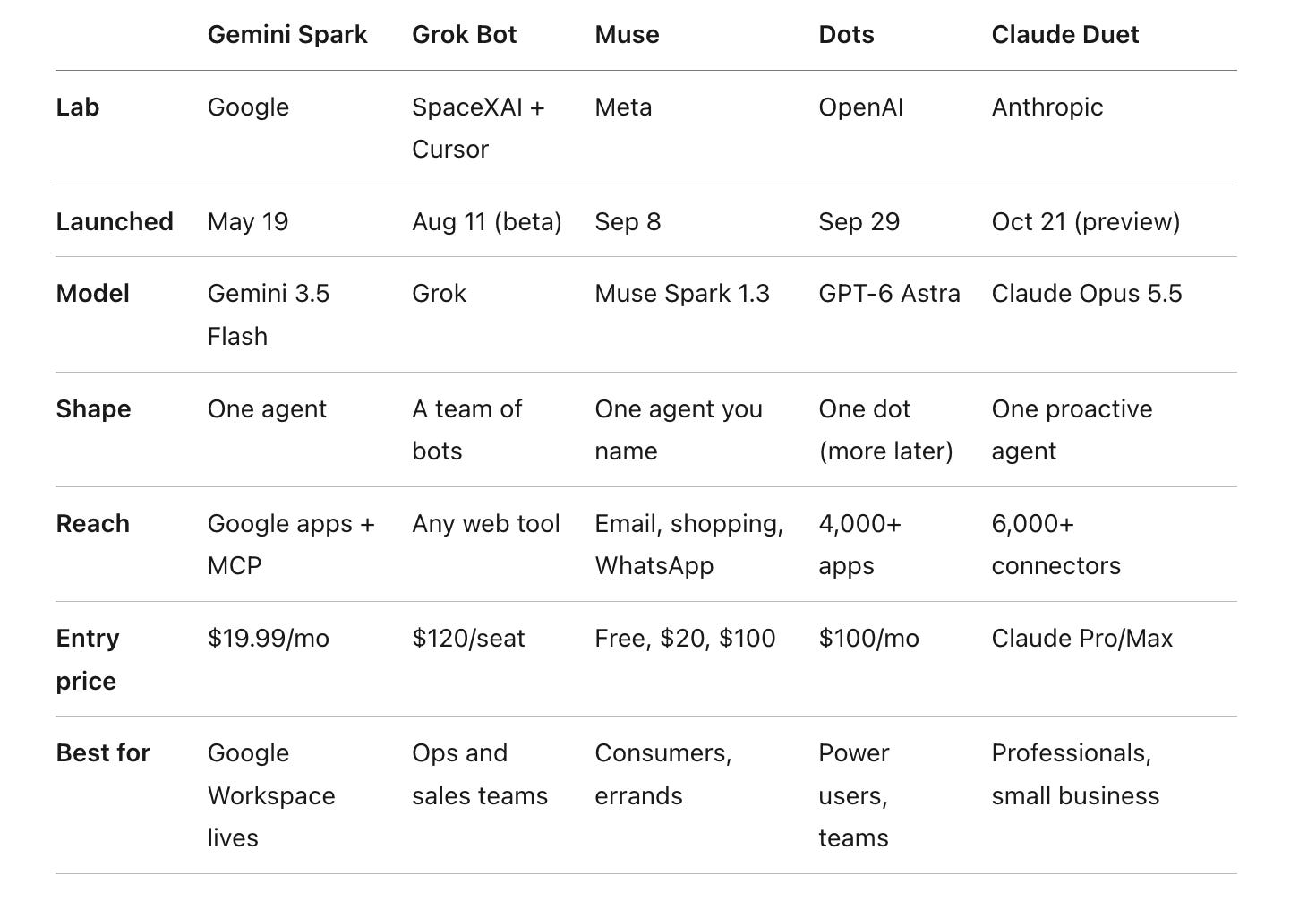
What all five share:
They run in the cloud, not on your phone. Each has its own computer, so it keeps going when yours is off.
They ask before money moves or messages go out. That is not politeness. An agent that reads the web can meet hidden instructions (prompt injection), and the only reliable defence is limiting what it can do on its own.
None of them is free at full power. Entry tickets run from about $20 to $300 a month.
4. Apple’s opening (analysis)
Apple is a year late, but it holds three cards no rival has:
Distribution. An agent Siri could reach every compatible iPhone with a software update, starting from the apps already on the phone through App Intents, the actions developers already expose to Siri.
The privacy brand. Every rival above runs in a cloud machine. If Apple can do more of the agent’s work on the device, that is a real difference. Apple has said nothing about this, so treat it as the question to watch.
Price. Siri AI costs nothing extra today, though Apple’s fine print already mentions a future fee.
The hard parts: apps must expose actions, iOS sandboxing makes background work harder, and the cloud costs are real. The date to watch is WWDC in June 2027.
5. What a leader should do this quarter
Pick one recurring workflow (inbox triage, invoice follow-up, meeting prep).
Run a 30-day pilot with one agent. Approvals on for anything that sends, pays, signs or deletes.
Give the agent its own accounts and least-privilege access, never your password.
Measure hours saved and errors caught, then decide on seats.
Write down who owns the agent’s mistakes before it makes one.
Today’s corners
🎓 Cert Corner: An AI agent reads web pages and email while it works. Which control best limits damage if a page contains a hidden prompt-injection instruction?
A) A larger context window
B) Least-privilege access plus human approval for consequential actions
C) A higher temperature setting
D) Connecting more plugins
🚩 Red Flag or Green Light? Your team’s new always-on agent can read the shared inbox and draft replies. Sending, paying and deleting need a human tap, it works in its own cloud computer, and it never sees your passwords. 🚩 or ✅?
🏛️ The Boardroom Call (cost): Your 40-person company wants an always-on agent. How do you buy?
A) Google AI Pro at $19.99 a seat for everyone
B) Five $100+ power-user seats for managers only
C) A 30-day pilot: one agent per team, measured on hours saved, then decide
D) Wait for Apple’s agent Siri in 2027
Pick one and defend it in the comments.
Answers and our take
🎓 Cert Corner: B. You can’t fully prevent prompt injection, so you limit what the agent can do with it: least privilege plus a human approval for anything consequential. It’s why all five agents above ask before they send, pay or delete. Practice more questions like this with DjamgaTech: https://djamgamind.com/apps/?app=djamgatech&ep=20261110&src=substack
🚩 Red Flag or Green Light: ✅ Green light. Read access, drafts only, approvals on consequential actions, an isolated computer and no stored credentials is the least-privilege setup all five vendors recommend. Keep it green by reviewing the approval log every week. Go deeper on agent security: https://djamgamind.com/ebooks/?book=aif-c01&ep=20261110&src=substack
🏛️ The Boardroom Call: our take is C. Prices span $19.99 to $300 a month, and the right agent depends on where your work already lives: Google Workspace, Slack and Teams, or your own tools. A 30-day pilot per team, measured on hours saved and errors caught, tells you which seats are worth buying. A is reasonable if your company already runs on Google Workspace. D bets on a product Apple has not announced. Your org does it differently? Tell us. How to judge AI business value: https://djamgamind.com/ebooks/?book=gcp-gail&ep=20261110&src=substack
📣 Advertise with AI Unraveled
Reach enterprise leaders who are making AI agent decisions this quarter. Sponsor one of our daily corners or a full segment, starting with a 4-week trial. 🏛️ The Boardroom Call is open for one sponsor: AI cost and model-routing companies, this one is yours. 👉 https://djamgamind.com/partners
🛠️ Tools from the show
🎓 DjamgaTech, certification practice (iPhone & iPad): https://djamgamind.com/apps/?app=djamgatech&ep=20261110&src=substack
🤖 AI & ML Tutor PRO: https://djamgamind.com/apps/?app=aitutor&ep=20261110&src=substack
🧩 iQz: 100 free puzzles (matrices, sequences, number series, verbal analogies and logic), plus 100 more with iQz PRO. Fully offline, no ads, no account: https://djamgamind.com/apps/?app=iqz&ep=20261110&src=substack
🌙 DjamgaMind Kids: https://djamgamind.com/apps/?app=kids&ep=20261110&src=substack
💼 Google Workspace for your team (business email, Docs, Drive, Gemini). Free 14-day trial: https://referworkspace.app.goo.gl/Q371 or https://sharegoogleworkspace.advocate.impact.com/mQZcXGY. 10% off your first year (Business Starter or Standard, Americas) with code 63F733CLLY7R7MM, 63F7D7CPD9XXUVT, 63FLKQHWV3AEEE6, 63JGLWWK36CP7WM. More codes: https://djamgamind.com/toolkit/#google-workspace
🔇 Commercial-free: DjamgaMind Executive on Apple Podcasts: https://podcasts.apple.com/podcast/id1885359791
Sources
MacRumors, Siri AI Rumored to Become “More Like an Agent” (Nov 8, 2026): https://www.macrumors.com/2026/11/08/siri-ai-rumored-to-become-more-agentic/
Mac Observer, Siri AI could act like an agent as early as 2027: https://www.macobserver.com/news/siri-ai-agent-2027-gurman/
MacTech, Google confirms Gemini will power Siri: https://www.mactech.com/2026/04/23/google-confirms-that-gemini-will-power-the-upcoming-more-personalized-version-of-siri/
DataCamp, Gemini Spark explained: https://www.datacamp.com/blog/gemini-spark
Android Police, Google’s renamed Gemini features: https://www.androidpolice.com/googles-renamed-gemini-features-field-guide/
xAI, Introducing Grok Bot: https://x.ai/news/introducing-grok-bot
Beam AI, Grok Bot for enterprise: https://beam.ai/agentic-insights/grok-bot-enterprise-ai-agents
Meta, Introducing Muse: https://about.fb.com/news/2026/09/introducing-muse-personal-ai-agent/
TechCrunch, Meta debuts Muse: https://techcrunch.com/2026/09/08/meta-debuts-its-muse-ai-agent-will-consumers-trust-it/
The Next Web, Meta jumps 11%: https://thenextweb.com/news/meta-jumps-11-as-investors-bet-on-its-muse-agent
BetaNews, OpenAI launches dots: https://betanews.com/article/openai-dots-agents-chatgpt/
Implicator, Dots and the $500 tier: https://www.implicator.ai/openai-500-chatgpt-tier-dots-paid-plans/
MacRumors, Anthropic Launches Claude Duet: https://www.macrumors.com/2026/10/21/anthropic-claude-duet/
CNBC, Claude Duet preview: https://www.cnbc.com/2026/10/21/anthropic-preview-of-claude-duet-personal-ai-agent-take-on-muse-dots.html
🔍 Keyword: always-on AI agents comparison 2026
Read original on Substack