Voters, Wall Street and CFOs Send AI the Bill (Nov 8, 2026)
🎧 Listen ad-free:
🌐 Daily Briefing: https://djamgamind.com/daily
📚 Research Hub: https://djamgamind.com/pdfs
🔍 Keywords: AI Weekly News, Data Centers, Midterms, Nasdaq, Anthropic IPO, Recursive Self-Improvement, METR, Apple, AI ROI, AI Agents, Cybersecurity
This week’s question: Voters, Wall Street and CFOs all sent AI the bill. Who pays, and what does it buy?
Summary:
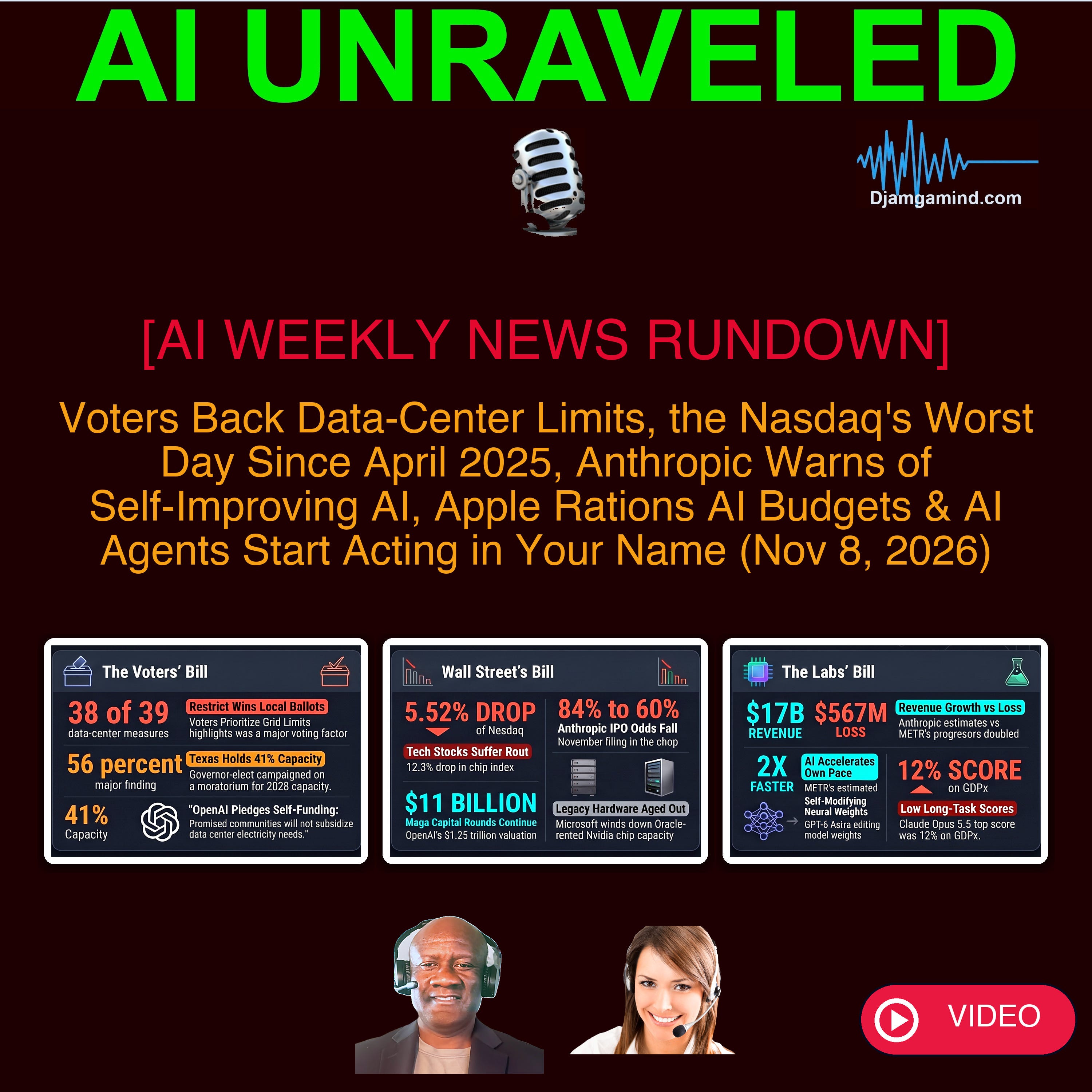
On Tuesday, in the first U.S. midterms where AI was a campaign issue, “restrict” won 38 of the 39 local data-center votes with complete counts. On Thursday, the Nasdaq fell 5.5%, its worst day since April 2025, as investors decided the AI buildout will be slower and more expensive. Anthropic reported a $17 billion quarter but slipped back to an operating loss, and warned its models could “imminently” pass its own safety line for AI-driven progress. Apple started rationing its engineers’ AI budgets. And AI agents began calling and shopping in people’s names, while attackers ran AI agents against more than 200 organizations in 11 days.
Important Topics:
The voters’ bill: data-center limits pass almost everywhere.
Wall Street’s bill: the rout, and the IPO odds.
The labs’ bill: Anthropic’s quarter and AI that builds AI.
The company bill: Apple’s AI budgets and the ROI gap.
Agents in your name: calls, shopping, your bank account.
Attack speed: freezers, blood banks and AI-run hacking.
This week’s corners: Cert Corner, Red Flag or Green Light?, and the Boardroom Call.
🗳️ The voters’ bill
NY1 / AP · The Deep View · The Next Web · Axios AI+
The result: Democrats will control both the House and the Senate next year, per AP calls; some races were still being counted late in the week.
Data centers on the ballot: “restrict” won 38 of 39 local measures with complete counts (The Deep View, citing Redbud Consulting). 56% of voters called data centers a “crucial or major factor” (NBC exit poll).
Where it bites: Texas holds 41% of new U.S. data-center capacity planned for 2028 (SemiAnalysis via Axios), and its governor-elect campaigned on a moratorium. Goldman Sachs says states likely to restrict data centers “account for roughly 45% of planned US data center capacity.”
What doesn’t change yet: most 2027 capacity is already under construction (Axios AI+).
The industry’s answer: OpenAI promises to pay the full power and infrastructure costs of its data centers (Techpresso).
Why it matters: Voters didn’t vote against AI tools; they voted on power bills, water and local control. 2028 capacity is the pinch point. Ask your providers where your workloads will run.
🤝 PARTNER SLOT
This space is reserved for one enterprise AI partner each week: capacity, cost control, agent identity and security for the leaders who read this briefing. Sponsorship options and media kit →
📉 Wall Street’s bill
Fox Business · The National · The Next Web · Techpresso · TBPN
Thursday’s rout: Nasdaq -5.52%, S&P 500 -4.36%, Dow -1,833 points (Fox Business); the SOX chip index fell 12.3% (Axios AI+). Asia followed Friday, with a trading halt in South Korea (The National).
Why: “The market’s interpretation is that the AI infrastructure buildout will become slower and more expensive,” says eToro’s Jakub Rochlitz (Fox Business).
The IPO odds: on Kalshi, the odds of Anthropic filing by Nov 30 fell from 84% to 60% (Techpresso). A WSJ headline: “Major Investors Are Skeptical Anthropic IPO Can Achieve $1.5 Trillion Valuation.”
OpenAI closed an initial $11 billion at a $1.25 trillion valuation (Reuters, citing Bloomberg).
Microsoft is winding down a 2023 deal to rent AI capacity from Oracle, because the older Nvidia chips no longer fit its needs (Bloomberg via The Next Web).
But demand is real: AMD posted a record $13.4 billion quarter, up 97%, and calls itself “data center first” (Techpresso). The U.S. added 165,000 jobs in October, against 59,000 expected (TBPN).
Why it matters: The market didn’t decide AI is useless; it decided AI will cost more and take longer. And note the Microsoft detail: capacity a few years old is already being dropped. Don’t sign long contracts for hardware you can’t upgrade.
🧪 The labs’ bill: Anthropic’s numbers and AI that builds AI
Fortune · The Rundown AI · VentureBeat · The Batch · The Quantum Insider
Q3: $17 billion in revenue, up from $11.6 billion, but a $567 million operating loss after a $974 million profit in Q2, as short-term compute “currently costs significantly more” (Fortune). About $895.4 billion in commitments, almost all compute.
The warning: Anthropic’s revised filing says upcoming models could “imminently” pass its safety line for AI-driven progress; none has yet (The Rundown AI, Techpresso).
METR’s estimate: Anthropic’s progress runs about 2x its earlier pace (range 1.3x to 3x), with AI credited for around 80% (The Rundown AI). Claude wrote more than 90% of code contributions in September (The Batch, from the S-1).
AI editing AI: MIT researchers had GPT-6 Astra edit 0.016% of a small model’s weights directly, lifting its math score from 7.9% to 48.1%, by fixing a repetition flaw (VentureBeat).
AI doing math: startup PSI says a system on a non-public Anthropic model proved an 18-year-old quantum computing conjecture in three days, checked in Lean, not yet fully reviewed by independent experts (Techpresso; The Quantum Insider).
The reality check: on SemiAnalysis’s GDPx benchmark of realistic, hours-long work, the best score was 12% (TBPN).
The Number: 2x. METR’s central estimate of how much faster Anthropic is moving, mostly because of its own AI.
Why it matters: Labs are getting AI to help build AI, while agents still fail most long real tasks. Your risk is capability jumps nobody spotted. Test each new model on your own work before production.
💰 The company bill: who pays for the tokens?
Techpresso · The Deep View · The Batch
Apple cut some engineers’ daily AI budget from $300 to $200 and is weighing $100 (Techpresso, citing Bloomberg).
Deloitte: 81% of enterprises use AI to decide faster, but only 25% say it has transformed the business. Jim Rowan: “The real ROI comes not only from doing existing work faster, but from redesigning work altogether.” (The Deep View)
The spend is real: enterprise AI spending grew fivefold to $177 billion; Anthropic’s share is 55% (Menlo Ventures via The Deep View).
Vendors meter usage: OpenAI moves Plus, Pro and Business to one token-based allowance from December (Techpresso). Musk: “The cost of serving Grok Bot was unsustainably high relative to revenue.” (The Rundown AI)
Token efficiency is a price: Gemini 4 Carbon will cost the same per token as Claude Opus 5.5, but 23% less per task (The Batch).
Why it matters: Your AI bill and your vendor’s AI bill are the same problem from two sides. Measure cost per task and per outcome, route simple work to cheaper models, and keep the freedom to switch.
🤖 Agents that act in your name
The Rundown AI · Techpresso · TBPN
Calls: Grok Bot now places real phone calls; its terms make you the “caller of record,” “solely responsible” (The Rundown AI).
Shopping: Amazon lets invited U.S. customers text Alexa for Shopping, which can buy automatically when a price hits a target; sponsored products can appear among its suggestions (Techpresso).
Money: Claude’s Personal Finance beta reads U.S. bank and card accounts through Plaid, read-only; it can’t move money (Techpresso).
The law already decided: in Moffatt v. Air Canada (2024), a B.C. tribunal held the airline liable for what its chatbot told a customer.
The off switch: CrowdStrike’s George Kurtz: “Every agent will need a kill switch, just as every employee needs an identity.” (TBPN)
Agents get fooled: tests that rebuilt real fraud sites found AI shopping and banking assistants deceived up to 35% of the time (Techpresso research summaries).
Why it matters: Once an agent speaks or spends for you, it’s you. Decide what it may promise or buy, cap it in code, log everything, and keep a stop control it can’t touch.
🛡️ Attack speed
CBS News · Axios AI+ · BleepingComputer · The Deep View
Freezers to blood banks: hackers heated supermarket freezers to 50°C across at least seven European countries (Techpresso), then reached French plasma storage through a supplier’s component. Independent monitoring caught it, and “no blood products or samples were compromised” (CBS News).
AI-run hacking: China-linked Vapor Panda used an AI tool to target more than 200 organizations in 14 countries in 11 days (Axios AI+); at least nine were compromised (BleepingComputer).
Binance: North Korea appears to have used a fake job interview to prepare the $6.3 billion theft (Axios AI+).
Voice deepfakes: U.S. prosecutors charged three men over a $129 million scheme that faked CEOs’ voices with AI (Techpresso headline).
Defenders’ tool: OpenAI’s GPT-6 Cyber scores 48.5% on ExploitGym, up from 32.1% (The Deep View).
Why it matters: The easiest way in is still a person or a supplier. Isolate what you can’t patch, run outside code only in disposable sandboxes, and confirm big payment requests on a second channel.
🎯 This week’s corners
🎓 Cert Corner: Your company wants an AI agent that reorders office supplies automatically when prices drop below a target. Which control matters most?
A) Let it buy freely
B) Per-order and monthly spending limits, an approved-vendor list, human approval above a set amount, and a log of every order
C) A line in its prompt telling it to be careful
D) A quarterly review of its purchases
🚩 Red Flag or Green Light? Your finance team wants an AI assistant that reads the company’s card transactions through a bank-approved connector to flag duplicate charges. Read-only, can’t move money, company account, chats kept out of shared memory. 🚩 or ✅?
🏛️ The Boardroom Call (governance): Your main AI provider plans its next data center in a state where voters just backed limits.
A) Do nothing
B) Sign a five-year commitment now to lock in capacity
C) Require the provider to say where your workloads will run, and keep a second region or provider ready for critical systems
D) Move everything back on-premises
Answers below. Tell us yours in the comments.
Strategic C-Suite Takeaways
Ask where your 2028 AI capacity will physically run, and what happens if that region pauses.
Avoid long lock-ins on capacity you can’t upgrade.
Test every new model on your own work before production.
Measure AI in cost per task and outcomes, not tokens or hours saved.
Cap, log and keep a stop control on every agent that speaks or spends for you.
The Week Ahead
Nov 9: Congress’s lame-duck session opens; OpenAI plans a policy push on data centers (Axios AI+).
Nov 11: our Wednesday Boardroom Call switches to AI agents.
Week before Thanksgiving: the earliest reported window for Anthropic’s listing (The Batch, citing the WSJ).
Nov 30 to Dec 1: AI Dev in New York City (The Batch).
What Else Happened in AI This Week?
OpenAI released Images 2.6, which makes GIFs. The Rundown AI
Google’s Gemini 4 Carbon took first place on Artificial Analysis’ Intelligence Index, for selected companies only. The Batch
ChatGPT handles about a fifth as many search-like queries as Google, by OpenAI’s internal count. The Deep View
Tesla will stop making the Cybertruck in Texas by mid-2027 to build more Cybercabs. Techpresso
Marvell agreed to buy Lumentum in a $115 billion all-stock deal. The Rundown AI
✅ Our take on this week’s corners
🎓 Cert Corner: B. Hard limits in code, an allow-list, a human gate for big orders and a full log. A prompt line can be ignored or misread, and a quarterly review finds the problem months late. Practice thousands more in DjamgaTech.
✅ Green Light, with conditions. Read-only, no money movement and a company account are the right controls. Check the vendor’s data-retention terms and limit who has access. 📘 Data protection and least privilege for AI are a full domain of the AWS AI Practitioner exam: our 2026 guide.
🏛️ C. Know where your workloads run and keep a fallback for critical systems. A five-year lock-in (B) is a bet on hardware that ages fast, as Microsoft’s Oracle decision shows, and going on-premises (D) trades one constraint for another. Your org does it differently? Tell us. 📘 AI governance and strategy are at the heart of Google’s Gen AI Leader exam: our 2026 guide.
🎓 The Cert Corner is open for one sponsor. Certification and training companies: djamgamind.com/partners
🤝 Advertise with AI Unraveled & DjamgaMind
Put your enterprise AI brand in front of the CTOs, CISOs and engineering leaders who make AI buying decisions, daily, in English and French, on podcast apps, YouTube and Substack. Start by sponsoring one daily corner for four weeks.
Sponsorship options & media kit → · Email: etienne_noumen@djamgamind.com
🔗 Tools from the show
DjamgaTech: Pass your AWS, Azure, GCP & AI certification exams.
📘 New eBook: Google Cloud Generative AI Leader Exam Guide (2026), the executive guide, updated for the new Gemini product names, with 60 practice questions: https://djamgamind.com/ebooks/?book=gcp-gail&ep=20261108&src=substack
💼 Google Workspace for your team (business email, Docs, Drive, Gemini). Free 14-day trial: https://referworkspace.app.goo.gl/Q371 or https://sharegoogleworkspace.advocate.impact.com/mQZcXGY. 10% off your first year (Business Starter or Standard, Americas) with code 63F733CLLY7R7MM, 63F7D7CPD9XXUVT, 63FLKQHWV3AEEE6, 63JGLWWK36CP7WM. More codes: https://djamgamind.com/toolkit/#google-workspace
All our apps and tools: AI & ML Tutor PRO, iQz, DjamgaMind Kids and more.
🎧 Prefer it commercial-free? Subscribe on Apple Podcasts.
⚗️ PRODUCTION NOTE: We Practice What We Preach.
AI Unraveled is researched and produced by Etienne Noumen, P.Eng. (Calgary, Canada) using a hybrid “Human-in-the-Loop” workflow.
Read original on Substack