Who Pays the AI Bill? Black Friday's Token Math (Nov 27, 2026)
🌐 Daily Briefing: https://djamgamind.com/daily
📚 Research Hub: https://djamgamind.com/pdfs
🔍 Keywords: AI Costs, Token Pricing, OpenAI Billing, GPT-6 Astra, Token Tax, Language Equity, Google Orchestrator, Antigravity, Gemini 4 Hydrogen, llama.cpp, Local AI, China AI Labs, Amazon AI Crawlers, ChatGPT Ads, Private Inference, Quantum Gravity, Builder’s Minute, KUKURI
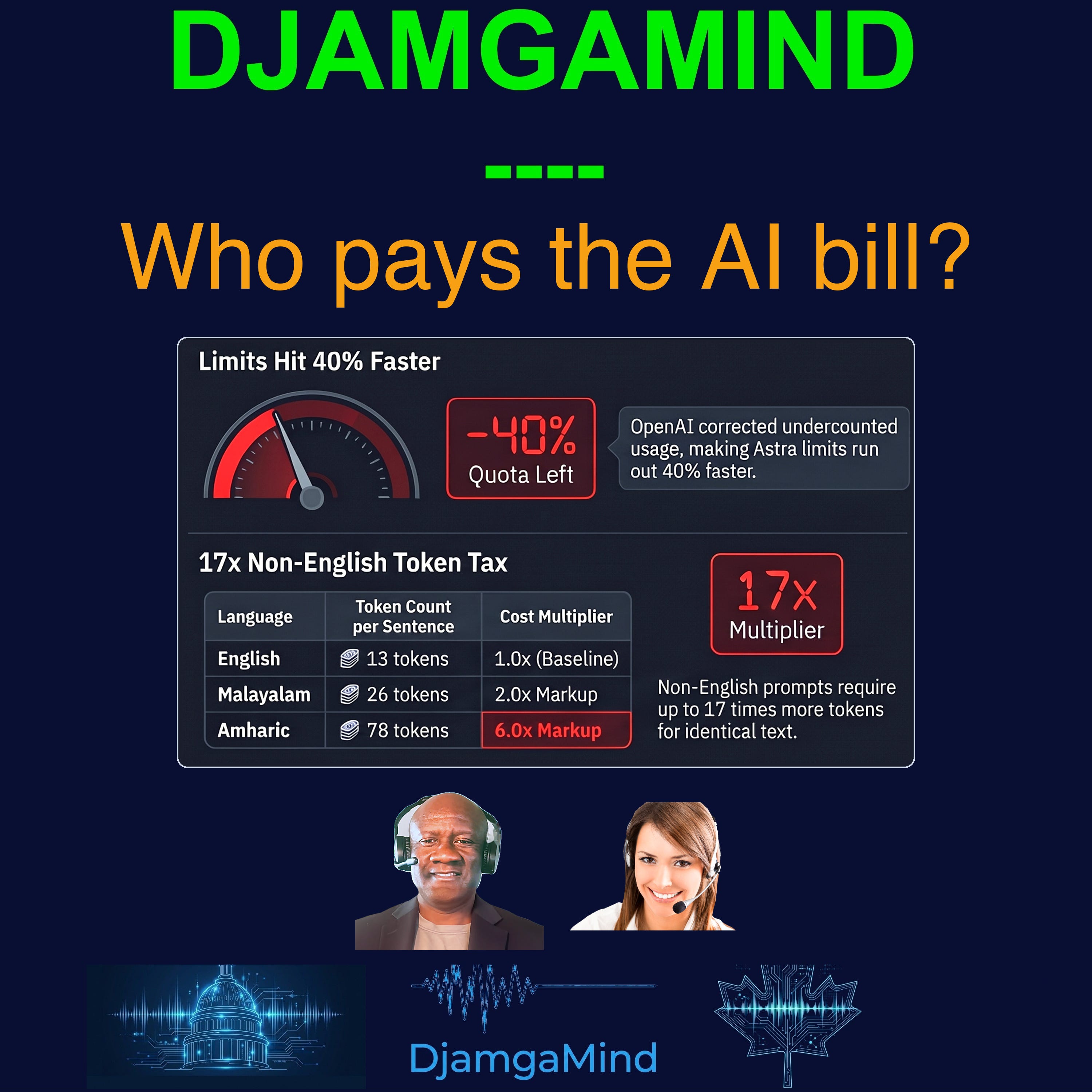
Today’s question: Who pays the AI bill?
Summary: It’s Black Friday, so let’s talk about the bill. The price per token barely moved this week, but what you pay did. OpenAI fixed a billing error, and users will now hit their limits 40% faster on its newest model. A study found the same sentence can cost 17 times more tokens in some languages than in English. Google showed a cheaper way to run coding agents: a big model plans, a small one does the work. Amazon shut out 99 AI crawlers while buying ads inside ChatGPT. And a physicist spent about 400 million tokens on a theory of gravity that other physicists aren’t buying yet.
Important Topics:
The token bill: a billing fix and a “token tax” on some languages.
The cheaper path: plan big, execute small, run local.
The access toll: who gets in, and who can read your prompts.
The proof bill: 400 million tokens, and the reviewers.
Our first Builder’s Minute: a founder in Japan, in his own voice.
💳 The token bill: when the meter changes
The Rundown AI · Techpresso · The Batch
The fix: OpenAI says it corrected a billing error that undercounted usage. Users will now hit limits 40% faster on its new Astra model and 25% faster on Sol (The Rundown AI). Techpresso’s headline: OpenAI “promises to make it 40% worse.”
The token tax: a study by the Coalition for Language Equity in AI Research (CLEAR) found the same content can cost up to 17 times more tokens in the worst-served languages. In GPT-5, one sentence took 13 tokens in English, 26 in Malayalam and 78 in Amharic. Many leading tokenizers got an F; Google’s Gemini and Gemma earned the best grade, a B (The Batch).
Newer isn’t always fairer: Alibaba’s Qwen 3.6 scored worse than the older Qwen 3 on the study’s ratio (The Batch).
Why it matters: The price per token can stay the same while the number of tokens changes underneath you. Budget per task done, not per token.
⚙️ The cheaper path: plan big, execute small, run local
Orchestrator: Google added Orchestrator to Antigravity, its coding agent. A larger Gemini model studies the code and writes a plan; the cheaper Gemini 4 Hydrogen carries it out and hands control back when a check fails twice.
The result: on Terminal-Bench, it came close to the bigger model alone while finishing 19% faster and using 24% less of its token quota, according to Google.
The catch: a cheaper model doesn’t always use fewer tokens. At its highest setting, Hydrogen produced 304 million output tokens on the Intelligence Index tests, against 205 million for the bigger Carbon.
Local AI grows up: llama.cpp, the software behind running language models on a laptop (and apps like Ollama and LM Studio), reached version 1.0. It lets people “keep their data on their own machines... and avoid paying a cloud provider for every token.”
Andrew Ng’s note: AI’s “far weaker performance on unverifiable tasks that require judgement means much work remains for people to do.”
Why it matters: The cheapest AI is a design choice. Route easy work to small or local models, keep the expensive one for planning and judgment, and measure the total.
🚧 The access toll: who gets in
China’s labs slow down: U.S. curbs on distillation and chip access are slowing China’s top AI labs, Reuters reported. Zhipu’s planned GLM-5.5 is partly held up by tighter anti-distillation safeguards at OpenAI and Anthropic; Moonshot’s Kimi K4 could slip to mid-2027 under a new rule on Chinese access to overseas compute (The Rundown AI).
Rankings shift: Kimi K3.1 Pro slid from fourth to ninth as Artificial Analysis moved to private tests (The Rundown AI).
Amazon’s door: Amazon’s website now names 99 crawlers and shuts them all out, three of them OpenAI’s, while Amazon buys Black Friday ads inside ChatGPT. “It wants ChatGPT’s shoppers and it does not want ChatGPT in the store” (AI Secret).
Private by design: OpenAI is testing Private Inference, which lets customers run prompts without the company being able to read them (The Rundown AI).
Disclosure: Anthropic makes Claude, which this show uses for research.
Why it matters: Access is now priced in rules: who can learn from whose outputs, whose crawlers get in, who can read your prompts. Each one is a cost line, even when no invoice arrives.
🧮 The proof bill: 400 million tokens for gravity
The claim: Stanford and OpenAI physicist Venkatesa Chandrasekaran released an 83-page preprint proposing a quantum description of gravity, developed with GPT-6 Astra over months and about 400 million tokens. It covers only empty space.
The praise: Sam Altman praised his “confidence and courage to keep pushing on something that others don’t think is possible.”
The pushback: UCL’s Jonathan Oppenheim said AI flagged more than a dozen issues; Columbia’s Peter Woit called it a publicity stunt. It “remains an unreviewed paper.”
The forecast: Google DeepMind co-founder Shane Legg puts the odds of “minimal AGI” before 2028 at over 50%: “we’re getting close now.”
Why it matters: The cost of an AI result isn’t the tokens. It’s the review: someone qualified has to spend time checking it.
🛠️ Our first Builder’s Minute
Submitted, unpaid, not an endorsement.
At the end of today’s episode, Takaya Tanoura, CEO of Spider Networks in Japan, tells you in his own voice about KUKURI - Agent Rules Hub: a library of ready-made AI rules that helps beginners build AGENTS.md and CLAUDE.md files, or paste the rules into ChatGPT and Gemini.
▶️ Audio and transcript: djamgamind.com/builders/kukuri · kukuriagent.com
Building in AI, cloud or security? Email etienne_noumen@djamgamind.com with a 60 to 90 second recording, a link and one line about what you built. It’s free, and every minute that airs gets its own page at djamgamind.com/builders.
🎯 Today’s corners
🎓 Cert Corner (from our AI-901 guide): An agent pipeline has a classification step where speed and cost matter most. Which model fits best?
A) The largest frontier model
B) A small, fast model
C) The same model with a higher temperature
D) The model with the longest context window
✅ Red Flag or Green Light? Every AI agent in your company has a monthly token cap, an alert at 80%, a cheaper model by default, and needs approval to switch to the premium model. 🚩 or ✅?
🏛️ The Boardroom Call (cost): Your AI vendor fixes a billing error: at the same price, your usage limits now run out 40% faster. What does the board ask for? A) Accept it; AI is worth it B) Re-measure cost per task, route routine work to cheaper or local models, and renegotiate C) Ban the tool D) Switch vendors this week. Pick one and defend it.
Answers at the end of this post.
Strategic C-Suite Takeaways
Budget per task done, not per token. Meters change: billing fixes, languages, reasoning settings.
Plan big, execute small. Use the expensive model to plan and judge; route the rest.
Check your language bill. If your customers write in poorly served languages, the same answer can cost many times more.
Access is a cost line. Crawler blocks, distillation rules and private inference change who can use what.
Price the review. An AI result isn’t cheap until someone qualified has checked it.
What Else Happened in AI on November 27, 2026?
42 state attorneys general are trying to block bankrupt Character AI from selling chats from more than 21 million accounts, including minors’. The Rundown AI
SpaceX received FCC approval for up to one million solar-powered satellites for its orbital AI data-center network, with deployment to begin by 2033. The Rundown AI
Anthropic launched Claude Duet, a personal agent app. The Rundown AI
Gemini added 60+ voices with local accents; Alibaba’s Qwen-Audio-3.1 speaks 65 languages. The Rundown AI
University of Sheffield researchers proposed StateBridge, letting agents pass internal states to each other instead of text. The Batch
✅ Our take on today’s corners
🎓 Cert Corner: B, a small, fast model. For a simple step like sorting requests, a small model does the job for a fraction of the price; save the big one for judgment. More in the AI-901 guide. Thousands more questions on DjamgaTech.
✅ Green Light. A cap, an alert before the cap, a cheaper default and an approval step for the premium model. That’s what a budget looks like when the meter can change without notice. Cost guardrails for agents are in the Kiro field guide.
🏛️ B. Don’t accept it blindly and don’t panic. Re-measure what each task really costs, move routine work to cheaper or local models, and bring those numbers to the renegotiation. For AI leaders: Generative AI Leader guide. Your org does it differently? Tell us.
✅ Red Flag or Green Light is open for one sponsor. AI security vendors: djamgamind.com/partners
🤝 Advertise with AI Unraveled & DjamgaMind
Put your enterprise AI brand in front of the CTOs, CISOs and engineering leaders who make AI buying decisions, daily, in English and French, on podcast apps, YouTube and Substack. Start by sponsoring one daily corner for four weeks. Sponsorship options & media kit → · Email: etienne_noumen@djamgamind.com
🔗 Tools from the show
DjamgaTech: Pass your AWS, Azure, GCP & AI certification exams.
📘 AI-901 Azure AI Fundamentals Exam Guide (2026): https://djamgamind.com/ebooks/?book=ai-901&ep=20261127&src=substack
📘 This week’s field guide: Spec-Driven Development with Kiro: The Enterprise Field Guide (2026). Part 2 airs Saturday: https://djamgamind.com/ebooks/?book=kiro-sdd&ep=20261127&src=substack
💼 Google Workspace for your team (business email, Docs, Drive, Gemini). Free 14-day trial: https://referworkspace.app.goo.gl/Q371 or https://sharegoogleworkspace.advocate.impact.com/mQZcXGY. 10% off your first year (Business Starter or Standard, Americas) with code 63F733CLLY7R7MM, 63F7D7CPD9XXUVT, 63FLKQHWV3AEEE6, 63JGLWWK36CP7WM. More codes: https://djamgamind.com/toolkit/#google-workspace
All our apps and tools: AI & ML Tutor PRO, iQz, DjamgaMind Kids and more.
🎧 Prefer it commercial-free? Subscribe on Apple Podcasts.
⚗️ PRODUCTION NOTE: We Practice What We Preach. AI Unraveled is researched and produced by Etienne Noumen, P.Eng. (Calgary, Canada) using a hybrid “Human-in-the-Loop” workflow.
Read original on Substack