AI Dashboard is available on the Web, Apple, Google, and Microsoft, PRO version
CyberSecurity 101 and Top 25 AWS Certified Security Specialty Questions and Answers Dumps
Almost 4.57 billion people were active internet users as of July 2020, encompassing 59 percent of the global population. 94% of enterprises use cloud. 77% of organizations worldwide have at least one application running on the cloud. This results in an exponential growth of cyber attacks. Therefore, CyberSecurity is one the biggest challenge to individuals and organizations worldwide: 158,727 cyber attacks per hour, 2,645 per minute and 44 every second of every day.
In this blog, we cover the Top 25 AWS Certified Security Specialty Questions and Answers Dumps and all latest and relevant information about CyberSecurity including:
- CyberSecurity Key Terms
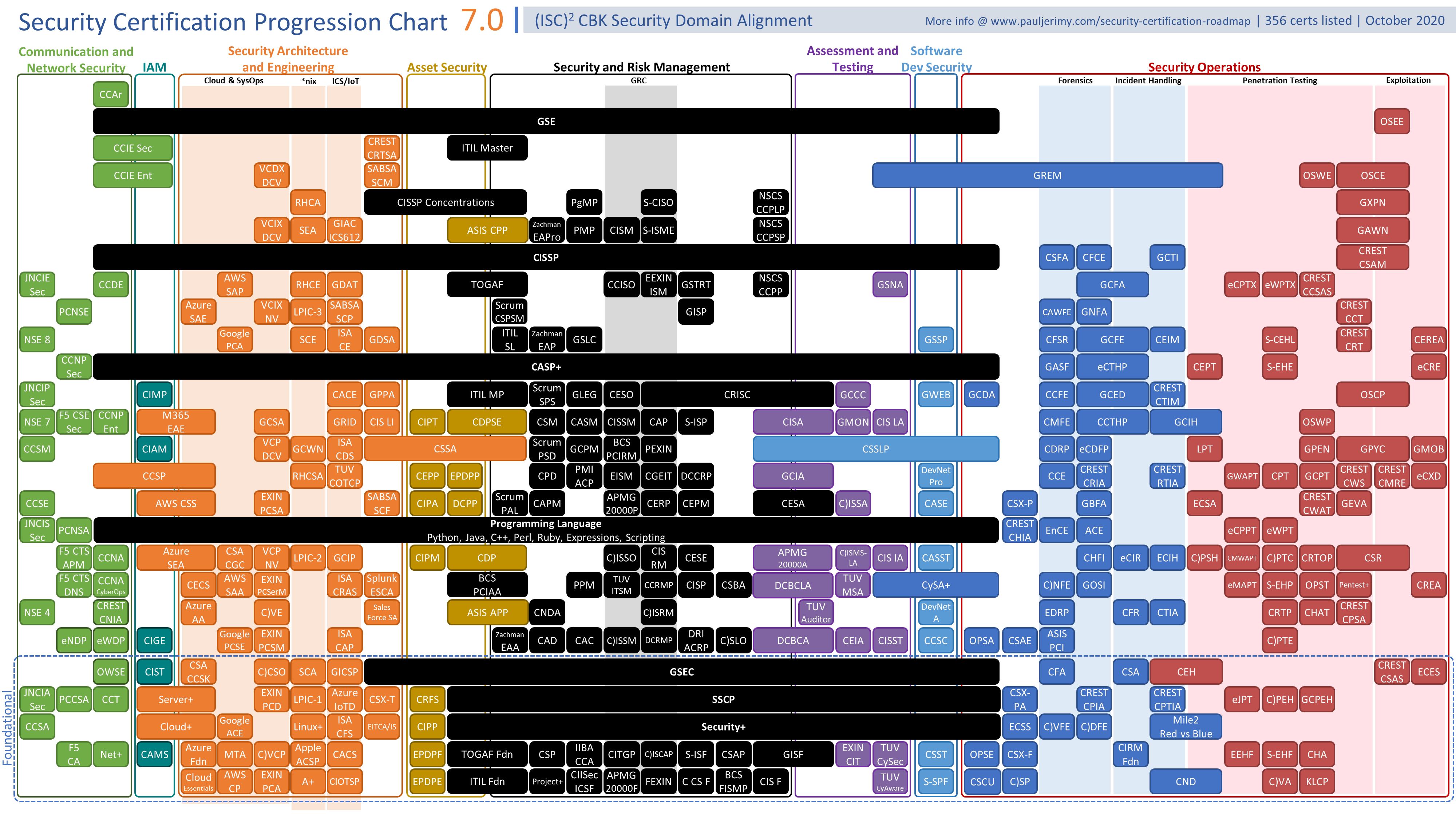
- CyberSecurity Certification Roadmap
- Hacking Tools Cheat Sheet
- Wireshark Cheat Sheet
- CyberSecurity Top Posts on Reddit
- Best CyberSecurity Books
- Best CyberSecurity Online Training
- Best CyberSecurity Courses
- Best CyberSecurity Podcasts
- Best Cybersecurity Youtube Channels
- CyberSecurity Jobs
- CyberSecurity Cheat Sheets
- How SSl Certificates Works
- Penetration Testing Terms
- CyberSecurity Post COVID-19
- CyberSecurity Questions and Answers
- What are the best ways to protect yourself on the internet?
- Who are the notable hackers
- History of RansomWare
I- The AWS Certified Security – Specialty (SCS-C01) examination is intended for individuals who perform a security role. This exam validates an examinee’s ability to effectively demonstrate knowledge about securing the AWS platform.
It validates an examinee’s ability to demonstrate:
An understanding of specialized data classifications and AWS data protection mechanisms.
Get 20% off Google Google Workspace (Google Meet) Standard Plan with the following codes: 96DRHDRA9J7GTN6

 Get 20% off Google Workspace (Google Meet) Business Plan (AMERICAS): M9HNXHX3WC9H7YE (Email us for more codes)
Active Anti-Aging Eye Gel, Reduces Dark Circles, Puffy Eyes, Crow's Feet and Fine Lines & Wrinkles, Packed with Hyaluronic Acid & Age Defying Botanicals

An understanding of data-encryption methods and AWS mechanisms to implement them.
An understanding of secure Internet protocols and AWS mechanisms to implement them.

A working knowledge of AWS security services and features of services to provide a secure production environment.

Competency gained from two or more years of production deployment experience using AWS security services and features.
The ability to make tradeoff decisions with regard to cost, security, and deployment complexity given a set of application requirements.

An understanding of security operations and risks.
Below are the Top 25 AWS Certified Security Specialty Questions and Answers Dumps including Notes, Hint and References:
Question 1: When requested through an STS API call, credentials are returned with what three components?
ANSWER1:
Notes/Hint1:

Reference1: Security Token, Access Key ID, Secret Access Key

Get mobile friendly version of the quiz @ the App Store
Question 2: A company has AWS workloads in multiple geographical locations. A Developer has created an Amazon Aurora database in the us-west-1 Region. The database is encrypted using a customer-managed AWS KMS key. Now the Developer wants to create the same encrypted database in the us-east-1 Region. Which approach should the Developer take to accomplish this task?
ANSWER2:

Notes/Hint2:
Reference2: copies an encrypted snapshot, KMS Keys are Region-specific
Get mobile friendly version of the quiz @ the App Store
Question 3: A corporate cloud security policy states that communication between the company’s VPC and KMS must travel entirely within the AWS network and not use public service endpoints. Which combination of the following actions MOST satisfies this requirement? (Select TWO.)
ANSWER3:
Notes/Hint3:
Reference3: AWS KMS

Get mobile friendly version of the quiz @ the App Store
Question 4: An application team is designing a solution with two applications. The security team wants the applications’ logs to be captured in two different places, because one of the applications produces logs with sensitive data. Which solution meets the requirement with the LEAST risk and effort?
ANSWER4:
Notes/Hint4:
Unlock the Secrets of Africa: Master African History, Geography, Culture, People, Cuisine, Economics, Languages, Music, Wildlife, Football, Politics, Animals, Tourism, Science and Environment with the Top 1000 Africa Quiz and Trivia. Get Yours Now!
"Become a Canada Expert: Ace the Citizenship Test and Impress Everyone with Your Knowledge of Canadian History, Geography, Government, Culture, People, Languages, Travel, Wildlife, Hockey, Tourism, Sceneries, Arts, and Data Visualization. Get the Top 1000 Canada Quiz Now!"
Reference4: Amazon CloudWatch Logs log group.
Get mobile friendly version of the quiz @ the App Store
Question 5: A security engineer must set up security group rules for a three-tier application:
- Presentation tier – Accessed by users over the web, protected by the security group presentation-sg
- Logic tier – RESTful API accessed from the presentation tier through HTTPS, protected by the security group logic-sg
- Data tier – SQL Server database accessed over port 1433 from the logic tier, protected by the security group data-sg
ANSWER5:
Notes/Hint5:
Reference5: n-tier architecture
Get mobile friendly version of the quiz @ the App Store
Question 6: A security engineer is working with a product team building a web application on AWS. The application uses Amazon S3 to host the static content, Amazon API Gateway to provide RESTful services, and Amazon DynamoDB as the backend data store. The users already exist in a directory that is exposed through a SAML identity provider. Which combination of the following actions should the engineer take to enable users to be authenticated into the web application and call APIs? (Select THREE).
ANSWER6:
Notes/Hint6:
Reference6: user pool attributes Amazon API Gateway
Get mobile friendly version of the quiz @ the App Store
Question 7: A company is hosting a web application on AWS and is using an Amazon S3 bucket to store images. Users should have the ability to read objects in the bucket. A security engineer has written the following bucket policy to grant public read access: 
ANSWER7:
Notes/Hint7:
Reference7: IAM Policy – Access to S3 bucket
Get mobile friendly version of the quiz @ the App Store
Question 8: A company decides to place database hosts in its own VPC, and to set up VPC peering to different VPCs containing the application and web tiers. The application servers are unable to connect to the database. Which network troubleshooting steps should be taken to resolve the issue? (Select TWO.)
ANSWER8:
Notes/Hint8:
Reference8: route tables , rules to the security group , security group in the other VPC
Get mobile friendly version of the quiz @ the App Store
Question 9: A company is building a data lake on Amazon S3. The data consists of millions of small files containing sensitive information. The security team has the following requirements for the architecture:
- Data must be encrypted in transit.
- Data must be encrypted at rest.
- The bucket must be private, but if the bucket is accidentally made public, the data must remain confidential.
ANSWER9:
Notes/Hint9:
Reference9: Bucket encryption using KMS, privileges granted data in transit
Get mobile friendly version of the quiz @ the App Store
Question 10: A security engineer must ensure that all API calls are collected across all company accounts, and that they are preserved online and are instantly available for analysis for 90 days. For compliance reasons, this data must be restorable for 7 years. Which steps must be taken to meet the retention needs in a scalable, cost-effective way?
ANSWER10:
Notes/Hint10:
Reference10: lifecycle policies
Get mobile friendly version of the quiz @ the App Store
Question 11: A security engineer has been informed that a user’s access key has been found on GitHub. The engineer must ensure that this access key cannot continue to be used, and must assess whether the access key was used to perform any unauthorized activities. Which steps must be taken to perform these tasks?
ANSWER11:
Notes/Hint11:
Reference11: malicious activities
Get mobile friendly version of the quiz @ the App Store
Question 12: You have a CloudFront
A) CloudFront
B) The ‘*’ path
ANSWER12:
Notes/Hint12:
Reference12: CloudFront
Get mobile friendly version of the quiz @ the App Store
Question 13: An application running
ANSWER13:
Notes/Hint13:
Reference13: S3
Get mobile friendly version of the quiz @ the App Store
Question 14: An organization is
ANSWER14:
Notes/Hint14:
Reference14: AWS
Get mobile friendly version of the quiz @ the App Store
Question 15: From a security
ANSWER15:
Notes/Hint15:
Reference15: IAM
Get mobile friendly version of the quiz @ the App Store
Question 16: A company is storing an
ANSWER16:
Notes/Hint16:
Reference16: IAM Roles for EC2
Get mobile friendly version of the quiz @ the App Store
Question 17: While signing in REST/
ANSWER17:
Notes/Hint17:
Reference17: Rest API
Get mobile friendly version of the quiz @ the App Store
Question 18: You are using AWS
ANSWER18:
Notes/Hint18:
Reference18: KMS
Get mobile friendly version of the quiz @ the App Store
Question 19: Your company has
ANSWER2:
Notes/Hint19:
Reference19: About Web Identity Federation
Get mobile friendly version of the quiz @ the App Store
Question 20: Your application
ANSWER20:
Notes/Hint20:
Reference20: Cognito Streams
ANSWER21:
Notes/Hint21:
Reference21: AWS Key
Question 22: Which of the following
ANSWER22:
Notes/Hint22:
Reference22: KMS
ANSWER23:
Notes/Hint23:
Reference23: Envelope encryption
Question 24: Which command can you
ANSWER24:
Notes/Hint24:
Reference24: AWS
Question 25: If an EC2 instance uses an instance role, key rotation is automatic and handled by __.
ANSWER25:
Notes/Hint25:
Reference25: IAM/STS
Question 26: A Security engineer must develop an AWS Identity and Access Management (IAM) strategy for a company’s organization in AWS Organizations. The company needs to give developers autonomy to develop and test their applications on AWS, but the company also needs to implement security guardrails to help protect itself. The company creates and distributes applications with different levels of data classification and types. The solution must maximize scalability.
Which combination of steps should the security engineer take to meet these requirements? (Choose three.)
A) Create an SCP to restrict access to highly privileged or unauthorized actions to specific AM principals. Assign the SCP to the appropriate AWS accounts.
B) Create an IAM permissions boundary to allow access to specific actions and IAM principals. Assign the IAM permissions boundary to all AM principals within the organization
C) Create a delegated IAM role that has capabilities to create other IAM roles. Use the delegated IAM role to provision IAM principals by following the principle of least privilege.
D) Create OUs based on data classification and type. Add the AWS accounts to the appropriate OU. Provide developers access to the AWS accounts based on business need.
E) Create IAM groups based on data classification and type. Add only the required developers’ IAM role to the IAM groups within each AWS account.
F) Create IAM policies based on data classification and type. Add the minimum required IAM policies to the developers’ IAM role within each AWS account.
Question 27: A Network Load Balancer (NLB) target instance is not entering the InService state. A security engineer determines that health checks are failing,
Which factors could cause the health check failures? (Choose three.)
A) The target instance’s security group does not allow traffic from the NLB.
B) The target instance’s security group is not attached to the NLB
C) The NLB’s security group is not attached to the target instance.
D) The target instance’s subnet network ACL does not allow traffic from the NLB.
E) The target instance’s security group is not using IP addresses to allow traffic from the NLB.
F) The target network ACL is not attached to the NLB.
Get mobile friendly version of the quiz @ the App Store
II- SOURCES:
0- Djamgatech Cloud Security Playlist on Youtube:
1- Developer Certified Exam Prep Pro App
2- Prepare for Your AWS Certification Exam


CYBERSECURITY KEY TERMS
- Cryptography: Practice and study of techniques for secure communication in the presence of third parties called adversaries.
- Hacking: catch-all term for any type of misuse of a computer to break the security of another computing system to steal data, corrupt systems or files, commandeer the environment or disrupt data-related activities in any way.
- Cyberwarfare: Uuse of technology to attack a nation, causing comparable harm to actual warfare. There is significant debate among experts regarding the definition of cyberwarfare, and even if such a thing exists
- Penetration testing: Colloquially known as a pen test, pentest or ethical hacking, is an authorized simulated cyberattack on a computer system, performed to evaluate the security of the system. Not to be confused with a vulnerability assessment.
- Malwares: Any software intentionally designed to cause damage to a computer, server, client, or computer network. A wide variety of malware types exist, including computer viruses, worms, Trojan horses, ransomware, spyware, adware, rogue software, and scareware.
- Malware Analysis Tool: Any .Run Malware hunting with live access to the heart of an incident https://any.run/Malware Analysis Total: VirusTotal – Analyze suspicious files and URLs to detect types of malware, automatically share them with the security community https://www.virustotal.com/gui/
- VPN: A virtual private network (VPN) extends a private network across a public network and enables users to send and receive data across shared or public networks as if their computing devices were directly connected to the private network. Applications running across a VPN may therefore benefit from the functionality, security, and management of the private network. Encryption is a common, although not an inherent, part of a VPN connection.
- Antivirus: Antivirus software, or anti-virus software (abbreviated to AV software), also known as anti-malware, is a computer program used to prevent, detect, and remove malware.
- DDos: A distributed denial-of-service (DDoS) attack is one of the most powerful weapons on the internet. When you hear about a website being “brought down by hackers,” it generally means it has become a victim of a DDoS attack.
- Fraud Detection: Set of activities undertaken to prevent money or property from being obtained through false pretenses. Fraud detection is applied to many industries such as banking or insurance. In banking, fraud may include forging checks or using stolen credit cards.
- Spywares: Spyware describes software with malicious behavior that aims to gather information about a person or organization and send such information to another entity in a way that harms the user; for example by violating their privacy or endangering their device’s security.
- Spoofing: Disguising a communication from an unknown source as being from a known, trusted source
- Pharming: Malicious websites that look legitimate and are used to gather usernames and passwords.
- Catfishing: Creating a fake profile for fraudulent or deceptive purposes
- SSL: Stands for secure sockets layer. Protocol for web browsers and servers that allows for the authentication, encryption and decryption of data sent over the Internet.
- Phishing emails: Disguised as trustworthy entity to lure someone into providing sensitive information
- Intrusion detection System: Device or software application that monitors a network or systems for malicious activity or policy violations. Any intrusion activity or violation is typically reported either to an administrator or collected centrally using a security information and event management system.
- Encryption: Encryption is the method by which information is converted into secret code that hides the information’s true meaning. The science of encrypting and decrypting information is called cryptography. In computing, unencrypted data is also known as plaintext, and encrypted data is called ciphertext.
- MFA: Multi-factor authentication (MFA) is defined as a security mechanism that requires an individual to provide two or more credentials in order to authenticate their identity. In IT, these credentials take the form of passwords, hardware tokens, numerical codes, biometrics, time, and location.
- Vulnerabilities: A vulnerability is a hole or a weakness in the application, which can be a design flaw or an implementation bug, that allows an attacker to cause harm to the stakeholders of an application. Stakeholders include the application owner, application users, and other entities that rely on the application.
- SQL injections: SQL injection is a code injection technique, used to attack data-driven applications, in which malicious SQL statements are inserted into an entry field for execution.
- Cyber attacks: In computers and computer networks an attack is any attempt to expose, alter, disable, destroy, steal or gain unauthorized access to or make unauthorized use of an asset.
- Confidentiality: Confidentiality involves a set of rules or a promise usually executed through confidentiality agreements that limits access or places restrictions on certain types of information.
- Secure channel: In cryptography, a secure channel is a way of transferring data that is resistant to overhearing and tampering. A confidential channel is a way of transferring data that is resistant to overhearing, but not necessarily resistant to tampering.
- Tunneling: Communications protocol that allows for the movement of data from one network to another. It involves allowing private network communications to be sent across a public network through a process called encapsulation.
- SSH: Secure Shell is a cryptographic network protocol for operating network services securely over an unsecured network. Typical applications include remote command-line, login, and remote command execution, but any network service can be secured with SSH.
- SSL Certificates: SSL certificates are what enable websites to move from HTTP to HTTPS, which is more secure. An SSL certificate is a data file hosted in a website’s origin server. SSL certificates make SSL/TLS encryption possible, and they contain the website’s public key and the website’s identity, along with related information.
- Phishing: Phishing is a cybercrime in which a target or targets are contacted by email, telephone or text message by someone posing as a legitimate institution to lure individuals into providing sensitive data such as personally identifiable information, banking and credit card details, and passwords.
- Cybercrime: Cybercrime, or computer-oriented crime, is a crime that involves a computer and a network. The computer may have been used in the commission of a crime, or it may be the target. Cybercrime may threaten a person, company or a nation’s security and financial health.
- Backdoor: A backdoor is a means to access a computer system or encrypted data that bypasses the system’s customary security mechanisms. A developer may create a backdoor so that an application or operating system can be accessed for troubleshooting or other purposes.
- Salt and Hash: A cryptographic salt is made up of random bits added to each password instance before its hashing. Salts create unique passwords even in the instance of two users choosing the same passwords. Salts help us mitigate rainbow table attacks by forcing attackers to re-compute them using the salts.
- Password: A password, sometimes called a passcode,[1] is a memorized secret, typically a string of characters, usually used to confirm the identity of a user.[2] Using the terminology of the NIST Digital Identity Guidelines,[3] the secret is memorized by a party called the claimant while the party verifying the identity of the claimant is called the verifier. When the claimant successfully demonstrates knowledge of the password to the verifier through an established authentication protocol,[4] the verifier is able to infer the claimant’s identity.
- Fingerprint: A fingerprint is an impression left by the friction ridges of a human finger. The recovery of partial fingerprints from a crime scene is an important method of forensic science. Moisture and grease on a finger result in fingerprints on surfaces such as glass or metal.
- Facial recognition: Facial recognition works better for a person as compared to fingerprint detection. It releases the person from the hassle of moving their thumb or index finger to a particular place on their mobile phone. A user would just have to bring their phone in level with their eye.
- Asymmetric key ciphers versus symmetric key ciphers (Difference between symmetric and Asymmetric encryption): The basic difference between these two types of encryption is that symmetric encryption uses one key for both encryption and decryption, and the asymmetric encryption uses public key for encryption and a private key for decryption.
- Decryption: The conversion of encrypted data into its original form is called Decryption. It is generally a reverse process of encryption. It decodes the encrypted information so that an authorized user can only decrypt the data because decryption requires a secret key or password.
- Algorithms: Finite sequence of well-defined, computer-implementable instructions, typically to solve a class of problems or to perform a computation.
- Authentication: is the act of proving an assertion, such as the identity of a computer system user. In contrast with identification, the act of indicating a person or thing’s identity, authentication is the process of verifying that identity. It might involve validating personal identity documents, verifying the authenticity of a website with a digital certificate,[1] determining the age of an artifact by carbon dating, or ensuring that a product or document is not counterfeit.
- DFIR: Digital forensic and incident response: Multidisciplinary profession that focuses on identifying, investigating, and remediating computer network exploitation. This can take varied forms and involves a wide variety of skills, kinds of attackers, an kinds of targets. We’ll discuss those more below.
- OTP: One Time Password: A one-time password, also known as one-time PIN or dynamic password, is a password that is valid for only one login session or transaction, on a computer system or other digital device
- Proxy Server and Reverse Proxy Server:A proxy server is a go‑between or intermediary server that forwards requests for content from multiple clients to different servers across the Internet. A reverse proxy server is a type of proxy server that typically sits behind the firewall in a private network and directs client requests to the appropriate backend server.
LATEST CYBER SECURITY NEWS
Cybersecurity Certification

WireShark Cheat Sheet
HACKING TOOLS CHEAT SHEET
Top CyberSecurity All Time Posts
Show All Around Defender Primers
- Linux CLI 101 https://wiki.sans.blue/Tools/pdfs/LinuxCLI101.pdf
- Linux CLI https://wiki.sans.blue/Tools/pdfs/LinuxCLI.pdf
- PowerShell Primer https://wiki.sans.blue/Tools/pdfs/PowerShell.pdf
- PowerShell Get-WinEvent https://wiki.sans.blue/Tools/pdfs/Get-WinEvent.pdf
Show Offensive * Exploit Database
Offensive * Exploit Database – The Exploit Database is maintained by Offensive Security, an information security training company that provides various Information Security Certifications as well as high end penetration testing services. https://www.exploit-db.com/
CYBERSECURITY NEWS
- Krebs On Security In depth security news and investigation https://krebsonsecurity.com/
- Dark Reading Cyber security’s comprehensive news site is now an online community for security professionals. https://www.darkreading.com/
- The Hacker News – The Hacker News (THN) is a leading, trusted, widely-acknowledged dedicated cybersecurity news platform, attracting over 8 million monthly readers including IT professionals, researchers, hackers, technologists, and enthusiasts. https://thehackernews.com
- SecuriTeam – A free and independent source of vulnerability information. https://securiteam.com/
- SANS NewsBites – “A semiweekly high-level executive summary of the most important news articles that have been published on computer security during the last week. Each news item is very briefly summarized and includes a reference on the web for detailed information, if possible.” Published for free on Tuesdays and Fridays. https://www.sans.org/newsletters/newsbites
CYBERSECURITY YOUTUBE CHANNELS
This list was originally forked/curated from here: https://wportal.xyz/collection/cybersec-yt1 on (7/29/2020) Attribution and appreciation to d4rckh
- Djamga Technology
- SimplyCyber Weekly vids, Simply Cyber brings Information security related content to help IT or Information Security professionals take their career further, faster. Current cyber security industry topics and techniques are explored to promote a career in the field. Topics cover offense, defense, governance, risk, compliance, privacy, education, certification, conferences; all with the intent of professional development. https://www.youtube.com/c/GeraldAuger
- IPPSec https://www.youtube.com/channel/UCa6eh7gCkpPo5XXUDfygQQA
- Tradecraft Security Weekly – Want to learn about all of the latest security tools and techniques? https://wiki.securityweekly.com/Tradecraft_Security_Weekly
- Derek Rook – CTF/Boot2root/wargames Walkthrough – lots of lengthy screenshot instructional vids https://www.youtube.com/channel/UCMACXuWd2w6_IEGog744UaA
- Adrian Crenshaw – lots of lengthy con-style talks https://www.youtube.com/user/irongeek
- LionSec – lots of brief screenshot instructional vids, no dialog https://www.youtube.com/channel/UCCQLBOt_hbGE-b9I696VRow
- Zer0Mem0ry – lots of brief c++ security videos, programming intensive https://www.youtube.com/channel/UCDk155eaoariJF2Dn2j5WKA
- webpwnized – lots of brief screenshot vids, some CTF walkthroughs https://www.youtube.com/channel/UCPeJcqbi8v46Adk59plaaXg
- Waleed Jutt – lots of brief screenshot vids covering web security and game programming https://www.youtube.com/channel/UCeN7cOELsyMHrzfMsJUgv3Q
- Troy Hunt – lone youtuber, medium length news videos, 16K followers, regular content https://www.youtube.com/channel/UCD6MWz4A61JaeGrvyoYl-rQ
- Tradecraft Security Weekly – Want to learn about all of the latest security tools and techniques?https://wiki.securityweekly.com/Tradecraft_Security_Weekly
- SSTec Tutorials – lots of brief screenshot vids, regular updates https://www.youtube.com/channel/UCHvUTfxL_9bNQgqzekPWHtg
- Shozab Haxor – lots of screenshot style instructional vids, regular updates, windows CLI tutorial https://www.youtube.com/channel/UCBwub2kRoercWQJ2mw82h3A
- Seytonic – variety of DIY hacking tutorials, hardware hacks, regular updates https://www.youtube.com/channel/UCW6xlqxSY3gGur4PkGPEUeA
- Security Weekly – regular updates, lengthy podcast-style interviews with industry pros https://www.youtube.com/channel/UCg–XBjJ50a9tUhTKXVPiqg
- SecureNinjaTV – brief news bites, irregular posting, 18K followers https://www.youtube.com/channel/UCNxfV4yR0nIlhFmfwcdf3BQ
- Samy Kamkar’s Applied hacking https://www.youtube.com/user/s4myk
- rwbnetsec – lots of medium length instructional videos covering tools from Kali 2.0, no recent posts. https://www.youtube.com/channel/UCAJ8Clc3188ek9T_5XTVzZQ
- Penetration Testing in Linux https://www.youtube.com/channel/UC286ntgASMskhPIJQebJVvA
- Pentester Academy TV – lots of brief videos, very regular posting, up to +8 a week https://www.youtube.com/channel/UChjC1q6Ami7W0E71TzPZELA
- Open SecurityTraining – lots of lengthy lecture-style vids, no recent posts, but quality info. https://www.youtube.com/channel/UCthV50MozQIfawL9a_g5rdg
- NetSecNow – channel of pentesteruniversity.org, seems to post once a month, screenshot instructional vids https://www.youtube.com/channel/UC6J_GnSAi7F2hY4RmnMcWJw
- Metasploitation – lots of screenshot vids, little to no dialogue, all about using Metasploit, no recent vids. https://www.youtube.com/channel/UC9Qa_gXarSmObPX3ooIQZrg
- LiveOverflow – Lots of brief-to-medium instructional vids, covering things like buffer overflows and exploit writing, regular posts. https://www.youtube.com/channel/UClcE-kVhqyiHCcjYwcpfj9w
- LionSec – lots of brief screenshot instructional vids, no dialog https://www.youtube.com/channel/UCCQLBOt_hbGE-b9I696VRow
- Latest Hacking News 10K followers, medium length screenshot videos, no recent releases https://www.youtube.com/user/thefieldhouse/feed
- John Hammond – Solves CTF problems. contains penTesting tips and tricks https://www.youtube.com/user/RootOfTheNull
- JackkTutorials – lots of medium length instructional vids with some AskMe vids from the youtuber https://www.youtube.com/channel/UC64x_rKHxY113KMWmprLBPA
- iExplo1t – lots of screenshot vids aimed at novices, 5.7K Followers, no recent posts https://www.youtube.com/channel/UCx0HClQ_cv0sLNOVhoO2nxg/videos
- HACKING TUTORIALS – handful of brief screenshot vids, no recent posts. https://www.youtube.com/channel/UCbsn2kQwNxcIzHwbdDjzehA
- HackerSploit – regular posts, medium length screenshot vids, with dialog https://www.youtube.com/channel/UC0ZTPkdxlAKf-V33tqXwi3Q
- GynvaelEN – Security streams from Google Researcher. Mainly about CTFs, computer security, programing and similar things. https://www.youtube.com/channel/UCCkVMojdBWS-JtH7TliWkVg
- Geeks Fort – KIF – lots of brief screenshot vids, no recent posts https://www.youtube.com/channel/UC09NdTL2hkThGLSab8chJMw
- Error 404 Cyber News – short screen-shot videos with loud metal, no dialog, bi-weekly https://www.youtube.com/channel/UC4HcNHFKshqj-aeyi6imW7Q
- Don Does 30 – amateur pen-tester posting lots of brief screenshot vids regularly, 9K Followers https://www.youtube.com/channel/UCarxjDjSYsIf50Jm73V1D7g
- Derek Rook – CTF/Boot2root/wargames Walkthrough – lots of lengthy screenshot instructional vids, https://www.youtube.com/channel/UCMACXuWd2w6_IEGog744UaA
- DemmSec – lots of pen testing vids, somewhat irregular uploads, 44K followers https://www.youtube.com/channel/UCJItQmwUrcW4VdUqWaRUNIg
- DEFCON Conference – lots of lengthy con-style vids from the iconical DEFCON https://www.youtube.com/channel/UC6Om9kAkl32dWlDSNlDS9Iw
- DedSec – lots of brief screenshot how-to vids based in Kali, no recent posts. https://www.youtube.com/channel/UCx34ZZW2KgezfUPPeL6m8Dw
- danooct1 – lots of brief screenshot, how-to vids regarding malware, regular content updates, 186K followers https://www.youtube.com/channel/UCqbkm47qBxDj-P3lI9voIAw
- BalCCon – Balkan Computer Congress – Long con-style talks from the Balkan Computer Congress, doesn’t update regularlyhttps://www.youtube.com/channel/UCoHypmu8rxlB5Axh5JxFZsA
- Corey Nachreiner – security newsbites, 2.7K subscribers, 2-3 videos a week, no set schedule https://www.youtube.com/channel/UC7dUL0FbVPGqzdb2HtWw3Xg
- Adrian Crenshaw – lots of lengthy con-style talks https://www.youtube.com/user/irongeek
- 0x41414141 – Channel with couple challenges, well explained https://www.youtube.com/channel/UCPqes566OZ3G_fjxL6BngRQ
- HackADay – Hackaday serves up Fresh Hacks Every Day from around the Internet. https://hackaday.com/
- TheCyberMentor – Heath Adams uploads regular videos related to various facets of cyber security, from bug bounty hunts to specific pentest methodologies like API, buffer overflows, networking. https://www.youtube.com/c/TheCyberMentor/
- Grant Collins – Grant uploads videos regarding breaking into cybersecurity, various cybersecurity projects, building up a home lab amongst many others. Also has a companion discord channel and a resource website. https://www.youtube.com/channel/UCTLUi3oc1-a7dS-2-YgEKmA/featured
CYBERSECURITY PODCASTS:
- Risky Business Published weekly, the Risky Business podcast features news and in-depth commentary from security industry luminaries. Hosted by award-winning journalist Patrick Gray, Risky Business has become a must-listen digest for information security professionals. https://risky.biz/
- Pauls Security Weekly This show features interviews with folks in the security community; technical segments, which are just that, very technical; and security news, which is an open discussion forum for the hosts to express their opinions about the latest security headlines, breaches, new exploits and vulnerabilities, “not” politics, “cyber” policies and more. https://securityweekly.com/category-shows/paul-security-weekly/
- Security Now – Steve Gibson, the man who coined the term spyware and created the first anti-spyware program, creator of Spinrite and ShieldsUP, discusses the hot topics in security today with Leo Laporte. https://twit.tv/shows/security-now
- Daily Information Security Podcast (“StormCast”) Stormcasts are daily 5-10 minute information security threat updates. The podcast is produced each work day, and typically released late in the day to be ready for your morning commute. https://isc.sans.edu/podcast.html
- ShadowTalk Threat Intelligence Podcast by Digital Shadow_. The weekly podcast highlights key findings of primary-source research our Intelligence Team is conducting, along with guest speakers discussing the latest threat actors, campaigns, security events and industry news. https://resources.digitalshadows.com/threat-intelligence-podcast-shadowtalk
- Don’t Panic – The Unit 42 Podcast Don’t Panic! is the official podcast from Unit 42 at Palo Alto Networks. We find the big issues that are frustrating cyber security practitioners and help simplify them so they don’t need to panic. https://unit42.libsyn.com/
- Recorded Future Recorded Future takes you inside the world of cyber threat intelligence. We’re sharing stories from the trenches and the operations floor as well as giving you the skinny on established and emerging adversaries. We also talk current events, technical tradecraft, and offer up insights on the big picture issues in our industry. https://www.recordedfuture.com/resources/podcast/
- The Cybrary Podcast Listen in to the Cybrary Podcast where we discuss a range topics from DevSecOps and Ransomware attacks to diversity and how to retain of talent. Entrepreneurs at all stages of their startup companies join us to share their stories and experience, including how to get funding, hiring the best talent, driving sales, and choosing where to base your business. https://www.cybrary.it/info/cybrary-podcast/
- Cyber Life The Cyber Life podcast is for cyber security (InfoSec) professionals, people trying to break into the industry, or business owners looking to learn how to secure their data. We will talk about many things, like how to get jobs, cover breakdowns of hot topics, and have special guest interviews with the men and women “in the trenches” of the industry. https://redcircle.com/shows/cyber-life
- Career Notes Cybersecurity professionals share their personal career journeys and offer tips and advice in this brief, weekly podcast from The CyberWire. https://www.thecyberwire.com/podcasts/career-notes
Below podcasts Added from here: https://infosec-conferences.com/cybersecurity-podcasts/
- Down the Security Rabbithole http://podcast.wh1t3rabbit.net/ Down the Security Rabbithole is hosted by Rafal Los and James Jardine who discuss, by means of interviewing or news analysis, everything about Cybersecurity which includes Cybercrime, Cyber Law, Cyber Risk, Enterprise Risk & Security and many more. If you want to hear issues that are relevant to your organization, subscribe and tune-in to this podcast.
- The Privacy, Security, & OSINT Show https://podcasts.apple.com/us/podcast/the-privacy-security-osint-show/id1165843330 The Privacy, Security, & OSINT Show, hosted by Michael Bazzell, is your weekly dose of digital security, privacy, and Open Source Intelligence (OSINT) opinion and news. This podcast will help listeners learn some ideas on how to stay secure from cyber-attacks and help them become “digitally invisible”.
- Defensive Security Podcast https://defensivesecurity.org/ Hosted by Andrew Kalat (@lerg) and Jerry Bell (@maliciouslink), the Defensive Security Podcasts aims to look/discuss the latest security news happening around the world and pick out the lessons that can be applied to keeping organizations secured. As of today, they have more than 200 episodes and some of the topics discussed include Forensics, Penetration Testing, Incident Response, Malware Analysis, Vulnerabilities and many more.
- Darknet Diaries https://darknetdiaries.com/episode/ Darknet Diaries Podcast is hosted and produced by Jack Rhysider that discuss topics related to information security. It also features some true stories from hackers who attacked or have been attacked. If you’re a fan of the show, you might consider buying some of their souvenirs here (https://shop.darknetdiaries.com/).
- Brakeing Down Security https://www.brakeingsecurity.com/ Brakeing Down Security started in 2014 and is hosted by Bryan Brake, Brian Boettcher, and Amanda Berlin. This podcast discusses everything about the Cybersecurity world, Compliance, Privacy, and Regulatory issues that arise in today’s organizations. The hosts will teach concepts that Information Security Professionals need to know and discuss topics that will refresh the memories of seasoned veterans.
- Open Source Security Podcast https://www.opensourcesecuritypodcast.com/ Open Source Security Podcast is a podcast that discusses security with an open-source slant. The show started in 2016 and is hosted by Josh Bressers and Kurt Siefried. As of this writing, they now posted around 190+ podcasts
- Cyber Motherboard https://podcasts.apple.com/us/podcast/cyber/id1441708044 Ben Makuch is the host of the podcast CYBER and weekly talks to Motherboard reporters Lorenzo Franceschi-Bicchierai and Joseph Cox. They tackle topics about famous hackers and researchers about the biggest news in cybersecurity. The Cyber- stuff gets complicated really fast, but Motherboard spends its time fixed in the infosec world so we don’t have to.
- Hak5 https://shop.hak5.org/pages/videos Hak5 is a brand that is created by a group of security professionals, hardcore gamers and “IT ninjas”. Their podcast, which is mostly uploaded on YouTube discusses everything from open-source software to penetration testing and network infrastructure. Their channel currently has 590,000 subscribers and is one of the most viewed shows when you want to learn something about security networks.
- Threatpost Podcast Series https://threatpost.com/category/podcasts/ Threatpost is an independent news site which is a leading source of information about IT and business security for hundreds of thousands of professionals worldwide. With an award-winning editorial team produces unique and high-impact content including security news, videos, feature reports and more, with their global editorial activities are driven by industry-leading journalist Tom Spring, editor-in-chief.
- CISO-Security Vendor Relationship Podcast https://cisoseries.com Co-hosted by the creator of the CISO/Security Vendor Relationship Series, David Spark, and Mike Johnson, in 30 minutes, this weekly program challenges the co-hosts, guests, and listeners to critique, share true stories. This podcast, The CISO/Security Vendor Relationship, targets to enlighten and educate listeners on improving security buyer and seller relationships.
- Getting Into Infosec Podcast Stories of how Infosec and Cybersecurity pros got jobs in the field so you can be inspired, motivated, and educated on your journey. – https://gettingintoinfosec.com/
- Unsupervised Learning Weekly podcasts and biweekly newsletters as a curated summary intersection of security, technology, and humans, or a standalone idea to provoke thought, by Daniel Miessler. https://danielmiessler.com/podcast/
SECURITY BOOKS:
- Building Secure & Reliable Systems Best Practices for Designing, Implementing and Maintaining Systems (O’Reilly) By Heather Adkins, Betsy Beyer, Paul Blankinship, Ana Oprea, Piotr Lewandowski, Adam Stubblefield https://landing.google.com/sre/books/
- Security Engineering By Ross Anderson – A guide to building dependable distributed systems. (and Ross Anderson is brilliant //OP editorial) https://www.cl.cam.ac.uk/~rja14/book.html
- The Cyber Skill Gap By Vagner Nunes – The Cyber Skill Gap: How To Become A Highly Paid And Sought After Information Security Specialist! (Use COUPON CODE: W4VSPTW8G7 to make it free) https://payhip.com/b/PdkW
- The Beginner’s Guide to Information Security By Limor Elbaz – Offers insight and resources to help readers embark on a career in one of the 21st century’s most important—and potentially lucrative—fields. https://www.amazon.com/Beginners-Guide-Information-Security-Kickstart-ebook/dp/B01JTDDSAM
- Free Springer Textbooks Valid at least through July, Springer is providing free access to several hundred titles in its eBook collection. Books are available via SpringerLink and can be viewed online or downloaded as PDF or EBUP files. Disciplines include computer science, networking, cryptography, digital forensics, and others. https://link.springer.com/search/page/1?facet-content-type=%22Book%22&package=mat-covid19_textbooks&facet-language=%22En%22&sortOrder=newestFirst&showAll=true
- Texas A&M Security Courses The web-based courses are designed to ensure that the privacy, reliability, and integrity of the information systems that power the global economy remain intact and secure. The web-based courses are offered through three discipline-specific tracks: general, non-technical computer users; technical IT professionals; and business managers and professionals. https://teex.org/program/dhs-cybersecurity/
CYBERSECURITY TRAINING:
- WebSecurity Academy Free online web security training from the creators of Burp Suite https://portswigger.net/web-security
- Mosse Cyber Security Institute Introduction to cybersecurity free certification with 100+ hours of training, no expiry/renewals, https://www.mosse-institute.com/certifications/mics-introduction-to-cyber-security.html
- BugCrowd University Free bug hunting resources and methodologies in form of webinars, education and training. https://www.bugcrowd.com/hackers/bugcrowd-university/
- Certified Network Security Specialist Certification and training; Expires Aug 31 2020 Use coupon code #StaySafeHome during checkout to claim your free access. Offer is valid till 31/08/2020. £500.00 Value https://www.icsi.co.uk/courses/icsi-cnss-certified-network-security-specialist-covid-19
- Metasploit Unleashed Most complete and in-depth Metasploit guide available, with contributions from the authors of the No Starch Press Metasploit Book. https://www.offensive-security.com/metasploit-unleashed/
- AWS Cloud Certified Get skills in AWS to be more marketable. Training is quality and free. https://www.youtube.com/watch?v=3hLmDS179YE Have to create an AWS account, Exam is $100.
- SANS Faculty Free Tools List of OSS developed by SANS staff. https://www.sans.org/media/free/free-faculty-tools.pdf?msc=sans-free-lp
- “Using ATT&CK for Cyber Threat Intelligence Training” – 4 hour training The goal of this training is for students to understand the following: at: https://attack.mitre.org/resources/training/cti/
- Coursera -“Coursera Together: Free online learning during COVID-19” Lots of different types of free training. https://blog.coursera.org/coursera-together-free-online-learning-during-covid-19/
- Fortinet Security Appliance Training Free access to the FortiGate Essentials Training Course and Network Security Expert courses 1 and 2 https://www.fortinet.com/training/cybersecurity-professionals.html
- Chief Information Security Officer (CISO) Workshop Training – The Chief Information Security Office (CISO) workshop contains a collection of security learnings, principles, and recommendations for modernizing security in your organization. This training workshop is a combination of experiences from Microsoft security teams and learnings from customers. – https://docs.microsoft.com/en-us/security/ciso-workshop/ciso-workshop
- CLARK Center Plan C – Free cybersecurity curriculum that is primarily video-based or provide online assignments that can be easily integrated into a virtual learning environments https://clark.center/home
- Hack.me is a FREE, community based project powered by eLearnSecurity. The community can build, host and share vulnerable web application code for educational and research purposes. It aims to be the largest collection of “runnable” vulnerable web applications, code samples and CMS’s online. The platform is available without any restriction to any party interested in Web Application Security. https://hack.me/
- Hacker101 – Free classes for web security – https://www.hacker101.com/
- ElasticStack – Free on-demand Elastic Stack, observability, and security courses. https://training.elastic.co/learn-from-home
- Hoppers Roppers – Community built around a series of free courses that provide training to beginners in the security field. https://www.hoppersroppers.org/training.html
- IBM Security Learning Academy Free technical training for IBM Security products. https://www.securitylearningacademy.com/
- M.E. Kabay Free industry courses and course materials for students, teachers and others are welcome to use for free courses and lectures. http://www.mekabay.com/courses/index.htm
- Open P-TECH Free digital learning on the tech skills of tomorrow. https://www.ptech.org/open-p-tech/
- Udemy – Online learning course platform “collection from the free courses in our learning marketplace” https://www.udemy.com/courses/free/
- Enroll Now Free: PCAP Programming Essentials in Python https://www.netacad.com/courses/programming/pcap-programming-essentials-python Python is the very versatile, object-oriented programming language used by startups and tech giants, Google, Facebook, Dropbox and IBM. Python is also recommended for aspiring young developers who are interested in pursuing careers in Security, Networking and Internet-of-Things. Once you complete this course, you are ready to take the PCAP – Certified Associate in Python programming. No prior knowledge of programming is required.
- Packt Web Development Course Web Development Get to grips with the fundamentals of the modern web Unlock one year of free online access. https://courses.packtpub.com/pages/free?fbclid=IwAR1FtKQcYK8ycCmBMXaBGvW_7SgPVDMKMaRVwXYcSbiwvMfp75gazxRZlzY
- Stanford University Webinar – Hacked! Security Lessons from Big Name Breaches 50 minute cyber lecture from Stanford.You Will Learn: — The root cause of key breaches and how to prevent them; How to measure your organization’s external security posture; How the attacker lifecycle should influence the way you allocate resources https://www.youtube.com/watch?v=V9agUAz0DwI
- Stanford University Webinar – Hash, Hack, Code: Emerging Trends in Cyber Security Join Professor Dan Boneh as he shares new approaches to these emerging trends and dives deeper into how you can protect networks and prevent harmful viruses and threats. 50 minute cyber lecture from Stanford. https://www.youtube.com/watch?v=544rhbcDtc8
- Kill Chain: The Cyber War on America’s Elections (Documentary) (Referenced at GRIMMCON), In advance of the 2020 Presidential Election, Kill Chain: The Cyber War on America’s Elections takes a deep dive into the weaknesses of today’s election technology, an issue that is little understood by the public or even lawmakers. https://www.hbo.com/documentaries/kill-chain-the-cyber-war-on-americas-elections
- Intro to Cybersecurity Course (15 hours) Learn how to protect your personal data and privacy online and in social media, and why more and more IT jobs require cybersecurity awareness and understanding. Receive a certificate of completion. https://www.netacad.com/portal/web/self-enroll/c/course-1003729
- Cybersecurity Essentials (30 hours) Foundational knowledge and essential skills for all cybersecurity domains, including info security, systems sec, network sec, ethics and laws, and defense and mitigation techniques used in protecting businesses. https://www.netacad.com/portal/web/self-enroll/c/course-1003733
- Pluralsight and Microsoft Partnership to help you become an expert in Azure. With skill assessments and over 200+ courses, 40+ Skill IQs and 8 Role IQs, you can focus your time on understanding your strengths and skill gaps and learn Azure as quickly as possible.https://www.pluralsight.com/partners/microsoft/azure
- Blackhat Webcast Series Monthly webcast of varying cyber topics. I will post specific ones in the training section below sometimes, but this is worth bookmarking and checking back. They always have top tier speakers on relevant, current topics. https://www.blackhat.com/html/webcast/webcast-home.html
- Federal Virtual Training Environment – US Govt sponsored free courses. There are 6 available, no login required. They are 101 Coding for the Public, 101 Critical Infrastructure Protection for the Public, Cryptocurrency for Law Enforcement for the Public, Cyber Supply Chain Risk Management for the Public, 101 Reverse Engineering for the Public, Fundamentals of Cyber Risk Management. https://fedvte.usalearning.gov/public_fedvte.php
- Harrisburg University CyberSecurity Collection of 18 curated talks. Scroll down to CYBER SECURITY section. You will see there are 4 categories Resource Sharing, Tools & Techniques, Red Team (Offensive Security) and Blue Teaming (Defensive Security). Lot of content in here; something for everyone. https://professionaled.harrisburgu.edu/online-content/
- OnRamp 101-Level ICS Security Workshop Starts this 4/28. 10 videos, Q&A / discussion, bonus audio, great links. Get up to speed fast on ICS security. It runs for 5 weeks. 2 videos per week. Then we keep it open for another 3 weeks for 8 in total. https://onramp-3.s4xevents.com
- HackXOR WebApp CTF Hackxor is a realistic web application hacking game, designed to help players of all abilities develop their skills. All the missions are based on real vulnerabilities I’ve personally found while doing pentests, bug bounty hunting, and research. https://hackxor.net/
- Suricata Training 5-part training module using a simulation as a backdrop to teach how to use Suricata. https://rangeforce.com/resource/suricata-challenge-reg/
- flAWS System Through a series of levels you’ll learn about common mistakes and gotchas when using Amazon Web Services (AWS). Multiple levels, “Buckets” of fun. http://flaws.cloud/
- Stanford CS 253 Web Security A free course from Stanford providing a comprehensive overview of web security. The course begins with an introduction to the fundamentals of web security and proceeds to discuss the most common methods for web attacks and their countermeasures. The course includes video lectures, slides, and links to online reading assignments. https://web.stanford.edu/class/cs253
- Linux Journey A free, handy guide for learning Linux. Coverage begins with the fundamentals of command line navigation and basic text manipulation. It then extends to more advanced topics, such as file systems and networking. The site is well organized and includes many examples along with code snippets. Exercises and quizzes are provided as well. https://linuxjourney.com
- Ryan’s Tutorials A collection of free, introductory tutorials on several technology topics including: Linux command line, Bash scripting, creating and styling webpages with HTML and CSS, counting and converting between different number systems, and writing regular expressions. https://ryanstutorials.net
- The Ultimate List of SANS Cheat Sheets Massive collection of free cybersecurity cheat sheets for quick reference (login with free SANS account required for some penetration testing resources). https://www.sans.org/blog/the-ultimate-list-of-sans-cheat-sheets/
- CYBER INTELLIGENCE ANALYTICS AND OPERATIONS Learn:The ins and outs of all stages of the intelligence cycle from collection to analysis from seasoned intel professionals. How to employ threat intelligence to conduct comprehensive defense strategies to mitigate potential compromise. How to use TI to respond to and minimize impact of cyber incidents. How to generate comprehensive and actionable reports to communicate gaps in defenses and intelligence findings to decision makers. https://www.shadowscape.io/cyber-intelligence-analytics-operat
- Linux Command Line for Beginners 25 hours of training – In this course, you’ll learn from one of Fullstack’s top instructors, Corey Greenwald, as he guides you through learning the basics of the command line through short, digestible video lectures. Then you’ll use Fullstack’s CyberLab platform to hone your new technical skills while working through a Capture the Flag game, a special kind of cybersecurity game designed to challenge participants to solve computer security problems by solving puzzles. Finally, through a list of carefully curated resources through a series of curated resources, we’ll introduce you to some important cybersecurity topics so that you can understand some of the common language, concepts and tools used in the industry. https://prep.fullstackacademy.com/
- Hacking 101 6 hours of free training – First, you’ll take a tour of the world and watch videos of hackers in action across various platforms (including computers, smartphones, and the power grid). You may be shocked to learn what techniques the good guys are using to fight the bad guys (and which side is winning). Then you’ll learn what it’s like to work in this world, as we show you the different career paths open to you and the (significant) income you could make as a cybersecurity professional. https://cyber.fullstackacademy.com/prepare/hacking-101
- Choose Your Own Cyber Adventure Series: Entry Level Cyber Jobs Explained YouTube Playlist (videos from my channel #simplyCyber) This playlist is a collection of various roles within the information security field, mostly entry level, so folks can understand what different opportunities are out there. https://www.youtube.com/playlist?list=PL4Q-ttyNIRAqog96mt8C8lKWzTjW6f38F
- NETINSTRUCT.COM Free Cybersecurity, IT and Leadership Courses – Includes OS and networking basics. Critical to any Cyber job. https://netinstruct.com/courses
- HackerSploit – HackerSploit is the leading provider of free and open-source Infosec and cybersecurity training. https://hackersploit.org/
- Resources for getting started (Free and Paid)Practice
- DetectionLab (Free)
- LetsDefend.io (Free/Paid)
- DetectionLabELK (Free)
Log Analysis
- malware-traffic-analysis (Free)
- Practical Packet Analysis (Book) Chris Sanders
- Logging and Log Management by Anton A. Chuvakin , Kevin J. Schmidt (Book)
- Sigma (Tool)
- SysmonSearch (Tool)
Network Monitoring
- Applied Network Security Monitoring: Collection, Detection, and Analysis (Book)
- Open Security Training
- SANS Reading Room
Linux Distributions
- Security Onion
- The Appliance for Digital Investigation and Analysis (ADIA) https://forensics.cert.org/#ADIA
- SANS Investigative Forensic Toolkit (SIFT) Workstation
Memory Analysis Tools
Professional Training
- FOR578: Cyber Threat Intelligence (Paid)
- SEC511: Continuous Monitoring & Security Operations (Paid)
- SEC445: SIEM Design & Implementation (Paid)
- AEGIS Certification (Paid)
Conferences
- Virus Bulletin
- SANS Blue Team Summit
- Blueteamcon
CYBERSECURITY COURSES: (Multi-week w/Enrollment)
- Computer Science courses with video lectures Intent of this list is to act as Online bookmarks/lookup table for freely available online video courses. Focus would be to keep the list concise so that it is easy to browse. It would be easier to skim through 15 page list, find the course and start learning than having to read 60 pages of text. If you are student or from non-CS background, please try few courses to decide for yourself as to which course suits your learning curve best. https://github.com/Developer-Y/cs-video-courses?utm_campaign=meetedgar&utm_medium=social&utm_source=meetedgar.com
- Cryptography I -offered by Stanford University – Rolling enrollment – Cryptography is an indispensable tool for protecting information in computer systems. In this course you will learn the inner workings of cryptographic systems and how to correctly use them in real-world applications. The course begins with a detailed discussion of how two parties who have a shared secret key can communicate securely when a powerful adversary eavesdrops and tampers with traffic. We will examine many deployed protocols and analyze mistakes in existing systems. The second half of the course discusses public-key techniques that let two parties generate a shared secret key. https://www.coursera.org/learn/crypto
- Software Security Rolling enrollment -offered by University of Maryland, College Park via Coursera – This course we will explore the foundations of software security. We will consider important software vulnerabilities and attacks that exploit them — such as buffer overflows, SQL injection, and session hijacking — and we will consider defenses that prevent or mitigate these attacks, including advanced testing and program analysis techniques. Importantly, we take a “build security in” mentality, considering techniques at each phase of the development cycle that can be used to strengthen the security of software systems. https://www.coursera.org/learn/software-security
- Intro to Information Security Georgia Institute of Technology via Udacity – Rolling Enrollment. This course provides a one-semester overview of information security. It is designed to help students with prior computer and programming knowledge — both undergraduate and graduate — understand this important priority in society today. Offered at Georgia Tech as CS 6035 https://www.udacity.com/course/intro-to-information-security–ud459
- Cyber-Physical Systems Security Georgia Institute of Technology via Udacity – This course provides an introduction to security issues relating to various cyber-physical systems including industrial control systems and those considered critical infrastructure systems. 16 week course – Offered at Georgia Tech as CS 8803 https://www.udacity.com/course/cyber-physical-systems-security–ud279
- Finding Your Cybersecurity Career Path – University of Washington via edX – 4 weeks long – self paced – In this course, you will focus on the pathways to cybersecurity career success. You will determine your own incoming skills, talent, and deep interests to apply toward a meaningful and informed exploration of 32 Digital Pathways of Cybersecurity. https://www.edx.org/course/finding-your-cybersecurity-career-path
- Building a Cybersecurity Toolkit – University of Washington via edX – 4 weeks self-paced The purpose of this course is to give learners insight into these type of characteristics and skills needed for cybersecurity jobs and to provide a realistic outlook on what they really need to add to their “toolkits” – a set of skills that is constantly evolving, not all technical, but fundamentally rooted in problem-solving. https://www.edx.org/course/building-a-cybersecurity-toolkit
- Cybersecurity: The CISO’s View – University of Washington via edX – 4 weeks long self-paced – This course delves into the role that the CISO plays in cybersecurity operations. Throughout the lessons, learners will explore answers to the following questions: How does cybersecurity work across industries? What is the professionals’ point of view? How do we keep information secure https://www.edx.org/course/cybersecurity-the-cisos-view
- Introduction to Cybersecurity – University of Washington via edX – In this course, you will gain an overview of the cybersecurity landscape as well as national (USA) and international perspectives on the field. We will cover the legal environment that impacts cybersecurity as well as predominant threat actors. – https://www.edx.org/course/introduction-to-cybersecurity
- Cyber Attack Countermeasures New York University (NYU) via Coursera – This course introduces the basics of cyber defense starting with foundational models such as Bell-LaPadula and information flow frameworks. These underlying policy enforcements mechanisms help introduce basic functional protections, starting with authentication methods. Learners will be introduced to a series of different authentication solutions and protocols, including RSA SecureID and Kerberos, in the context of a canonical schema. – https://www.coursera.org/learn/cyber-attack-countermeasures
- Introduction to Cyber Attacks New York University (NYU) via Coursera – This course provides learners with a baseline understanding of common cyber security threats, vulnerabilities, and risks. An overview of how basic cyber attacks are constructed and applied to real systems is also included. Examples include simple Unix kernel hacks, Internet worms, and Trojan horses in software utilities. Network attacks such as distributed denial of service (DDOS) and botnet- attacks are also described and illustrated using real examples from the past couple of decades. https://www.coursera.org/learn/intro-cyber-attacks
- Enterprise and Infrastructure Security New York University (NYU) via Coursera – This course introduces a series of advanced and current topics in cyber security, many of which are especially relevant in modern enterprise and infrastructure settings. The basics of enterprise compliance frameworks are provided with introduction to NIST and PCI. Hybrid cloud architectures are shown to provide an opportunity to fix many of the security weaknesses in modern perimeter local area networks. https://www.coursera.org/learn/enterprise-infrastructure-security
- Network Security Georgia Institute of Technology via Udacity – This course provides an introduction to computer and network security. Students successfully completing this class will be able to evaluate works in academic and commercial security, and will have rudimentary skills in security research. The course begins with a tutorial of the basic elements of cryptography, cryptanalysis, and systems security, and continues by covering a number of seminal papers and monographs in a wide range of security areas. – https://www.udacity.com/course/network-security–ud199
- Real-Time Cyber Threat Detection and Mitigation – New York University (NYU) via Coursera This course introduces real-time cyber security techniques and methods in the context of the TCP/IP protocol suites. Explanation of some basic TCP/IP security hacks is used to introduce the need for network security solutions such as stateless and stateful firewalls. Learners will be introduced to the techniques used to design and configure firewall solutions such as packet filters and proxies to protect enterprise assets. https://www.coursera.org/learn/real-time-cyber-threat-detection
CYBERSECURITY JOBS:
CYBERSECURITY Cheat sheets
- Privilege-Escalation: This cheasheet is aimed at the CTF Players and Beginners to help them understand the fundamentals of Privilege Escalation with examples. https://github.com/Ignitetechnologies/Privilege-Escalation
- Malware analysis tools and resources. https://github.com/rshipp/awesome-malware-analysis
- Analyzing Malicious Documents Cheat Sheet https://zeltser.com/analyzing-malicious-documents/
- ReverseEngineering Cheat Sheet https://www.cybrary.it/wp-content/uploads/2017/11/cheat-sheet-reverse-v6.png
- SQL Injection | Various DBs http://pentestmonkey.net/category/cheat-sheet/sql-injection
- Nmap Cheat Sheet and Pro Tips https://hackertarget.com/nmap-cheatsheet-a-quick-reference-guide/
- PENTESTING LocalFileInclude Cheat Sheet https://highon.coffee/blog/lfi-cheat-sheet/
- Penetration Testing Tools Cheat Sheet https://highon.coffee/blog/penetration-testing-tools-cheat-sheet/
- Reverse Shell Cheat Sheet https://highon.coffee/blog/reverse-shell-cheat-sheet/
- nbtscan Cheat Sheet https://highon.coffee/blog/nbtscan-cheat-sheet/
- Linux Commands Cheat Sheet https://highon.coffee/blog/linux-commands-cheat-sheet/
- Kali Linux Cheat Sheet https://i.redd.it/9bu827i9tr751.jpg
- Hacking Tools Cheat Sheet (Diff tools) https://i.redd.it/fviaw8s43q851.jpg
- Google Search Operators: The Complete List (42 Advanced Operators) https://ahrefs.com/blog/google-advanced-search-operators/
- (Multiple) (Good) Cheat Sheets – Imgur https://imgur.com/gallery/U5jqgik
- Active-Directory-Exploitation-Cheat-Sheet: A cheat sheet that contains common enumeration and attack methods for Windows Active Directory. https://github.com/S1ckB0y1337/Active-Directory-Exploitation-Cheat-Sheet
- Shodan Query Filters https://github.com/JavierOlmedo/shodan-filters
- Getting Real with XSS – A reference on the new technquies to XSS https://labs.f-secure.com/blog/getting-real-with-xss/
SANS Massive List of Cheat Sheets Curated from here: https://www.sans.org/blog/the-ultimate-list-of-sans-cheat-sheets/
General IT Security * Windows and Linux Terminals & Command Lines https://assets.contentstack.io/v3/assets/blt36c2e63521272fdc/bltea7de5267932e94b/5eb08aafcf88d36e47cf0644/Cheatsheet_SEC301-401_R7.pdf
- TCP/IP and tcpdump https://www.sans.org/security-resources/tcpip.pdf?msc=Cheat+Sheet+Blog
- IPv6 Pocket Guide https://www.sans.org/security-resources/ipv6_tcpip_pocketguide.pdf?msc=Cheat+Sheet+Blog
- Powershell Cheat Sheet https://assets.contentstack.io/v3/assets/blt36c2e63521272fdc/bltf146e4f361db3938/5e34a7bc946d717e2eab6139/power-shell-cheat-sheet-v41.pdf
- Writing Tips for IT Professionals https://zeltser.com/writing-tips-for-it-professionals/
- Tips for Creating and Managing New IT Products https://zeltser.com/new-product-management-tips/
- Tips for Getting the Right IT Job https://zeltser.com/getting-the-right-it-job-tips/
- Tips for Creating a Strong Cybersecurity Assessment Report https://zeltser.com/security-assessment-report-cheat-sheet/
- Critical Log Review Checklist for Security Incidents https://zeltser.com/security-incident-log-review-checklist/
- Security Architecture Cheat Sheet for Internet Applications https://zeltser.com/security-architecture-cheat-sheet/
- Tips for Troubleshooting Human Communications https://zeltser.com/human-communications-cheat-sheet/
- Security Incident Survey Cheat Sheet for Server Administrators https://zeltser.com/security-incident-survey-cheat-sheet/
- Network DDoS Incident Response Cheat Sheet https://zeltser.com/ddos-incident-cheat-sheet/
- Information Security Assessment RFP Cheat Sheet https://zeltser.com/cheat-sheets/
Digital Forensics and Incident Response
- SIFT Workstation Cheat Sheet https://digital-forensics.sans.org/media/sift_cheat_sheet.pdf?msc=Cheat+Sheet+Blog
- Plaso Filtering Cheat Sheet https://digital-forensics.sans.org/media/Plaso-Cheat-Sheet.pdf?msc=Cheat+Sheet+Blog
- Tips for Reverse-Engineering Malicious Code https://digital-forensics.sans.org/media/reverse-engineering-malicious-code-tips.pdf?msc=Cheat+Sheet+Blog
- REMnux Usage Tips for Malware Analysis on Linux https://digital-forensics.sans.org/media/remnux-malware-analysis-tips.pdf?msc=Cheat+Sheet+Blog
- Analyzing Malicious Documents https://digital-forensics.sans.org/media/analyzing-malicious-document-files.pdf?msc=Cheat+Sheet+Blog
- Malware Analysis and Reverse-Engineering Cheat Sheet https://digital-forensics.sans.org/media/malware-analysis-cheat-sheet.pdf?msc=Cheat+Sheet+Blog
- SQlite Pocket Reference Guide https://digital-forensics.sans.org/media/SQlite-PocketReference-final.pdf?msc=Cheat+Sheet+Blog
- Eric Zimmerman’s tools Cheat Sheet https://digital-forensics.sans.org/media/EricZimmermanCommandLineToolsCheatSheet-v1.0.pdf?msc=Cheat+Sheet+Blog
- Rekall Memory Forensics Cheat Sheet https://digital-forensics.sans.org/media/rekall-memory-forensics-cheatsheet.pdf?msc=Cheat+Sheet+Blog
- Linux Shell Survival Guide https://digital-forensics.sans.org/media/linux-shell-survival-guide.pdf?msc=Cheat+Sheet+Blog
- Windows to Unix Cheat Sheet https://digital-forensics.sans.org/media/windows_to_unix_cheatsheet.pdf?msc=Cheat+Sheet+Blog
- Memory Forensics Cheat Sheet https://digital-forensics.sans.org/media/volatility-memory-forensics-cheat-sheet.pdf?msc=Cheat+Sheet+Blog
- Hex and Regex Forensics Cheat Sheet https://digital-forensics.sans.org/media/hex_file_and_regex_cheat_sheet.pdf?msc=Cheat+Sheet+Blog
- FOR518 Mac & iOS HFS+ Filesystem Reference Sheet https://assets.contentstack.io/v3/assets/blt36c2e63521272fdc/blt61c336e02577e733/5eb0940e248a28605479ccf0/FOR518_APFS_CheatSheet_012020.pdf
- The majority of DFIR Cheat Sheets can be found here –> https://digital-forensics.sans.org/community/cheat-sheets?msc=Cheat+Sheet+Blog.
Penetration Testing * Swiss Army Knife collection of PenTesting Cheatsheets https://github.com/swisskyrepo/PayloadsAllTheThings
- SQLite Injection Cheat Sheet https://github.com/unicornsasfuel/sqlite_sqli_cheat_sheet
- SSL/TLS Vulnerability Cheat Sheet https://github.com/IBM/tls-vuln-cheatsheet
- Windows Intrusion Discovery Cheat Sheet v3.0 https://pen-testing.sans.org/retrieve/windows-cheat-sheet.pdf?msc=Cheat+Sheet+Blog
- Intrusion Discovery Cheat Sheet v2.0 (Linux) https://pen-testing.sans.org/retrieve/linux-cheat-sheet.pdf?msc=Cheat+Sheet+Blog
- Intrusion Discovery Cheat Sheet v2.0 (Windows 2000) https://assets.contentstack.io/v3/assets/blt36c2e63521272fdc/bltd6fa777a3215f34a/5eb08aae08d37e6d82ef77fe/win2ksacheatsheet.pdf
- Windows Command Line https://pen-testing.sans.org/retrieve/windows-command-line-sheet.pdf?msc=Cheat+Sheet+Blog
- Netcat Cheat Sheet https://pen-testing.sans.org/retrieve/netcat-cheat-sheet.pdf?msc=Cheat+Sheet+Blog
- Misc Tools Cheat Sheet https://pen-testing.sans.org/retrieve/misc-tools-sheet.pdf?msc=Cheat+Sheet+Blog
- Python 3 Essentials https://www.sans.org/blog/sans-cheat-sheet-python-3/?msc=Cheat+Sheet+Blog
- Windows Command Line Cheat Sheet https://assets.contentstack.io/v3/assets/blt36c2e63521272fdc/blt4e45e00c2973546d/5eb08aae4461f75d77a48fd4/WindowsCommandLineSheetV1.pdf
- SMB Access from Linux Cheat Sheet https://assets.contentstack.io/v3/assets/blt36c2e63521272fdc/blta6a2ae64ec0ed535/5eb08aaeead3926127b4df44/SMB-Access-from-Linux.pdf
- Pivot Cheat Sheet https://assets.contentstack.io/v3/assets/blt36c2e63521272fdc/blt0f228a4b9a1165e4/5ef3d602395b554cb3523e7b/pivot-cheat-sheet-v1.0.pdf
- Google Hacking and Defense Cheat Sheet https://www.sans.org/security-resources/GoogleCheatSheet.pdf?msc=Cheat+Sheet+Blog
- Scapy Cheat Sheet https://wiki.sans.blue/Tools/pdfs/ScapyCheatSheet_v0.2.pdf
- Nmap Cheat Sheet https://assets.contentstack.io/v3/assets/blt36c2e63521272fdc/blte37ba962036d487b/5eb08aae26a7212f2db1c1da/NmapCheatSheetv1.1.pdf
Cloud Security Cheat sheets
- Multicloud Cheat Sheet https://www.sans.org/security-resources/posters/cloud/multicloud-cheat-sheet-215?msc=blog-ultimate-list-cheat-sheets
CYBERSECURITY Q&A
AWS Certified Developer A. PRO
Source: What is the best cheap Wi-Fi cracking/hacking adapter?
Hey everyone, I’ve started getting into hacking, and would like to know the cheapest but best Wi-Fi cracking/deauthing/hacking adapter. I’m on a fairly tight budget of 20AUD and am willing to compromise if needed. Priority is a card with monitor mode, then cracking capabilities, then deauthing, etc. Thank you guys! By the way, if there are any beginner tips you are willing to give, please let me know!
How SSL Certificates Work
- A browser or server attempts to connect to a website (i.e. a web server) secured with SSL. The browser/server requests that the web server identify itself.
- The web server sends the browser/server a copy of its SSL certificate.
- The browser/server checks to see whether or not it trusts the SSL certificate. If so, it sends a message to the web server.
- The web server sends back a digitally signed acknowledgement to start an SSL encrypted session.
- Encrypted data is shared between the browser/server and the web server.

There are many benefits to using SSL certificates. Namely, SSL customers can:
- Utilize HTTPs, which elicits a stronger Google ranking
- Create safer experiences for your customers
- Build customer trust and improve conversions
- Protect both customer and internal data
- Encrypt browser-to-server and server-to-server communication
- Increase security of your mobile and cloud apps
Penetration Testing Terms
Penetration Testing Terms to know:
- Authentication — The process of checking if a user is allowed to gain access to a system. eg. Login forms with username and password.
- Authorization — Checking if the authenticated user has access to perform an action. eg. user, admin, super admin roles.
- Audit — Conduct a complete inspection of an organization’s network to find vulnerable endpoints or malicious software.
- Access Control List — A list that contains users and their level of access to a system.
- Aircrack-ng — Wifi penetration testing software suite. Contains sniffing, password cracking, and general wireless attacking tools.
- Backdoor — A piece of code that lets hackers get into the system easily after it has been compromised.
- Burp Suite — Web application security software, helps test web apps for vulnerabilities. Used in bug bounty hunting.
- Banner Grabbing — Capturing basic information about a server like the type of web server software (eg. apache) and services running on it.
- Botnet — A network of computers controlled by a hacker to perform attacks such as Distributed Denial of Service.
- Brute-Force Attack — An attack where the hacker tries different login combinations to gain access. eg. trying to crack a 9 -digit numeric password by trying all the numbers from 000000000 to 999999999
- Buffer Overflow — When a program tries to store more information than it is allowed to, it overflows into other buffers (memory partitions) corrupting existing data.
- Cache — Storing the response to a particular operation in temporary high-speed storage is to serve other incoming requests better. eg. you can store a database request in a cache till it is updated to reduce calling the database again for the same query.
- Cipher — Cryptographic algorithm for encrypting and decrypting data.
- Code Injection — Injecting malicious code into a system by exploiting a bug or vulnerability.
- Cross-Site Scripting — Executing a script on the client-side through a legitimate website. This can be prevented if the website sanitizes user input.
- Compliance — A set of rules defined by the government or other authorities on how to protect your customer’s data. Common ones include HIPAA, PCI-DSS, and FISMA.
- Dictionary Attack — Attacking a system with a pre-defined list of usernames and passwords. eg. admin/admin is a common username/password combination used by amateur sysadmins.
- Dumpster Diving — Looking into a company’s trash cans for useful information.
- Denial of Service & Distributed Denial of Service — Exhausting a server’s resources by sending too many requests is Denial of Service. If a botnet is used to do the same, its called Distributed Denial of Service.
- DevSecOps — Combination of development and operations by considering security as a key ingredient from the initial system design.
- Directory Traversal — Vulnerability that lets attackers list al the files and folders within a server. This can include system configuration and password files.
- Domain Name System (DNS) — Helps convert domain names into server IP addresses. eg. Google.com -> 216.58.200.142
- DNS Spoofing — Trikcnig a system’s DNS to point to a malicious server. eg. when you enter ‘facebook.com’, you might be redirected to the attacker’s website that looks like Facebook.
- Encryption — Encoding a message with a key so that only the parties with the key can read the message.
- Exploit — A piece of code that takes advantage of a vulnerability in the target system. eg. Buffer overflow exploits can get you to root access to a system.
- Enumeration — Mapping out all the components of a network by gaining access to a single system.
- Footprinting — Gathering information about a target using active methods such as scanning and enumeration.
- Flooding — Sending too many packets of data to a target system to exhaust its resources and cause a Denial of Service or similar attacks.
- Firewall — A software or hardware filter that can be configured to prevent common types of attacks.
- Fork Bomb — Forking a process indefinitely to exhaust system resources. Related to a Denial of Service attack.
- Fuzzing — Sending automated random input to a software program to test its exception handling capacity.
- Hardening — Securing a system from attacks like closing unused ports. Usually done using scripts for servers.
- Hash Function — Mapping a piece of data into a fixed value string. Hashes are used to confirm data integrity.
- Honey Pot — An intentionally vulnerable system used to lure attackers. This is then used to understand the attacker’s strategies.
- HIPAA — The Health Insurance Portability and Accountability Act. If you are working with healthcare data, you need to make sure you are HIPAA compliant. This is to protect the customer’s privacy.
- Input Validation — Checking user inputs before sending them to the database. eg. sanitizing form input to prevent SQL injection attacks.
- Integrity — Making sure the data that was sent from the server is the same that was received by the client. This ensures there was no tampering and integrity is achieved usually by hashing and encryption.
- Intrusion Detection System — A software similar to a firewall but with advanced features. Helps in defending against Nmap scans, DDoS attacks, etc.
- IP Spoofing — Changing the source IP address of a packet to fool the target into thinking a request is coming from a legitimate server.
- John The Ripper — Brilliant password cracking tool, runs on all major platforms.
- Kerberos — Default authorization software used by Microsoft, uses a stronger encryption system.
- KeyLogger — A software program that captures all keystrokes that a user performs on the system.
- Logic Bombs — A piece of code (usually malicious) that runs when a condition is satisfied.
- Light Weight Directory Access Protocol (LDAP) — Lightweight client-server protocol on Windows, central place for authentication. Stores usernames and passwords to validate users on a network.
- Malware — Short for “Malicious Software”. Everything from viruses to backdoors is malware.
- MAC Address — Unique address assigned to a Network Interface Card and is used as an identifier for local area networks. Easy to spoof.
- Multi-factor Authentication — Using more than one method of authentication to access a service. eg. username/password with mobile OTP to access a bank account (two-factor authentication)
- MD5 — Widely used hashing algorithm. Once a favorite, it has many vulnerabilities.
- Metasploit — All in one penetration testing framework that helps to successfully exploit vulnerabilities and gain access to target systems.
- Meterpreter — An advanced Metasploit payload that lives in memory and hard to trace.
- Null-Byte Injection — An older exploit, uses null bytes (i.e. %00, or 0x00 in hexadecimal) to URLs. This makes web servers return random/unwanted data which might be useful for the attacker. Easily prevented by doing sanity checks.
- Network Interface Card(NIC) — Hardware that helps a device connect to a network.
- Network Address Translation — Utility that translates your local IP address into a global IP address. eg. your local IP might be 192.168.1.4 but to access the internet, you need a global IP address (from your router).
- Nmap — Popular network scanning tool that gives information about systems, open ports, services, and operating system versions.
- Netcat — Simple but powerful tool that can view and record data on a TCP or UDP network connections. Since it is not actively maintained, NCat is preferred.
- Nikto — A popular web application scanner, helps to find over 6700 vulnerabilities including server configurations and installed web server software.
- Nessus — Commercial alternative to NMap, provides a detailed list of vulnerabilities based on scan results.
- Packet — Data is sent and received by systems via packets. Contains information like source IP, destination IP, protocol, and other information.
- Password Cracking — Cracking an encrypted password using tools like John the Ripper when you don’t have access to the key.
- Password Sniffing — Performing man-in-the-middle attacks using tools like Wireshark to find password hashes.
- Patch — A software update released by a vendor to fix a bug or vulnerability in a software system.
- Phishing — Building fake web sites that look remarkably similar to legitimate websites (like Facebook) to capture sensitive information.
- Ping Sweep — A technique that tries to ping a system to see if it is alive on the network.
- Public Key Cryptography — Encryption mechanism that users a pair of keys, one private and one public. The sender will encrypt a message using your public key which then you can decrypt using your private key.
- Public Key Infrastructure — A public key infrastructure (PKI) is a system to create, store, and distribute digital certificates. This helps sysadmins verify that a particular public key belongs to a certain authorized entity.
- Personally Identifiable Information (PII) — Any information that identified a user. eg. Address, Phone number, etc.
- Payload — A piece of code (usually malicious) that performs a specific function. eg. Keylogger.
- PCI-DSS — Payment Card Industry Data Security Standard. If you are working with customer credit cards, you should be PCI-DSS compliant.
- Ransomware — Malware that locks your system using encryption and asks you to pay a price to get the key to unlock it.
- Rainbow Table — Pre calculated password hashes that will help you crack password hashes of the target easily.
- Reconnaissance — Finding data about the target using methods such as google search, social media, and other publicly available information.
- Reverse Engineering — Rebuilding a piece of software based on its functions.
- Role-Based Access — Providing a set of authorizations for a role other than a user. eg. “Managers” role will have a set of permissions while the “developers” role will have a different set of permissions.
- Rootkit — A rootkit is a malware that provides unauthorized users admin privileges. Rootkits include keyloggers, password sniffers, etc.
- Scanning — Sending packets to a system and gaining information about the target system using the packets received. This involved the 3-way-handshake.
- Secure Shell (SSH) — Protocol that establishes an encrypted communication channel between a client and a server. You can use ssh to login to remote servers and perform system administration.
- Session — A session is a duration in which a communication channel is open between a client and a server. eg. the time between logging into a website and logging out is a session.
- Session Hijacking — Taking over someone else’s session by pretending to the client. This is achieved by stealing cookies and session tokens. eg. after you authenticate with your bank, an attacker can steal your session to perform financial transactions on your behalf.
- Social Engineering — The art of tricking people into making them do something that is not in their best interest. eg. convincing someone to provide their password over the phone.
- Secure Hashing Algorithm (SHA) — Widely used family of encryption algorithms. SHA256 is considered highly secure compared to earlier versions like SHA 1. It is also a one-way algorithm, unlike an encryption algorithm that you can decrypt. Once you hash a message, you can only compare with another hash, you cannot re-hash it to its earlier format.
- Sniffing — performing man-in-the-middle attacks on networks. Includes wired and wireless networks.
- Spam — Unwanted digital communication, including email, social media messages, etc. Usually tries to get you into a malicious website.
- Syslog — System logging protocol, used by system administrators to capture all activity on a server. Usually stored on a separate server to retain logs in the event of an attack.
- Secure Sockets Layer (SSL) — Establishes an encrypted tunnel between the client and server. eg. when you submit passwords on Facebook, only the encrypted text will be visible for sniffers and not your original password.
- Snort — Lightweight open-source Intrusion Detection System for Windows and Linux.
- SQL Injection — A type of attack that can be performed on web applications using SQL databases. Happens when the site does not validate user input.
- Trojan — A malware hidden within useful software. eg. a pirated version of MS office can contain trojans that will execute when you install and run the software.
- Traceroute — Tool that maps the route a packet takes between the source and destination.
- Tunnel — Creating a private encrypted channel between two or more computers. Only allowed devices on the network can communicate through this tunnel.
- Virtual Private Network — A subnetwork created within a network, mainly to encrypt traffic. eg. connecting to a VPN to access a blocked third-party site.
- Virus — A piece of code that is created to perform a specific action on the target systems. A virus has to be triggered to execute eg. autoplaying a USB drive.
- Vulnerability — A point of attack that is caused by a bug / poor system design. eg. lack of input validation causes attackers to perform SQL injection attacks on a website.
- War Driving — Travelling through a neighborhood looking for unprotected wifi networks to attack.
- WHOIS — Helps to find information about IP addresses, its owners, DNS records, etc.
- Wireshark — Open source program to analyze network traffic and filter requests and responses for network debugging.
- Worm — A malware program capable of replicating itself and spreading to other connected systems. eg. a worm to built a botnet. Unlike Viruses, Worms don’t need a trigger.
- Wireless Application Protocol (WAP) — Protocol that helps mobile devices connect to the internet.
- Web Application Firewall (WAF) — Firewalls for web applications that help with cross-site scripting, Denial of Service, etc.
- Zero-Day — A newly discovered vulnerability in a system for which there is no patch yet. Zero-day vulnerabilities are the most dangerous type of vulnerabilities since there is no possible way to protect against one.
- Zombie — A compromised computer, controlled by an attacker. A group of zombies is called a Botnet.
CyberSecurity Post COVID-19
How does Covid19 affect cyber risk?
- Increased distributed working: With organizations embracing work from home, incremental risks have been observed due to a surge in Bring Your Own Device (BYOD), Virtual Private Network (VPN), Software As A Service (SaaS), O365 and Shadow IT, as it could be exploited by various Man-in-the-Middle (MITM) attack vectors.
- Reimagine Business Models: Envisioning new business opportunities, modes of working, and renewed investment priorities. With reduced workforce capability, compounded with skill shortages, staff who are focusing on business as usual tasks can be victimized, via social engineering.
- Digital Transformation and new digital infrastructure: With the change in nature for organizations across the industrial and supply chain sector – security is deprioritized. Hardening of the industrial systems and cloud based infrastructure is crucial as cyber threats exploit these challenges via vulnerability available for unpatched systems.
- With an extreme volume of digital communication, security awareness is lowered with increased susceptibility. Malicious actors are using phishing techniques to exploit such situations.
Re-evaluate your approach to cyber
- Which cyber scenarios your organization appears to be preparing for or is prepared?
- Is there a security scenario that your organization is currently ignoring – but shouldn’t be?
- What would your organization need to do differently in order to win, in each of the identified cyber scenarios?
- What capabilities, cyber security partnerships, and workforce strategies do you need to strengthen?
The organizations should reflect the following scenarios at a minimum and consider:
- Which cyber scenarios your organization appears to be preparing for or is prepared?
- Is there a security scenario that your organization is currently ignoring – but shouldn’t be?
- What would your organization need to do differently in order to win, in each of the identified cyber scenarios?
- What capabilities, cyber security partnerships, and workforce strategies do you need to strengthen?
- To tackle the outcome from the above scenarios, the following measures are the key:
Inoculation through education: Educate and / or remind your employees about –
- Your organization’s defense – remote work cyber security policies and best practices
- Potential threats to your organization and how will it attack – with a specific focus on social engineering scams and identifying COVID-19 phishing campaigns
- Assisting remote employees with enabling MFA across the organization assets
Adjust your defenses: Gather cyber threat intelligence and execute a patching sprint:
- Set intelligence collection priorities
- Share threat intelligence with other organizations
- Use intelligence to move at the speed of the threat
- Focus on known tactics, such as phishing and C-suite fraud.
Prioritize unpatched critical systems and common vulnerabilities.
Enterprise recovery: If the worst happens and an attack is successful, follow a staged approach to recovering critical business operations which may include tactical items such as:
- Protect key systems through isolation
- Fully understand and contain the incident
- Eradicate any malware
- Implement appropriate protection measures to improve overall system posture
- Identify and prioritize the recovery of key business processes to deliver operations
- Implement a prioritized recovery plan
Cyber Preparedness and Response: It is critical to optimize the detection capability thus, re-evaluation of the detection strategy aligned with the changing landscape is crucial. Some key trends include:
- Secure and monitor your cloud environments and remote working applications
- Increase monitoring to identify threats from shadow IT
- Analyze behavior patterns to improve detection content
Finding the right cyber security partner: To be ready to respond identify the right partner with experience and skillset in Social Engineering, Cyber Response, Cloud Security, and Data Security.
Critical actions to address
At this point, as the organizations are setting the direction towards the social enterprise, it is an unprecedented opportunity to lead with cyber discussions and initiatives. Organizations should immediately gain an understanding of newly introduced risks and relevant controls by:
- Getting a seat at the table
- Understanding the risk prioritization:
- Remote workforce/technology performance
- Operational and financial implications
- Emerging insider and external threats
- Business continuity capabilities
Assessing cyber governance and security awareness in the new operating environment
Assessing the highest areas of risk and recommend practical mitigation strategies that minimize impact to constrained resources.
Keeping leadership and the Board apprised of ever-changing risk profile
Given the complexity of the pandemic and associated cyber challenges, there is reason to believe that the recovery phase post-COVID-19 will require unprecedented levels of cyber orchestration, communication, and changing of existing configurations across the organization.
CyberSecurity: Protect Yourself on Internet
- Use two factor authentication when possible. If not possible, use strong unique passwords that are difficult to guess or crack. This means avoiding passwords that use of common words, your birthdate, your SSN, names and birthdays of close associates, etc.
- Make sure the devices you are using are up-to-date and have some form of reputable anti-virus/malware software installed.
- Never open emails, attachments, programs unless they are from a trusted source (i.e., a source that can be verified). Also disregard email or web requests that ask you to share your personal or account information unless you are sure the request and requestor are legitimate.
- Try to only use websites that are encrypted. To do this, look for either the trusted security lock symbol before the website address and/or the extra “s” at the end of http in the URL address bar.
- Avoid using an administrator level account when using the internet.
- Only enable cookies when absolutely required by a website.
- Make social media accounts private or don’t use social media at all.
- Consider using VPNs and encrypting any folders/data that contains sensitive data.
- Stay away from using unprotected public Wi-Fi networks.
Social media is genetically engineered in Area 51 to harvest as much data from you as possible. Far beyond just having your name and age and photograph.
Never use the same username twice anywhere, or the same password twice anywhere.
Use Tor/Tor Browser whenever possible. It’s not perfect, but it is a decent default attempt at anonymity.
Use a VPN. Using VPN and Tor can be even better.
Search engines like DuckDuckGo offer better privacy (assuming they’re honest, which you can never be certain of) than Google which, like social media, works extremely hard to harvest every bit of data from you that they can.
Never give your real details anywhere. Certainly not things like your name or pictures of yourself, but even less obvious things like your age or country of origin. Even things like how you spell words and grammatical quirks can reveal where you’re from.
Erase your comments from websites after a few days/weeks. It might not erase them from the website’s servers, but it will at least remove them from public view. If you don’t, you can forget they exist and you never know how or when they can and will be used against you.
With Reddit, you can create an account fairly easily over Tor using no real information. Also, regularly nuke your accounts in case Reddit or some crazy stalker is monitoring your posts to build a profile of who you might be. Source: Reddit
Notable Hackers
- Adrian Lamo – gained media attention for breaking into several high-profile computer networks, including those of The New York Times, Yahoo!, and Microsoft, culminating in his 2003 arrest. Lamo was best known for reporting U.S. soldier Chelsea Manning to Army criminal investigators in 2010 for leaking hundreds of thousands of sensitive U.S. government documents to WikiLeaks.
- Albert Gonzales – an American computer hacker and computer criminal who is accused of masterminding the combined credit card theft and subsequent reselling of more than 170 million card and ATM numbers from 2005 to 2007: the biggest such fraud in history.
- Andrew Auernheimer (known as Weev) – Went to jail for using math against AT&T website.
- Barnaby Jack – was a New Zealand hacker, programmer and computer security expert. He was known for his presentation at the Black Hat computer security conference in 2010, during which he exploited two ATMs and made them dispense fake paper currency on the stage. Among his other most notable works were the exploitation of various medical devices, including pacemakers and insulin pumps.
- Benjamin Delpy – Mimikatz
- DVD-Jon – He wrote the DeCSS software, which decodes the Content Scramble System used for DVD licensing enforcement.
- Eric Corley (known as Emmanuel Goldstein) – 2600
- Gary McKinnon – a Scottish systems administrator and hacker who was accused in 2002 of perpetrating the “biggest military computer hack of all time,” although McKinnon himself states that he was merely looking for evidence of free energy suppression and a cover-up of UFO activity and other technologies potentially useful to the public. 👽🛸
- George Hotz aka geohot – “The former Facebook engineer took on the giants of the tech world by developing the first iPhone carrier-unlock techniques,” says Mark Greenwood, head of data science at Netacea, “followed a few years later by reverse engineering Sony’s PlayStation 3, clearing the way for users to run their own code on locked-down hardware. George sparked an interest in a younger generation frustrated with hardware and software restrictions being imposed on them and led to a new scene of opening up devices, ultimately leading to better security and more openness.”
- Guccifer 2.0 – a persona which claimed to be the hacker(s) that hacked into the Democratic National Committee (DNC) computer network and then leaked its documents to the media, the website WikiLeaks, and a conference event.
- Hector Monsegur (known as Sabu) – an American computer hacker and co-founder of the hacking group LulzSec. He Monsegur became an informant for the FBI, working with the agency for over ten months to aid them in identifying the other hackers from LulzSec and related groups.
- Jacob Appelbaum – an American independent journalist, computer security researcher, artist, and hacker. He has been employed by the University of Washington, and was a core member of the Tor project, a free software network designed to provide online anonymity.
- James Forshaw – one of the world’s foremost bug bounty huners
- Jeanson James Ancheta – On May 9, 2006, Jeanson James Ancheta (born 1985) became the first person to be charged for controlling large numbers of hijacked computers or botnets.
- Jeremy Hammond – He was convicted of computer fraud in 2013 for hacking the private intelligence firm Stratfor and releasing data to the whistle-blowing website WikiLeaks, and sentenced to 10 years in prison.
- John Draper – also known as Captain Crunch, Crunch or Crunchman (after the Cap’n Crunch breakfast cereal mascot), is an American computer programmer and former legendary phone phreak.
- Kevin Mitnick – Free Kevin
- Kimberley Vanvaeck (known as Gigabyte) – a virus writer from Belgium known for a long-standing dispute which involved the internet security firm Sophos and one of its employees, Graham Cluley. Vanvaeck wrote several viruses, including Quis, Coconut and YahaSux (also called Sahay). She also created a Sharp virus (also called “Sharpei”), credited as being the first virus to be written in C#.
- Lauri Love – a British activist charged with stealing data from United States Government computers including the United States Army, Missile Defense Agency, and NASA via computer intrusion.
- Michael Calce (known as MafiaBoy) – a security expert from Île Bizard, Quebec who launched a series of highly publicized denial-of-service attacks in February 2000 against large commercial websites, including Yahoo!, Fifa.com, Amazon.com, Dell, Inc., E*TRADE, eBay, and CNN.
- Mudge – Peiter C. Zatko, better known as Mudge, is a network security expert, open source programmer, writer, and a hacker. He was the most prominent member of the high-profile hacker think tank the L0pht as well as the long-lived computer and culture hacking cooperative the Cult of the Dead Cow.
- Phineas Fisher – vigilante hacker god
- PRAGMA – Also known as Impragma or PHOENiX, PRAGMA is the author of Snipr, one of the most prolific credential stuffing tools available online.
- The 414s – The 414s were a group of computer hackers who broke into dozens of high-profile computer systems, including ones at Los Alamos National Laboratory, Sloan-Kettering Cancer Center, and Security Pacific Bank, in 1982 and 1983.
- The Shadow Brokers – is a hacker group who first appeared in the summer of 2016. They published several leaks containing hacking tools from the National Security Agency (NSA), including several zero-day exploits. Specifically, these exploits and vulnerabilities targeted enterprise firewalls, antivirus software, and Microsoft products.[6] The Shadow Brokers originally attributed the leaks to the Equation Group threat actor, who have been tied to the NSA’s Tailored Access Operations unit.
Notable Viruses & Worms
- Anna Kournikova
- Blaster
- Code Red
- Conficker
- ILOVEYOU virus
- Melissa virus
- Morris Worm
- MyDoom
- Santy
- Slammer
- Storm Worm
- Stuxnet
- WannaCry virus
- Welchia
History
- The Strange History of Ransomware
The first ransomware virus predates e-mail, even the Internet as we know it, and was distributed on floppy disk by the postal service. It sounds quaint, but in some ways this horse-and-buggy version was even more insidious than its modern descendants. Contemporary ransomware tends to bait victims using legitimate-looking email attachments — a fake invoice from UPS, or a receipt from Delta airlines. But the 20,000 disks dispatched to 90 countries in December of 1989 were masquerading as something far more evil: AIDS education software.
How to protect sensitive data for its entire lifecycle in AWS

You can protect data in-transit over individual communications channels using transport layer security (TLS), and at-rest in individual storage silos using volume encryption, object encryption or database table encryption. However, if you have sensitive workloads, you might need additional protection that can follow the data as it moves through the application stack. Fine-grained data protection techniques such as field-level encryption allow for the protection of sensitive data fields in larger application payloads while leaving non-sensitive fields in plaintext. This approach lets an application perform business functions on non-sensitive fields without the overhead of encryption, and allows fine-grained control over what fields can be accessed by what parts of the application. Read m ore here…


I Passed AWS Security Specialty SCS-C01 Testimonials
Passing the SCS-C01 AWS Certified Security Specialty exam
I’ve been studying for both DevOps DOP-C01 and Security Specialty SCS-C01 tests but opted to just focus on SCS-C01 since the DevOps exam seems like a tough one to pass. I’m planning to take the DevOps one next but I read that there’s a new DOP-C02 version just came out so I might postpone it until for a couple of months.
This AWS Certified Security Specialty exam is easier than the SAA exam since the main focus is all about security. The official Exam Guide has been my ultimate guide in knowing the particular AWS services to focus for the test. Once I got 90% on all my practice tests attempts from TD, I went ahead and booked my exam.
Here’s a compilation of all the helpful SCS-C01 posts that helped me:
https://www.reddit.com/r/AWSCertifications/comments/xpwtiv/aws_certified_security_specialty_pretty/
The Exam Readiness: AWS Certified Security Specialty course provides a good summary of all the relevant topics that are about to be asked in the exam. Prepare to see topics in Key Management Infrastructure, IPS/IDS, network security, EKS/ECS container security and many more.
Cybersecurity Breaking News – Top Stories
- North American Developers Optimistic About Generative AI and Code Securityby /u/yourbasicgeek (cybersecurity) on April 25, 2024 at 9:52 pm
submitted by /u/yourbasicgeek [link] [comments]
- Question for people searching for their 1st Cyber job: Search Techniquesby /u/Critical-Property-44 (cybersecurity) on April 25, 2024 at 9:11 pm
Hello! I was doing some searching on LinkedIN and got to wondering: I wonder how other people search for jobs? (Yes; I use other sites...just seeing what happens on LI.) Do you only search for titles? Do you use titles that could be interchangeable depending on the organization? Have you ever searched by certifications? I am sure the people who already have jobs could give some suggestions; it's always great to see what the new people are doing! submitted by /u/Critical-Property-44 [link] [comments]
- Has anyone made it out of this field?by /u/Longjumping-Pin5976 (cybersecurity) on April 25, 2024 at 7:45 pm
I’ve worked in security for seven years and have had certain elements really worn me down over time. I don’t know what happened, but over the past year the following have really made me feel dissatisfaction with this work: •The feeling of not really creating anything with my labor. •Being a cost center to the business and having budget constantly scrutinized/not getting enough to adequately cover a security program. •Having documented security risk constantly dismissed by leadership or stakeholders. Constantly occuring despite tangibly showing them in multiple ways and communication styles. •Generally being disliked by other parts of the parts of the organization and the typically antisocial nature of technical workers at my org makes the job very lonely. •Constant, reactive firefighting. Nobody cares about what security does unless something negative is happening. I think security is interesting and was able to shrug most of this stuff off early on. But with the market contracting and companies trying to outsource or downsize a cost center, it makes the field less attractive for the long run. Has anyone found skills they picked up in security transferred well to other industries? I was looking at industrial hygiene and safety a while back and it seems like it would be more personally meaningful since there’s a human safety element. Hoping to hear if anyone was able to make moves out of a seemingly niche field. submitted by /u/Longjumping-Pin5976 [link] [comments]
- what would you do?by /u/Organic-Clue773 (cybersecurity) on April 25, 2024 at 7:28 pm
hello everyone. So basically im currently between 2 offers, i've been working as a software developer for 2 years now and i've been studying to pivot my career into cybersecurity. i've been interviewing and i have 2 offers on the table, one is for a GRC focused role that pays more than the other offer (basically the same that i currently get payed), and i prefer a more technical role, and the other one is for a trainee position of soc analyst of 12 months after witch i would be integrated in the company full time, but for the first year i would take a significant pay cut from what i currently get payed. The company that offered me the GRC role has said that they facilitate changes in positions internally, so with some training and formations maybe i could go to a soc analyst position there, without having to suffer a pay cut for a year, but still, could take some time. what would you guys do in this position? submitted by /u/Organic-Clue773 [link] [comments]
- Assessmentby /u/Little-Armadillo2686 (cybersecurity) on April 25, 2024 at 7:24 pm
Ever heard of having to take an cybersecurity scenario assessment after an interview? I have my first cybersecurity interview coming up and hearing that just threw me off. I have an hour interview panel and then an assessment afterwards that’ll take an hour as well. Thanks for any advice provided. submitted by /u/Little-Armadillo2686 [link] [comments]
- Open Source Project Security Audit Requestby /u/Accurate-Screen8774 (cybersecurity) on April 25, 2024 at 7:11 pm
https://github.com/positive-intentions/chat im not sure if this is for this subreddit so let me know and i will remove the post. im working on an open source project. id like to ask if somone would be interested in contributing a security audit for my project. id like to publish it to my docs (credited). i recieved advice that a good start would be to create a threat-model for my project. i have made a start, but i think it's enough to most of "how it works". id appriciate any advice on what i can update to make it more clear. https://positive-intentions.com/docs/research/threat-model it is of course LLM generated, but i think it is a good start and i hope we can improve it together. to explain the app a little bit, it is a decentralized p2p chat app. it is created as a webapp but i think it works in a unique way. a high-level explination of my app can be seen here. the authentication sequence is described here. generally the docs on the project are not good, but feel free to ask me for clarity on any details and i hope to take the opportunity to update the docs accordingly. submitted by /u/Accurate-Screen8774 [link] [comments]
- Zero Trust Solution for Securing Web Appby /u/Big_Phone_3620 (cybersecurity) on April 25, 2024 at 7:05 pm
I have some apps hosted in AWS that I want to secure using a Zero Trust solution. I looked at Cloudflare Access but their free plan doesn't allow storing logs and I can't use multi level subdomains. AWS has AWS Verified Access but that is insanely expensive. Anyone have any recommendations for any other solutions? Either cloud offerings or hosting something open-source on AWS itself. submitted by /u/Big_Phone_3620 [link] [comments]
- Unauthenticated privilege escalation in Horacius (Identity and Access Management) - CVE-2024-29417: a security software vulnerability allows for local privilege escalation, even when Windows is locked.by /u/Zealousideal_Tip2086 (cybersecurity) on April 25, 2024 at 7:04 pm
submitted by /u/Zealousideal_Tip2086 [link] [comments]
- CompTIA CySA+ vs SEC+by /u/theunknownlives (cybersecurity) on April 25, 2024 at 6:47 pm
Little background info: I have about 3 years of work experience as a Cybersecurity Analyst (1.5 officially with the title the other 1.5 just doing the work with my IT Analyst title until they finally gave me the new Cybersecurity Analyst title). I have 4 years of IT experience in general. I recently left my job looking for a new one. I'm not getting many interviews as I suspect I don't have much education, as I only have a GED. Concerns: I don't feel like I need the Security+ cert as I have the basic concepts and knowledge. I would rather work on getting my CySA+, as I feel it has more relevant knowledge and more focused on the job I'm looking to do. HOWEVER, I have NEVER seen any job application postings asking for CySA+, even on Cybersecurity Analyst positions posted. They only ask for either CISSP, CISM, GIAC, SEC+, or other related certs. Questions: What I'd like to know, is if I get the CySA+ cert if it would help me with job interviews? Is the CySA+ cert industry recognized and will help me with interviews? Or if I should get the Sec+ instead, if the CySA+ is not an industry recognized cert? submitted by /u/theunknownlives [link] [comments]
- Coverage Guided Fuzzing – Extending Instrumentation to Hunt Down Bugs Faster!by /u/IncludeSec (cybersecurity) on April 25, 2024 at 6:34 pm
Hello once again! In our latest blog post, we introduce coverage-guided fuzzing with a brief description of fundamentals and a demonstration of how modifying program instrumentation can be used to more easily track down the source of vulnerabilities and identify interesting fuzzing paths. https://blog.includesecurity.com/2024/04/coverage-guided-fuzzing-extending-instrumentation/ submitted by /u/IncludeSec [link] [comments]
- Security Concerns While Building a Website for my Medical Businessby /u/Successful-Music-768 (cybersecurity) on April 25, 2024 at 6:15 pm
I am planning to make a website for my medical business. I'm currently thinking about using GoDaddy or WIX to start off. Are there anything I should be aware of to make my business more secure? Any steps I should be aware of when running my website? Are Domain Protection worth it? I am planning to have patients enter in their information through my website. submitted by /u/Successful-Music-768 [link] [comments]
- Are Level 1 & 2 SOC Analyst's becoming irrelevant positions?by /u/sudochief (cybersecurity) on April 25, 2024 at 6:08 pm
TL;DR Based off current market and technology trends it seems Tier I & II Analyst positions are becoming obsolete. Having trouble finding analyst work, even with 1.5yrs analyst exp, 3.5yrs total IT exp. Thinking of honing skills more in the engineering side of the house. What areas of security would y'all recommend to focus on developing skills/education in? I'm curious to know everyone's thought's on this, I certainly have my opinions based off my observations of the current climate of the job market. I am looking for a job and have been looking into analyst II position's, and recently have been looking at analyst 1 positions as well because I haven't had too much luck with the former. I should add that my current gig is a level 1 analyst, I can honestly say that I love the work I do, have been in the role for a year and a half now, and have been working IT for 3 and a half years now. It seems the way the market is trending, and with the direction the technology is heading, companies would rather just hire a few people as a one size fits all engineer/analyst, and maybe hire one or two Tier III analysts to catch anything that slips through the cracks. I guess I'm a little frustrated at this point because even the Tier I position's I don't seem to be qualified for even though I have 1.5yrs experience of Analyst & IR work, 3 total yrs of IT. Aside from that, besides having a degree, I've shown my willigness to continue my education, having obtained Net+, Sec+, and CySA+ all in the past couple years. Wondering if at this point I should just focus on a degree and maybe narrow down on skills related to SOAR and engineering. submitted by /u/sudochief [link] [comments]
- North Korea's Lazarus Group Deploys New Kaolin RAT via Fake Job Luresby info@thehackernews.com (The Hacker News) (The Hacker News) on April 25, 2024 at 4:47 pm
The North Korea-linked threat actor known as Lazarus Group employed its time-tested fabricated job lures to deliver a new remote access trojan called Kaolin RAT. The malware could, "aside from standard RAT functionality, change the last write timestamp of a selected file and load any received DLL binary from [command-and-control] server," Avast security researcher Luigino
- Potential Papa Johns breach?by /u/HopeValArt (cybersecurity) on April 25, 2024 at 4:16 pm
submitted by /u/HopeValArt [link] [comments]
- How MFA Is Falling Shortby /u/KolideKenny (cybersecurity) on April 25, 2024 at 3:55 pm
submitted by /u/KolideKenny [link] [comments]
- Multiple Vulnerabilities in Open Devin (Autonomous AI Software Engineer)by /u/Standard_Arm_4476 (cybersecurity) on April 25, 2024 at 2:28 pm
submitted by /u/Standard_Arm_4476 [link] [comments]
- How will the US ban Tiktok on a technical level?by /u/no_shit_dude2 (cybersecurity) on April 25, 2024 at 2:22 pm
What are your thoughts around the technicalities of banning a service such as Tiktok? Will the company be dissolved completely or will there be pressure put on Apple/Google app stores to remove the app, or even a DNS level block? Just using Tiktok as an example here but curious about the technicalities of blocking a website/service. submitted by /u/no_shit_dude2 [link] [comments]
- Being used??by /u/I_said_watch_Clark_ (cybersecurity) on April 25, 2024 at 2:06 pm
Anyone in cyber security think they're being used just to fill a blank hole and mark off a checkbox that your org needs to show they have a ft cybersecurity employee on-hand? submitted by /u/I_said_watch_Clark_ [link] [comments]
- Are ISO 42001 and NIST AI RMF on Your Radar This Year?by /u/CyberSavvy2901 (cybersecurity) on April 25, 2024 at 1:51 pm
I’ve been seeing a lot of buzz around ISO 42001 and NIST AI RMF lately and it seems these frameworks are gaining traction across industries. Have any of you considered adopting these frameworks for your organization this year? Or maybe your CISO has mentioned them? submitted by /u/CyberSavvy2901 [link] [comments]
- Qualys vs Nexpose vs Nessusby /u/Exciting_Passenger39 (cybersecurity) on April 25, 2024 at 1:02 pm
Hello all, I am sure you may have seen a post like this a handful of times, last few I have found were a few years old. I am looking for opinions and experience on these 3 Vulnerability scanners. ( Our main goal was to get some info on EOL software / os ) Currently using Nexpose which seems to be decent, most use friendly / easy to navigate. Trialing Qualys and Nessus at the same time currently also. Qualys seems to be the most detailed out of the 3. Nessus seems easier to use and I like the on demand remediation scan. Qualys & Nexpose agents both report back after x amount of time where Nessus agent only works on a daily scan. Qualys and Nessus seem to be finding more 3rd party application Vulnerabilities then Nexpose. Any pros and cons or experience with these long term that you could provide? submitted by /u/Exciting_Passenger39 [link] [comments]
Smartphone 101 – Pick a smartphone for me – android or iOS – Apple iPhone or Samsung Galaxy or Huawei or Xaomi or Google Pixel
Top 100 AWS Solutions Architect Associate Certification Exam Questions and Answers Dump SAA-C03
Active Hydrating Toner, Anti-Aging Replenishing Advanced Face Moisturizer, with Vitamins A, C, E & Natural Botanicals to Promote Skin Balance & Collagen Production, 6.7 Fl Oz



Age Defying 0.3% Retinol Serum, Anti-Aging Dark Spot Remover for Face, Fine Lines & Wrinkle Pore Minimizer, with Vitamin E & Natural Botanicals


Firming Moisturizer, Advanced Hydrating Facial Replenishing Cream, with Hyaluronic Acid, Resveratrol & Natural Botanicals to Restore Skin's Strength, Radiance, and Resilience, 1.75 Oz

Skin Stem Cell Serum


Smartphone 101 - Pick a smartphone for me - android or iOS - Apple iPhone or Samsung Galaxy or Huawei or Xaomi or Google Pixel
Can AI Really Predict Lottery Results? We Asked an Expert.





Djamgatech

Read Photos and PDFs Aloud for me iOS
Read Photos and PDFs Aloud for me android
Read Photos and PDFs Aloud For me Windows 10/11
Read Photos and PDFs Aloud For Amazon
Get 20% off Google Workspace (Google Meet) Business Plan (AMERICAS): M9HNXHX3WC9H7YE (Email us for more)
Get 20% off Google Google Workspace (Google Meet) Standard Plan with the following codes: 96DRHDRA9J7GTN6(Email us for more)


FREE 10000+ Quiz Trivia and and Brain Teasers for All Topics including Cloud Computing, General Knowledge, History, Television, Music, Art, Science, Movies, Films, US History, Soccer Football, World Cup, Data Science, Machine Learning, Geography, etc....

List of Freely available programming books - What is the single most influential book every Programmers should read
- Bjarne Stroustrup - The C++ Programming Language
- Brian W. Kernighan, Rob Pike - The Practice of Programming
- Donald Knuth - The Art of Computer Programming
- Ellen Ullman - Close to the Machine
- Ellis Horowitz - Fundamentals of Computer Algorithms
- Eric Raymond - The Art of Unix Programming
- Gerald M. Weinberg - The Psychology of Computer Programming
- James Gosling - The Java Programming Language
- Joel Spolsky - The Best Software Writing I
- Keith Curtis - After the Software Wars
- Richard M. Stallman - Free Software, Free Society
- Richard P. Gabriel - Patterns of Software
- Richard P. Gabriel - Innovation Happens Elsewhere
- Code Complete (2nd edition) by Steve McConnell
- The Pragmatic Programmer
- Structure and Interpretation of Computer Programs
- The C Programming Language by Kernighan and Ritchie
- Introduction to Algorithms by Cormen, Leiserson, Rivest & Stein
- Design Patterns by the Gang of Four
- Refactoring: Improving the Design of Existing Code
- The Mythical Man Month
- The Art of Computer Programming by Donald Knuth
- Compilers: Principles, Techniques and Tools by Alfred V. Aho, Ravi Sethi and Jeffrey D. Ullman
- Gödel, Escher, Bach by Douglas Hofstadter
- Clean Code: A Handbook of Agile Software Craftsmanship by Robert C. Martin
- Effective C++
- More Effective C++
- CODE by Charles Petzold
- Programming Pearls by Jon Bentley
- Working Effectively with Legacy Code by Michael C. Feathers
- Peopleware by Demarco and Lister
- Coders at Work by Peter Seibel
- Surely You're Joking, Mr. Feynman!
- Effective Java 2nd edition
- Patterns of Enterprise Application Architecture by Martin Fowler
- The Little Schemer
- The Seasoned Schemer
- Why's (Poignant) Guide to Ruby
- The Inmates Are Running The Asylum: Why High Tech Products Drive Us Crazy and How to Restore the Sanity
- The Art of Unix Programming
- Test-Driven Development: By Example by Kent Beck
- Practices of an Agile Developer
- Don't Make Me Think
- Agile Software Development, Principles, Patterns, and Practices by Robert C. Martin
- Domain Driven Designs by Eric Evans
- The Design of Everyday Things by Donald Norman
- Modern C++ Design by Andrei Alexandrescu
- Best Software Writing I by Joel Spolsky
- The Practice of Programming by Kernighan and Pike
- Pragmatic Thinking and Learning: Refactor Your Wetware by Andy Hunt
- Software Estimation: Demystifying the Black Art by Steve McConnel
- The Passionate Programmer (My Job Went To India) by Chad Fowler
- Hackers: Heroes of the Computer Revolution
- Algorithms + Data Structures = Programs
- Writing Solid Code
- JavaScript - The Good Parts
- Getting Real by 37 Signals
- Foundations of Programming by Karl Seguin
- Computer Graphics: Principles and Practice in C (2nd Edition)
- Thinking in Java by Bruce Eckel
- The Elements of Computing Systems
- Refactoring to Patterns by Joshua Kerievsky
- Modern Operating Systems by Andrew S. Tanenbaum
- The Annotated Turing
- Things That Make Us Smart by Donald Norman
- The Timeless Way of Building by Christopher Alexander
- The Deadline: A Novel About Project Management by Tom DeMarco
- The C++ Programming Language (3rd edition) by Stroustrup
- Patterns of Enterprise Application Architecture
- Computer Systems - A Programmer's Perspective
- Agile Principles, Patterns, and Practices in C# by Robert C. Martin
- Growing Object-Oriented Software, Guided by Tests
- Framework Design Guidelines by Brad Abrams
- Object Thinking by Dr. David West
- Advanced Programming in the UNIX Environment by W. Richard Stevens
- Hackers and Painters: Big Ideas from the Computer Age
- The Soul of a New Machine by Tracy Kidder
- CLR via C# by Jeffrey Richter
- The Timeless Way of Building by Christopher Alexander
- Design Patterns in C# by Steve Metsker
- Alice in Wonderland by Lewis Carol
- Zen and the Art of Motorcycle Maintenance by Robert M. Pirsig
- About Face - The Essentials of Interaction Design
- Here Comes Everybody: The Power of Organizing Without Organizations by Clay Shirky
- The Tao of Programming
- Computational Beauty of Nature
- Writing Solid Code by Steve Maguire
- Philip and Alex's Guide to Web Publishing
- Object-Oriented Analysis and Design with Applications by Grady Booch
- Effective Java by Joshua Bloch
- Computability by N. J. Cutland
- Masterminds of Programming
- The Tao Te Ching
- The Productive Programmer
- The Art of Deception by Kevin Mitnick
- The Career Programmer: Guerilla Tactics for an Imperfect World by Christopher Duncan
- Paradigms of Artificial Intelligence Programming: Case studies in Common Lisp
- Masters of Doom
- Pragmatic Unit Testing in C# with NUnit by Andy Hunt and Dave Thomas with Matt Hargett
- How To Solve It by George Polya
- The Alchemist by Paulo Coelho
- Smalltalk-80: The Language and its Implementation
- Writing Secure Code (2nd Edition) by Michael Howard
- Introduction to Functional Programming by Philip Wadler and Richard Bird
- No Bugs! by David Thielen
- Rework by Jason Freid and DHH
- JUnit in Action
#BlackOwned #BlackEntrepreneurs #BlackBuniness #AWSCertified #AWSCloudPractitioner #AWSCertification #AWSCLFC02 #CloudComputing #AWSStudyGuide #AWSTraining #AWSCareer #AWSExamPrep #AWSCommunity #AWSEducation #AWSBasics #AWSCertified #AWSMachineLearning #AWSCertification #AWSSpecialty #MachineLearning #AWSStudyGuide #CloudComputing #DataScience #AWSCertified #AWSSolutionsArchitect #AWSArchitectAssociate #AWSCertification #AWSStudyGuide #CloudComputing #AWSArchitecture #AWSTraining #AWSCareer #AWSExamPrep #AWSCommunity #AWSEducation #AzureFundamentals #AZ900 #MicrosoftAzure #ITCertification #CertificationPrep #StudyMaterials #TechLearning #MicrosoftCertified #AzureCertification #TechBooks
Top 1000 Canada Quiz and trivia: CANADA CITIZENSHIP TEST- HISTORY - GEOGRAPHY - GOVERNMENT- CULTURE - PEOPLE - LANGUAGES - TRAVEL - WILDLIFE - HOCKEY - TOURISM - SCENERIES - ARTS - DATA VISUALIZATION

Top 1000 Africa Quiz and trivia: HISTORY - GEOGRAPHY - WILDLIFE - CULTURE - PEOPLE - LANGUAGES - TRAVEL - TOURISM - SCENERIES - ARTS - DATA VISUALIZATION

Exploring the Pros and Cons of Visiting All Provinces and Territories in Canada.


Exploring the Advantages and Disadvantages of Visiting All 50 States in the USA

Health Health, a science-based community to discuss health news and the coronavirus (COVID-19) pandemic
- Why Idaho’s hospitals are having pregnant patients airlifted out of stateby /u/nbcnews on April 25, 2024 at 3:41 pm
submitted by /u/nbcnews [link] [comments]
- What do weight loss drugs mean for a diet industry built on eating less and exercising more?by /u/Maxcactus on April 25, 2024 at 3:23 pm
submitted by /u/Maxcactus [link] [comments]
- Nestlé destroys two million bottles of Perrier over bacterial contaminationby /u/Sariel007 on April 25, 2024 at 2:09 pm
submitted by /u/Sariel007 [link] [comments]
- U.S. birth rate drops to record low, ending pandemic uptickby /u/CBSnews on April 25, 2024 at 1:34 pm
submitted by /u/CBSnews [link] [comments]
- Genomic surveillance could prevent the next pandemic, experts sayby /u/euronews-english on April 25, 2024 at 12:31 pm
submitted by /u/euronews-english [link] [comments]
Today I Learned (TIL) You learn something new every day; what did you learn today? Submit interesting and specific facts about something that you just found out here.
- TIL Semen can trigger anaphylactic allergic reactions in some people if their partner had recently eaten the allergen foodby /u/StolenViolentAnts on April 25, 2024 at 3:24 pm
submitted by /u/StolenViolentAnts [link] [comments]
- TIL about US Navy gunner Loyce Deen. Killed while flying, his body was too mangled to remove from the Avenger torpedo bomber he was in. The ship's crew covered the body and buried Deen at sea, using the Avenger as his coffin. It's the only known burial at sea involving an aircraft as tomb.by /u/MrMojoFomo on April 25, 2024 at 3:20 pm
submitted by /u/MrMojoFomo [link] [comments]
- TIL that originally Pixar made computers and made 3D animations to show how powerful their computers were. People liked the cartoons so much they later became an entertainment companyby /u/SoullessMemenist on April 25, 2024 at 2:45 pm
submitted by /u/SoullessMemenist [link] [comments]
- TIL of Benford's Law, which states that almost 50% of numbers in real-life datasets start with 1 or 2. This can be used to detect tax fraud.by /u/MyKinkyCountess on April 25, 2024 at 1:52 pm
submitted by /u/MyKinkyCountess [link] [comments]
- TIL that the same man, William A. Mitchell, invented Tang, Cool Whip, and Pop Rocks.by /u/BenjaminGeiger on April 25, 2024 at 1:29 pm
submitted by /u/BenjaminGeiger [link] [comments]
Reddit Science This community is a place to share and discuss new scientific research. Read about the latest advances in astronomy, biology, medicine, physics, social science, and more. Find and submit new publications and popular science coverage of current research.
- The case against the "gay gene": researchers predict it's impossible to say anything meaningful about the influence of genetics on sexualityby /u/buffalorino on April 25, 2024 at 2:57 pm
submitted by /u/buffalorino [link] [comments]
- People who get “catch-up sleep” on weekends are less likely to have depressive symptoms | The association was notably stronger among men, individuals under the age of 65, and those who sleep fewer hours on weekdays.by /u/chrisdh79 on April 25, 2024 at 2:36 pm
submitted by /u/chrisdh79 [link] [comments]
- Antarctic sea-ice loss reduces breeding success of emperor penguins. 2022 and 2023 have been the worst years on record for breeding success, impacting between 20-30% of the penguin colonies.by /u/Creative_soja on April 25, 2024 at 1:43 pm
submitted by /u/Creative_soja [link] [comments]
- Maternal grandmothers' investment can improve the well-being of grandchildren who have faced adversities in life. The positive effects can last well into adulthood.by /u/universityofturku on April 25, 2024 at 1:30 pm
submitted by /u/universityofturku [link] [comments]
- People who take acid-reducing drugs may have a higher risk of migraine and other severe headache than people who do not take these medicationsby /u/giuliomagnifico on April 25, 2024 at 1:13 pm
submitted by /u/giuliomagnifico [link] [comments]
Reddit Sports Sports News and Highlights from the NFL, NBA, NHL, MLB, MLS, and leagues around the world.
- Adrian Newey: Red Bull design chief to leave teamby /u/Gym-for-ants on April 25, 2024 at 3:41 pm
submitted by /u/Gym-for-ants [link] [comments]
- Sharks fire coach David Quinn after NHL-worst 19-54-9 seasonby /u/Oldtimer_2 on April 25, 2024 at 1:19 pm
submitted by /u/Oldtimer_2 [link] [comments]
- Cain Velasquez's attempted murder trial set for Septemberby /u/Oldtimer_2 on April 25, 2024 at 1:02 pm
submitted by /u/Oldtimer_2 [link] [comments]
- Our NFL draft cheat sheet: Everything you need to know on top prospects, team needs, projectionsby /u/jefferymr15 on April 25, 2024 at 12:48 pm
submitted by /u/jefferymr15 [link] [comments]
- MLB Roundup: Gunnar Henderson leads Orioles to win over Angelsby /u/kundu123 on April 25, 2024 at 11:13 am
submitted by /u/kundu123 [link] [comments]